

The Internet Doesn’t Decentralize Itself
From DARPA to Big Tech to blockchain to AI, the web keeps swinging between openness and capture. The next phase will not decentralize by accident.
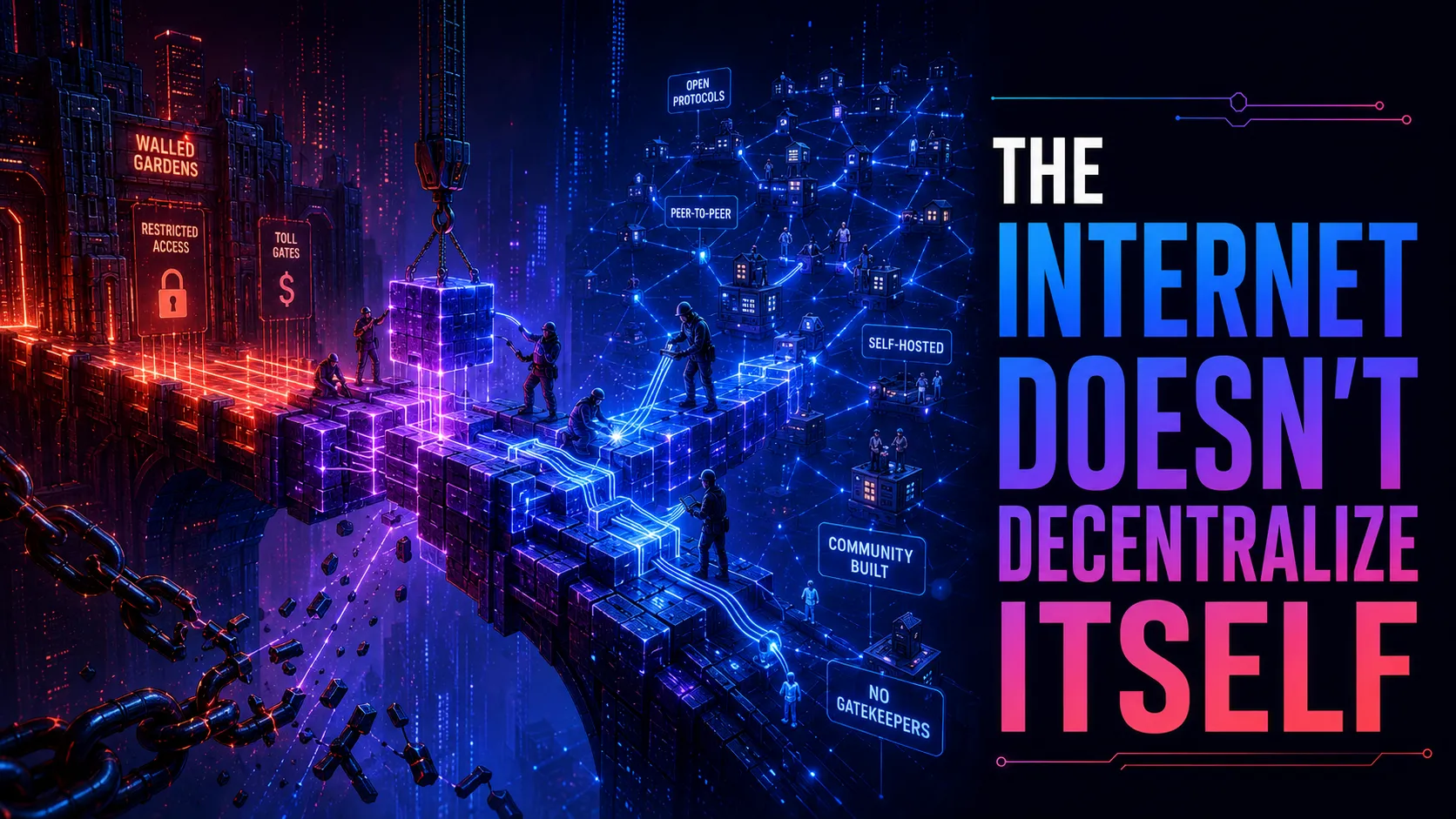
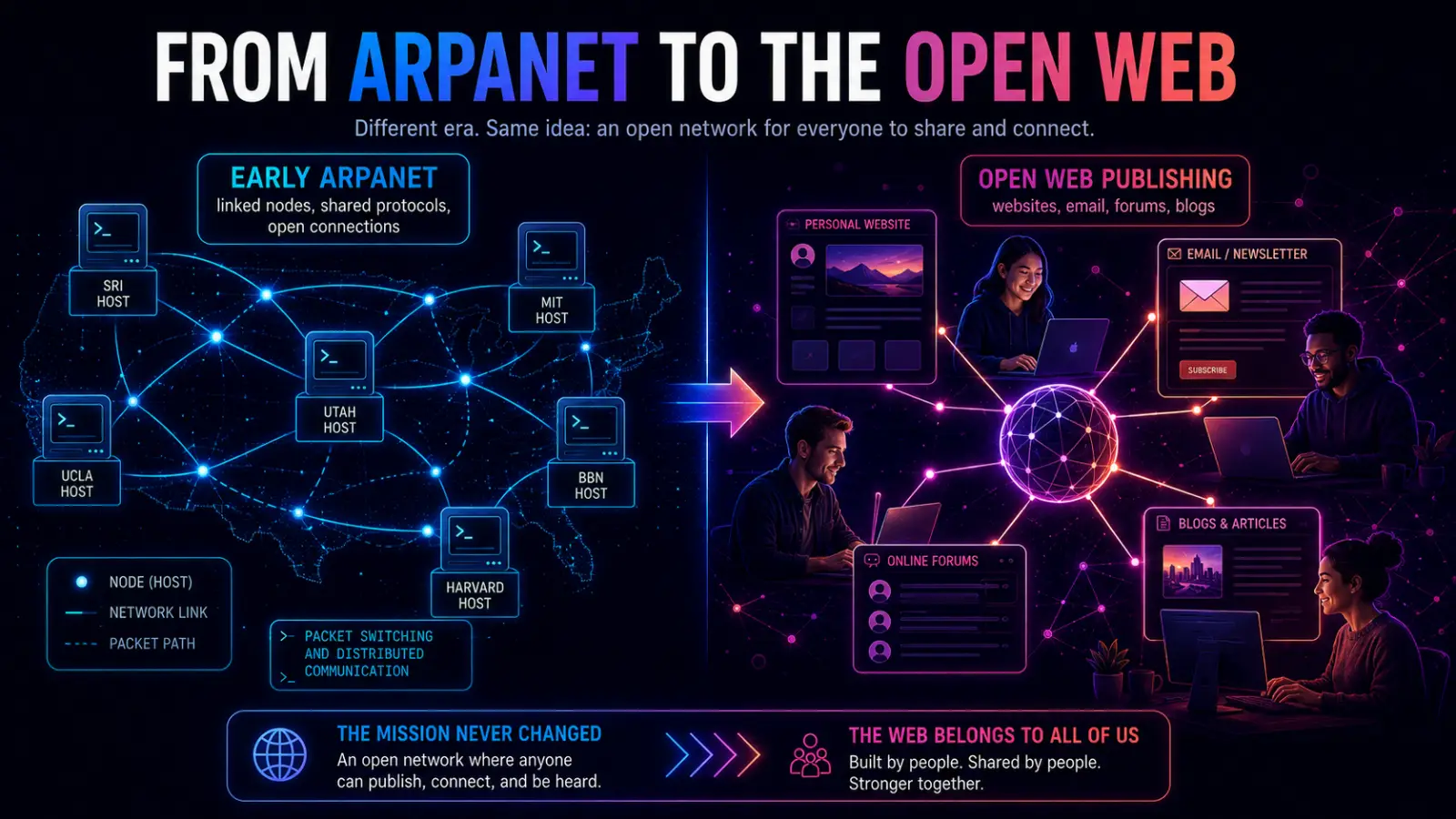
The internet was never as decentralized as people like to imagine. It came from government-backed research, military funding, universities, engineers, and early network builders trying to connect computers together. ARPANET was funded by ARPA, which later became DARPA, and its first computer-to-computer message was sent between UCLA and the Stanford Research Institute in 1969.
That is the contradiction at the heart of the internet. It had centralized origins, but produced a decentralized outcome.
People could launch websites, run forums, publish blogs, send email, host servers, and build communities without needing permission from a handful of platforms. The early internet was not perfect, but it was open enough for normal people to build on.
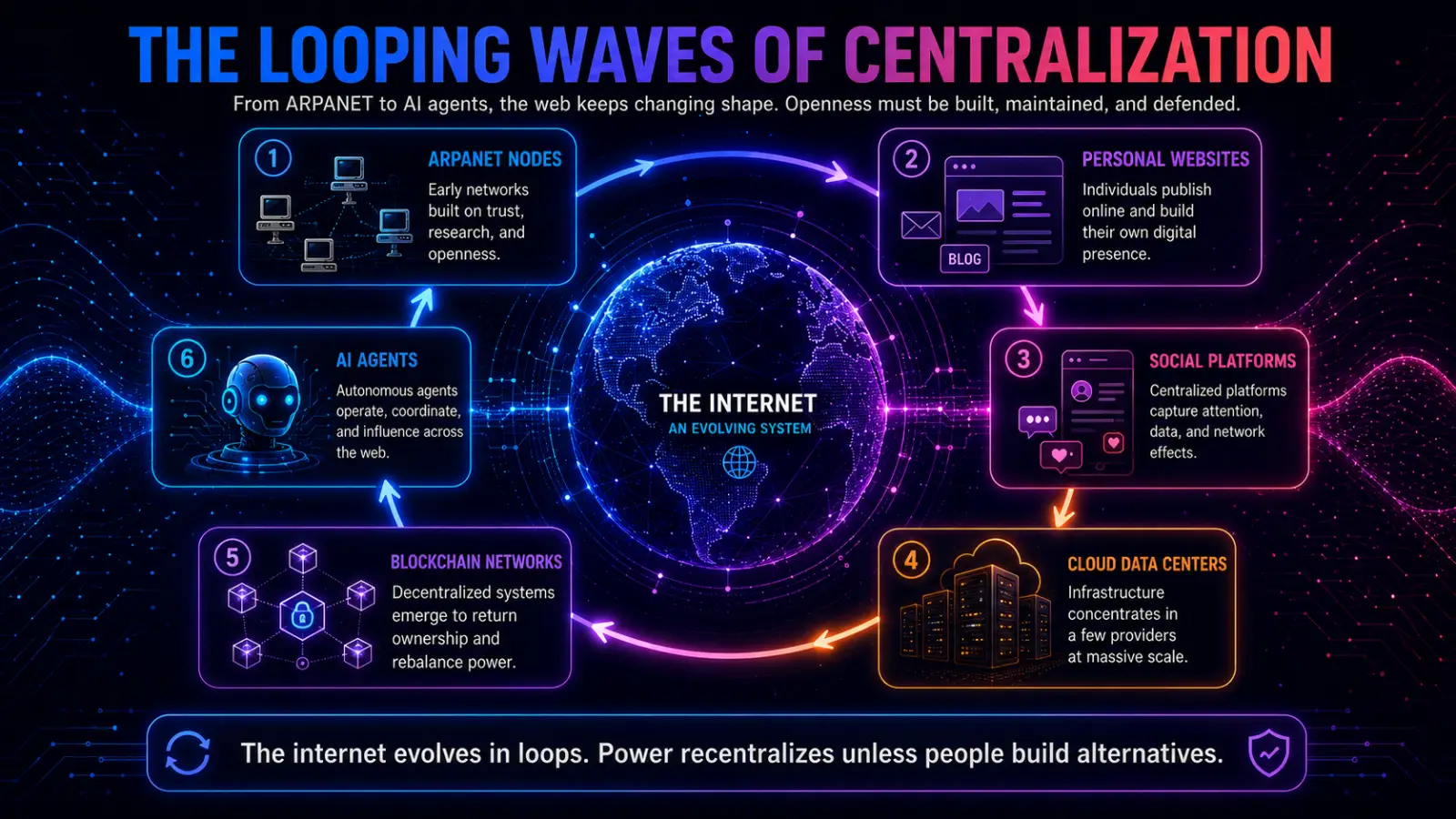
Then the loop started. Open protocols became websites. Websites became platforms. Platforms became data monopolies. Data monopolies became cloud empires. Blockchain tried to push the web back toward ownership and portability. Now AI is turning the web into raw material for answer engines, agents, and automated interfaces.
The internet does not decentralize itself. Every open layer eventually gets captured unless people actively defend it.
The Internet Started Centralized, But Became Open
The early internet was not some pure decentralized utopia. It came from institutions, research labs, standards bodies, universities, military funding, and technical coordination. DARPA describes ARPANET as a pioneering network for sharing digital resources among geographically separated computers, with its initial demonstration in 1969 helping lead toward the modern internet.
The important part is that the result was still more open than the internet we are drifting toward now. The web’s early power came from the fact that no single company owned the default user experience.
You could:
Publish without Facebook.
Send an email without Google.
Build a website without Apple.
Form a community without Discord.
Discover information without one algorithm deciding everything for you.
The internet remained open because the center of gravity had not yet been fully captured. That distinction matters. Decentralization was not a perfect technical purity. It was the absence of total platform dependency.
The early internet was not decentralized because it was pure. It was decentralized because the chokepoints had not yet fully formed.
The First Capture Was Infrastructure
As the internet became commercial, it needed infrastructure. Hosting, search, payments, browsers, app stores, cloud computing, analytics, content delivery, advertising systems, identity, and security layers all made the internet easier to use.
That is how centralization usually wins. It starts as convenience. It becomes in control after everyone depends on it.
Amazon, Microsoft, Google, Oracle, Meta, Apple, and other major technology companies have become core components of the modern internet stack. Some control cloud infrastructure. Some control discovery. Some control devices. Some control identity. Some control app access. Some control advertising. Some control social distribution.
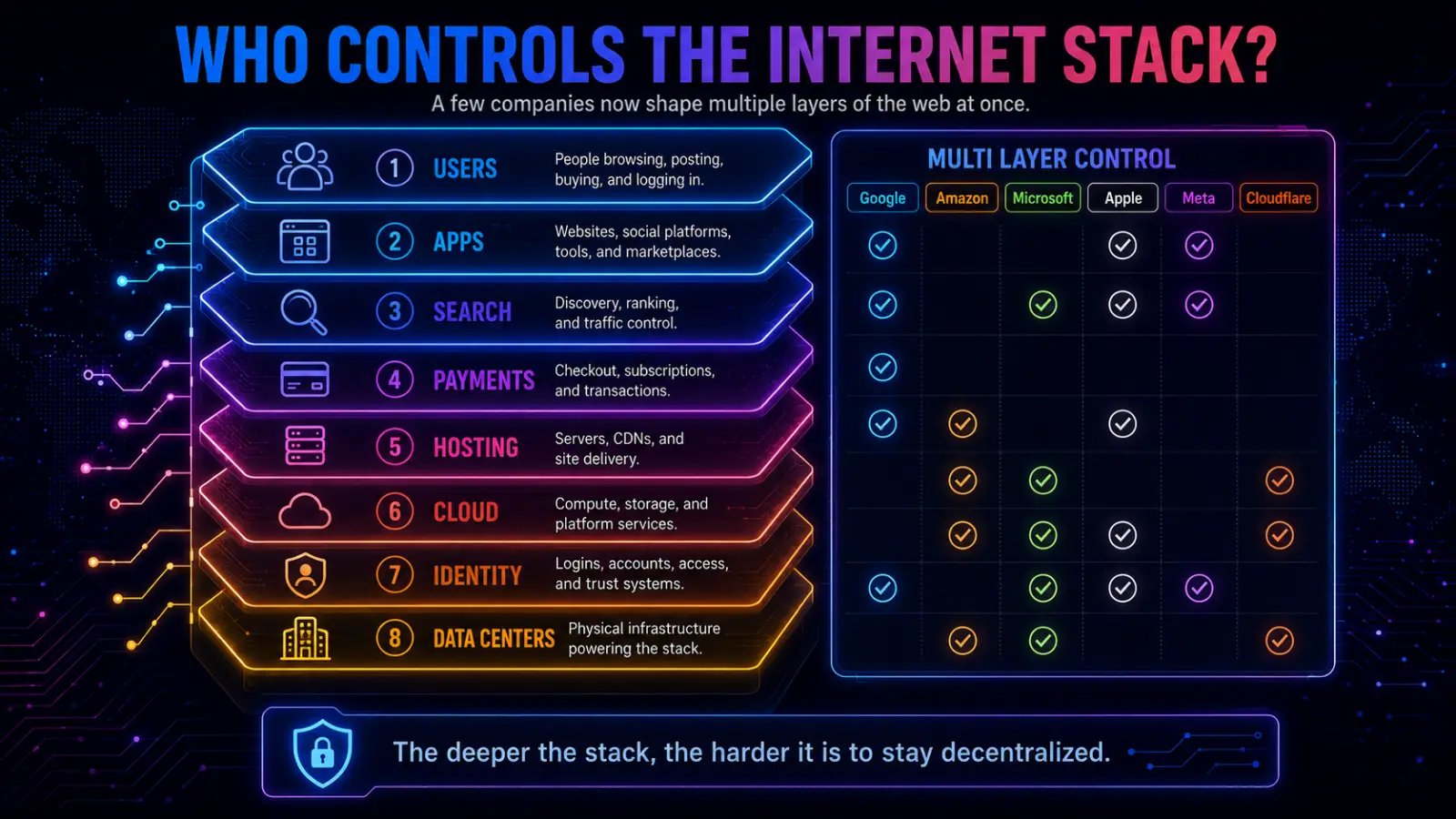
Cloud infrastructure shows how concentrated this has become. Synergy Research reported that Amazon, Microsoft, and Google together accounted for 63% of enterprise cloud infrastructure spending in Q3 2025.
That does not mean every website is owned by Big Tech. It means a huge amount of the internet depends on the same small set of providers. If your website depends on a single cloud provider, payment processor, domain registrar, app store, search engine, or social platform for distribution, you are not fully independent. You are renting independence.
Centralization usually starts as a convenience. It becomes controlled after dependency sets in.
The Web Became Easier, But Less Sovereign
The trade-off was simple. The internet became easier to launch on, easier to scale on, easier to monetize, and easier to navigate. It also became easier to throttle, demonetize, de-rank, deplatform, surveil, and control.
A personal website gives you ownership. A social profile gives you reach. Most people choose to reach. That was understandable, but it created the next capture point.
The Second Capture Was Discovery
The open web did not disappear all at once. People still have websites. Creators still publish. Communities still form. Independent media still exists.
The problem is discovery.
Most people do not navigate the internet directly anymore. They experience it through search engines, social feeds, recommendation systems, app stores, content platforms, and now AI-generated answers. The question is no longer just, “Can I publish?” The question is, “Will anyone see it?”
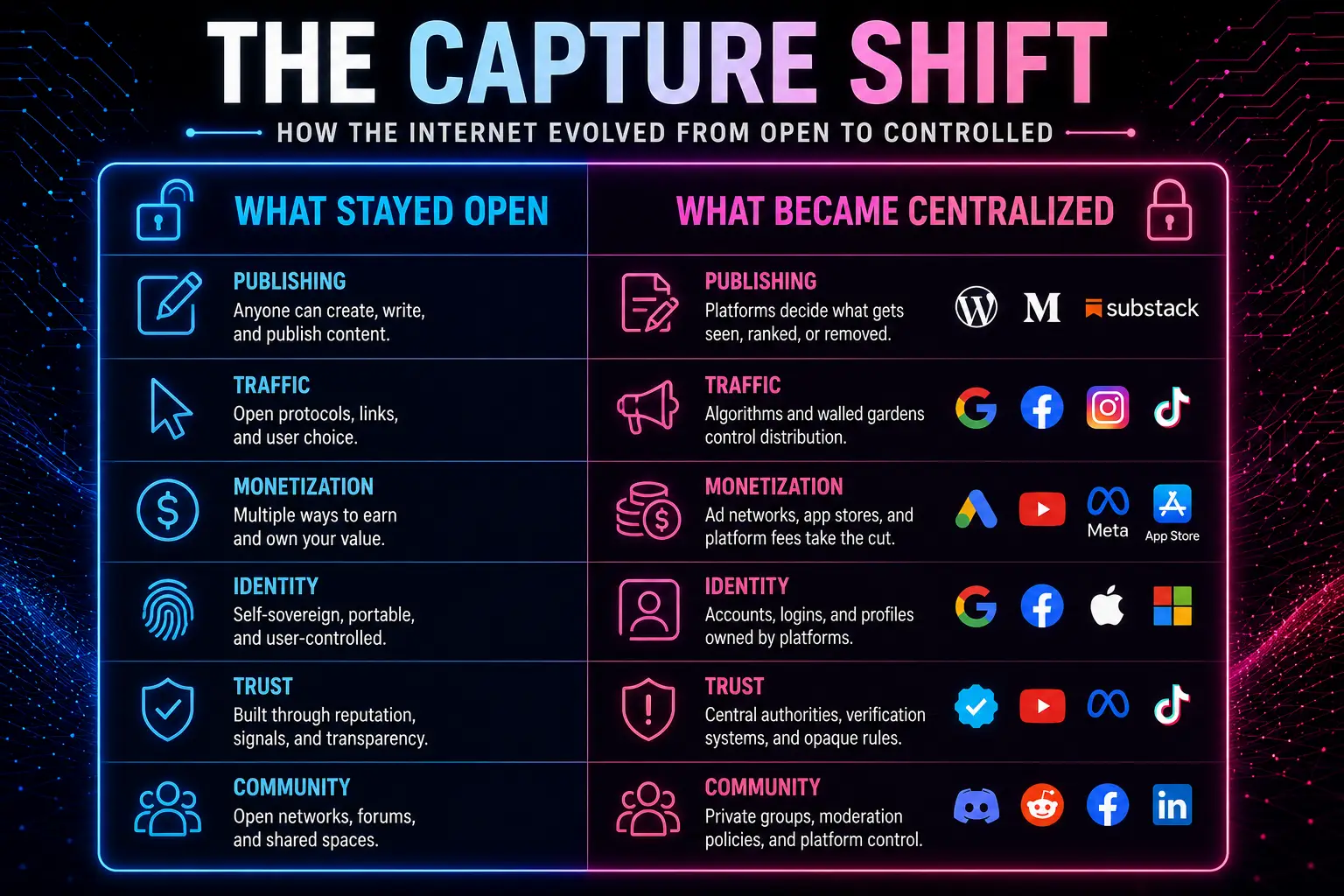
Google shaped search visibility. Facebook shaped social distribution. YouTube shaped video discovery. Apple and Google shaped app access. Amazon shaped product discovery. TikTok, Reddit, X, Instagram, and LinkedIn shaped cultural discovery.
The website still existed, but the traffic came through gatekeepers. That is the discovery oligopoly.
Publishing stayed open. Discovery became centralized.
The Platform Era Made Everyone a Tenant
Social media felt like decentralization at first. Anyone could publish, build an audience, create a page, launch a channel, and reach people without owning a newspaper, radio station, or TV network. Compared to traditional media, that was a massive opening.
The problem was that the distribution was never truly yours. The algorithm decided what mattered. The platform owned the data. The rules changed constantly. The monetization could disappear overnight.

This is the platform bargain: you get access to the crowd, but the platform owns the room.
A platform audience is not the same thing as an owned audience.
Blockchain Was a Re-Decentralization Attempt
Blockchain was not just about coins going up. At its best, it was an attempt to rebuild parts of the internet around ownership, portability, and permissionless access.
Instead of platform accounts, it offered wallets. Instead of closed databases, it offered open ledgers. Instead of platform points, it offered tokens. Instead of hosted apps, it pushed toward decentralized applications. Instead of corporate policy as the final authority, it experimented with community governance.
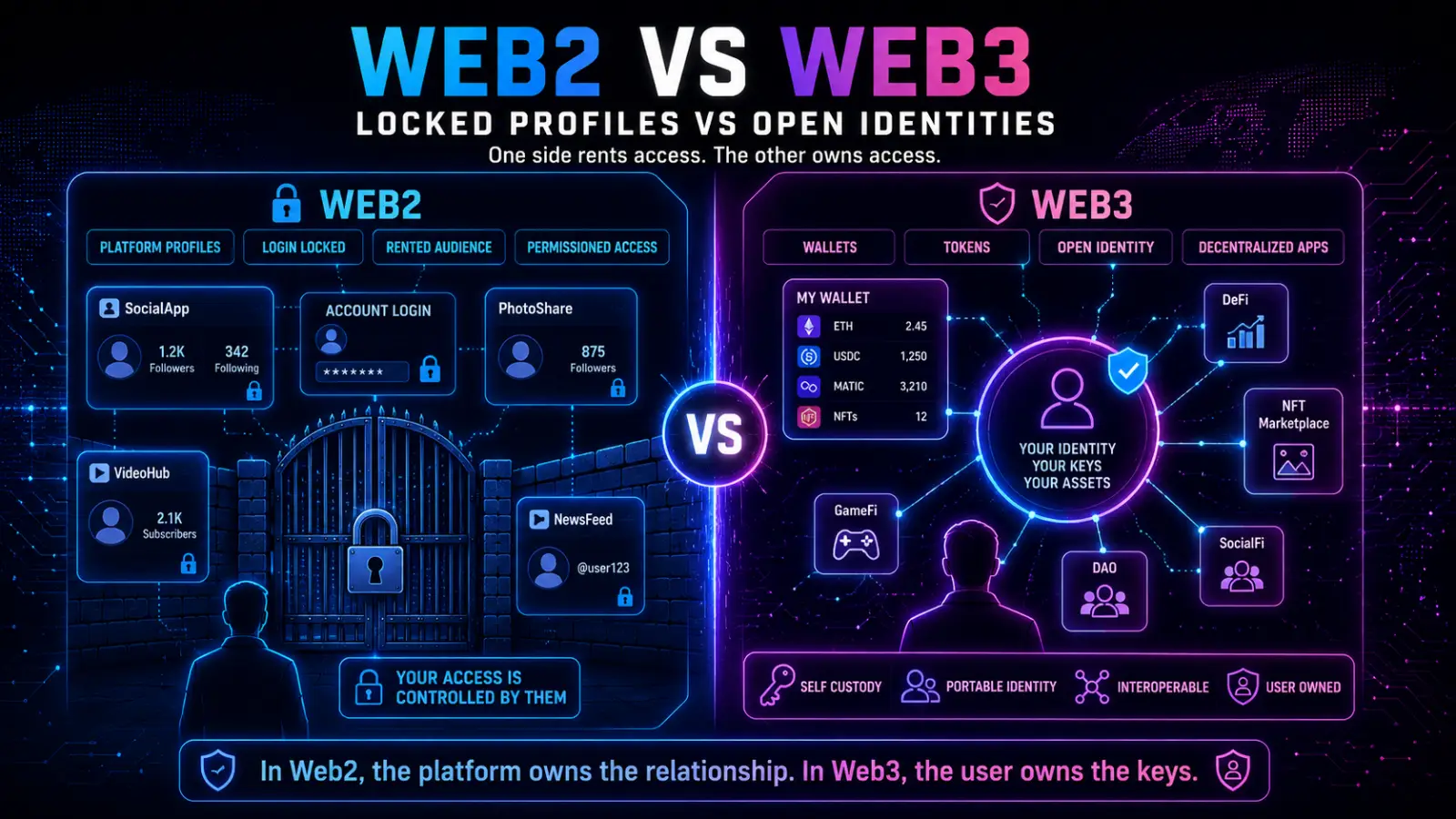
It was messy. It still is. There were scams, hype cycles, failed projects, fake decentralization, unusable apps, bad incentives, centralized exchanges, and plenty of Web3 platforms that were basically Web2 companies with tokens.
But the core attempt mattered because it was a response to the platform internet. It asked a simple question: what if users could own part of the network rather than rent access to it?
Web3 did not appear because Web2 was working. It appeared because too much of the internet had become rented space.
Web3 Still Sat on Web2 Infrastructure
The problem is that much of Web3 never fully escaped the old stack. A decentralized app might still depend on a centralized website. A token might be on-chain, but traded through a centralized exchange. An NFT might be user-owned, but displayed through a hosted marketplace. A protocol might be permissionless, but accessed through a front end that can be taken down.
That does not make Web3 pointless. It makes the decentralization problem clearer.
Decentralization is not one feature. It is a stack.
The Internet’s Centralization Loop
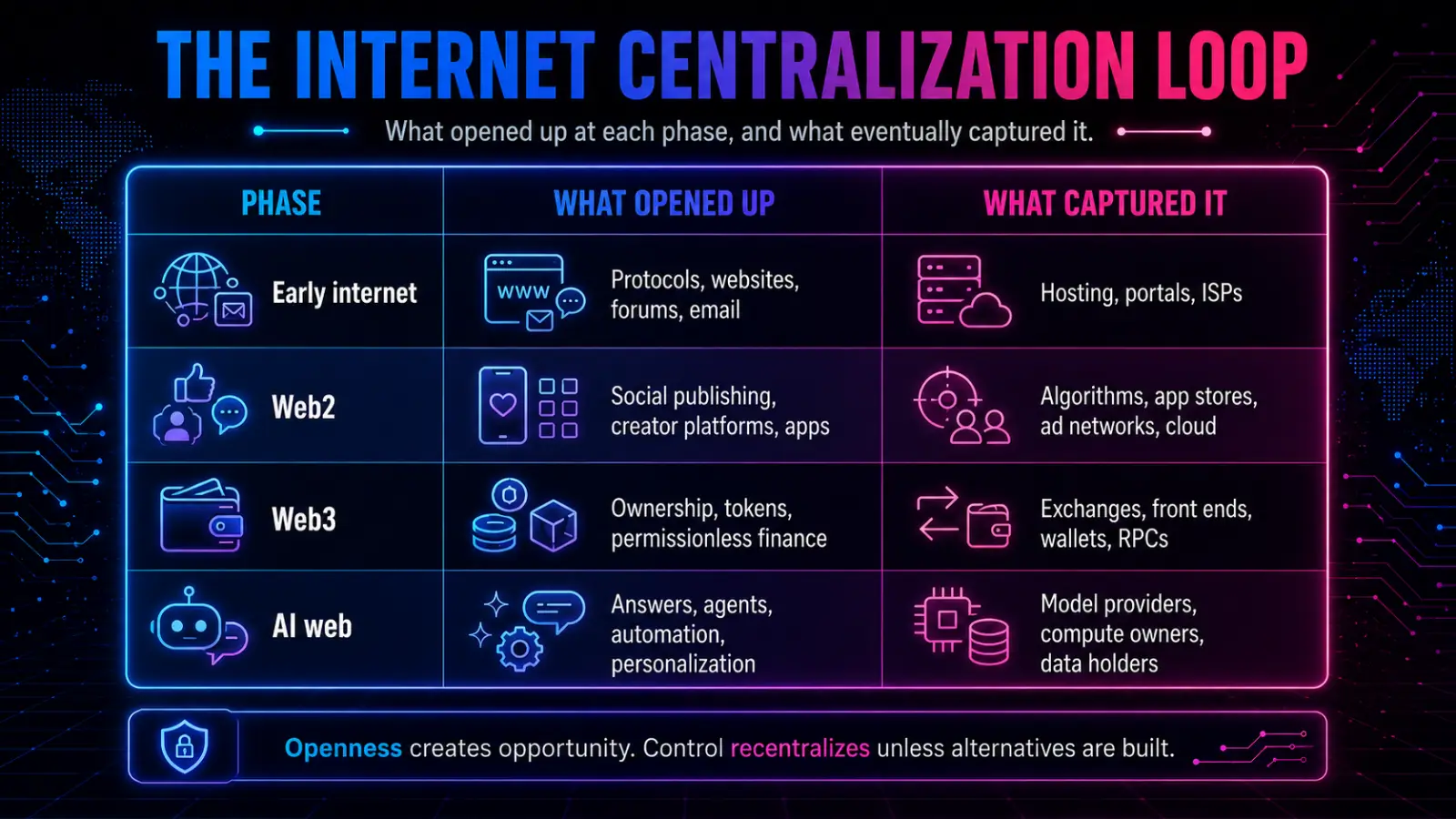
The pattern is not random. Every time the internet opens up, someone finds the most valuable bottleneck and builds a business around controlling it.
In Web1, the bottleneck was access and hosting. In Web2, it was distribution and identity. In Web3, it became usability, liquidity, and interfaces. In the AI era, the bottleneck is becoming compute, data, and answers.
Every decentralized wave creates new value. Every new value layer attracts a new gatekeeper.
The Digital Enclosure Loop
This is where the next phase gets more serious. A 2025 ProMarket analysis describes the risk of AI markets concentrating around companies that can afford high-quality content licenses, proprietary data, and the computing needed to build stronger systems. The concern is that these advantages create barriers that smaller competitors cannot easily overcome.
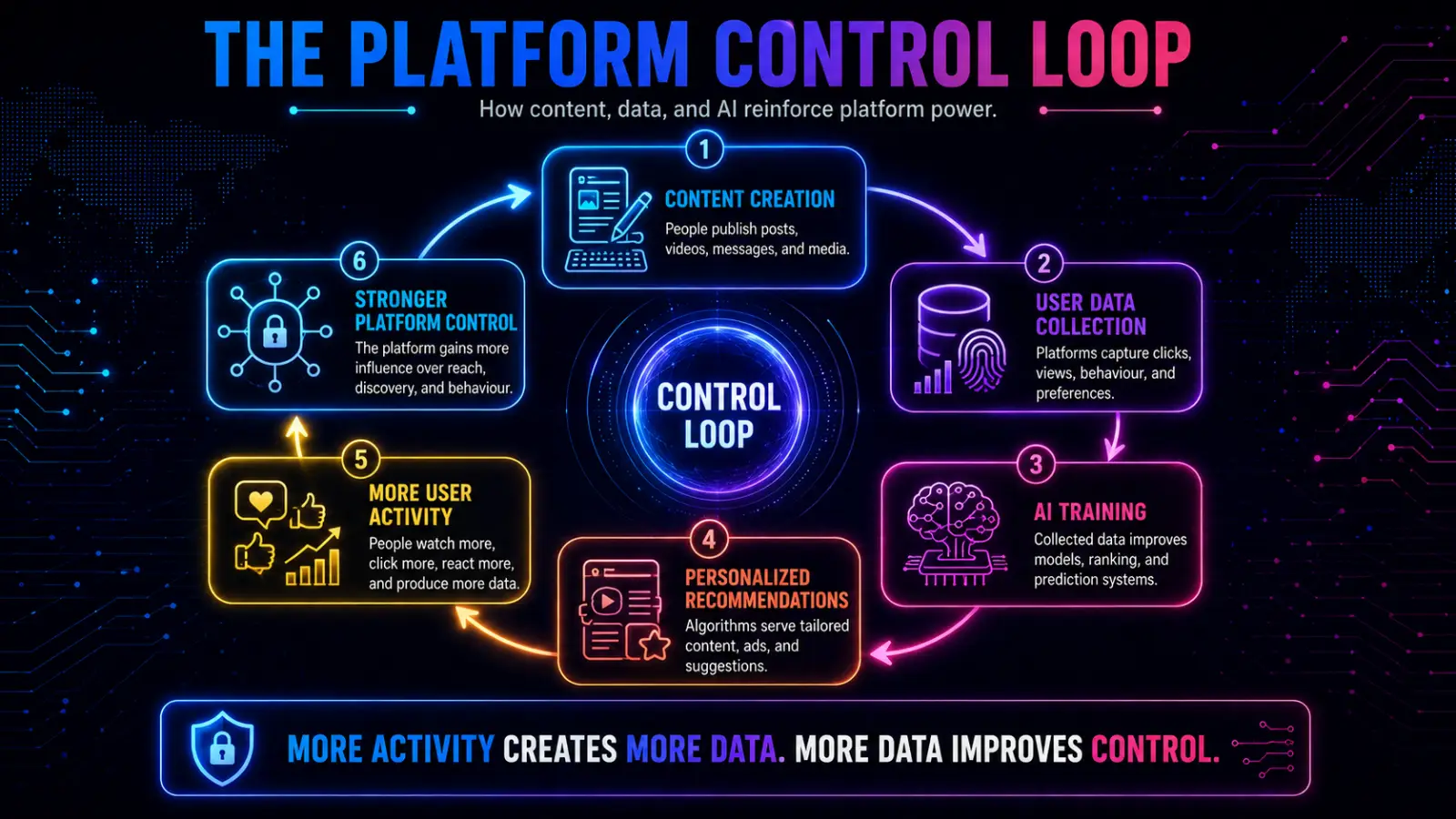
The new moat is not just content, users, data, or compute. It is all of them together.
A platform can own or license content, monitor how users interact with it, improve AI systems based on that interaction, personalize the experience, keep people on the platform, and use the resulting data to improve the system again.
The loop looks like this:
Control or license the content.
Collect user behavior.
Improve the AI system.
Personalize the product.
Capture more user activity.
Strengthen the data advantage.
Repeat.
That is the digital enclosure loop.
The old walled garden kept you inside an app. The new walled garden keeps your behavior inside a model.
AI Is the Next Centralization Layer
AI is being sold as empowerment, and in many ways, it is. It helps people write, code, research, summarize, automate, translate, design, and build faster. The problem is not that AI exists. The problem is that AI changes the interface to the internet.
Search gave you links. Social gave you feeds. AI gives you answers. Agents will take actions.
That means whoever controls the AI interface can shape what people see, trust, buy, believe, ignore, and act on.
AI does not just summarize the internet. It can replace the user’s need to visit it.
This is a bigger shift than most people realize. When users stop browsing and start asking agents, the agent becomes the gatekeeper. When people stop reading sources and start reading summaries, the summarizer becomes the publisher. When creators write for machine extraction instead of audience connection, publishing becomes upstream labor for someone else’s product.
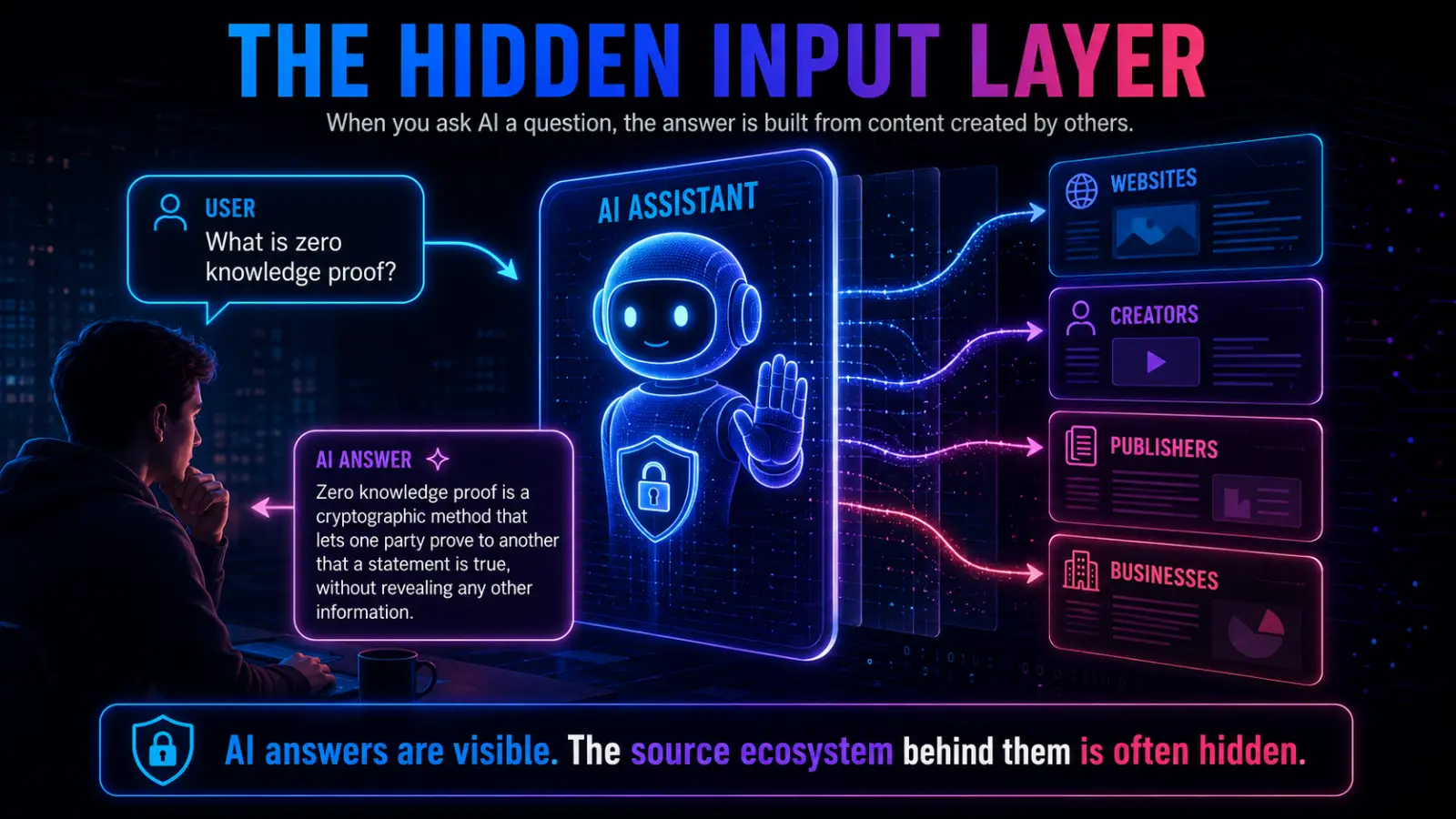
Pew Research found that Google users who encountered an AI summary clicked a traditional search result in 8% of visits, compared with 15% of visits for users who did not encounter an AI summary.
That is the central problem with AI search. It turns the web into answer material, but not necessarily traffic material.
Agents Make the Gatekeeper Invisible
AI agents may become the next browser. Instead of visiting 10 websites, you ask an agent to compare products. Instead of reading five articles, you ask for the answer. Instead of visiting a booking site, you tell an agent to book the trip.
That sounds useful, but it creates an obvious control point. Which sources does the agent trust? Which businesses does it recommend? Which products are excluded? Which publishers are cited? Which actions are allowed? Which wallets, payments, apps, and services are integrated?
Search rankings were visible enough to debate. Feeds were visible enough to complain about. AI agents may hide the entire decision-making process behind a confident answer. That is not decentralization. That is automated intermediation.
The Open Web Is Becoming Raw Material
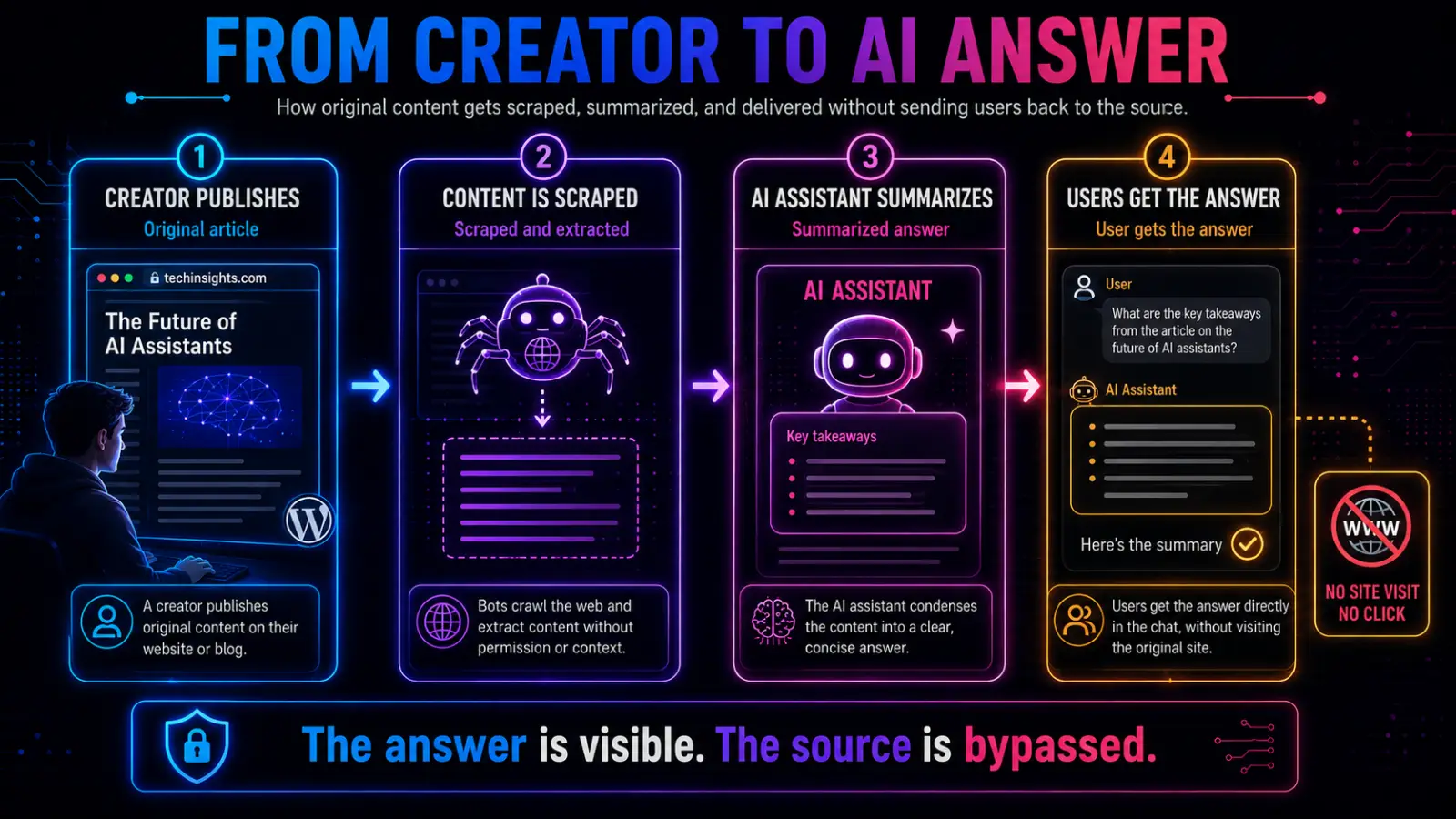
The open web used to be a destination. Now it is becoming input. Articles become summaries. Videos become training data. Posts become sentiment signals. Forums become answer material. Reviews become recommendation fuel. Creators become unpaid data suppliers.
This is why AI centralization feels different from previous platform shifts. Social platforms captured distribution. AI platforms may capture the content layer itself.
They can ingest the work, transform it, present it, and keep the user in their interface. The creator still does the work. The AI system captures the answer. The platform captures the user. The original source gets less attention.
This connects directly to the problem I covered in The Dead Internet Theory in 2026: the internet is becoming harder to trust because bots, synthetic content, fake engagement, automated feeds, and AI-generated summaries increasingly mediate what people see online.
The open web cannot survive as unpaid raw material for closed AI systems.
Why This Matters
The issue is not that every centralized system is evil. The issue is that centralization creates leverage.
Sometimes that leverage is used for convenience. Sometimes it is used for safety. Sometimes it is used for profit. Sometimes it is used for censorship. Sometimes it is used to quietly change the rules.
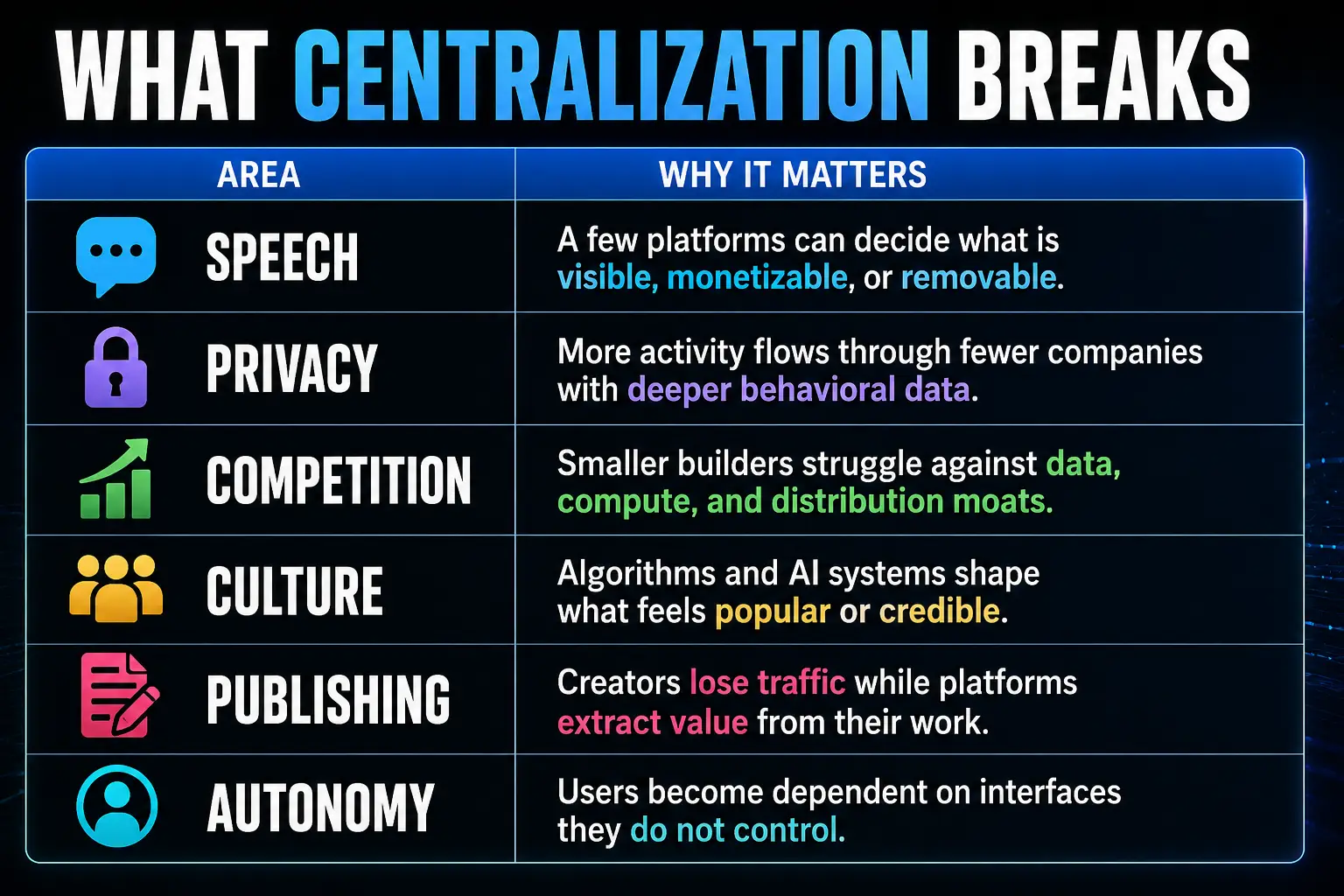
The problem is not one company. It is the structure. When too much of the internet depends on too few chokepoints, everyone else becomes fragile.
Centralization is not always malicious, but it always creates leverage.
Decentralization Requires Active Support
People often talk about decentralization as if it is inevitable. It is not. Centralization is usually easier because it offers the convenient default.
It is easier to use a single login, cloud, platform, algorithm, AI assistant, and ecosystem. It is easier to trade ownership for convenience.
That is why decentralization does not win by default. It has to be chosen.
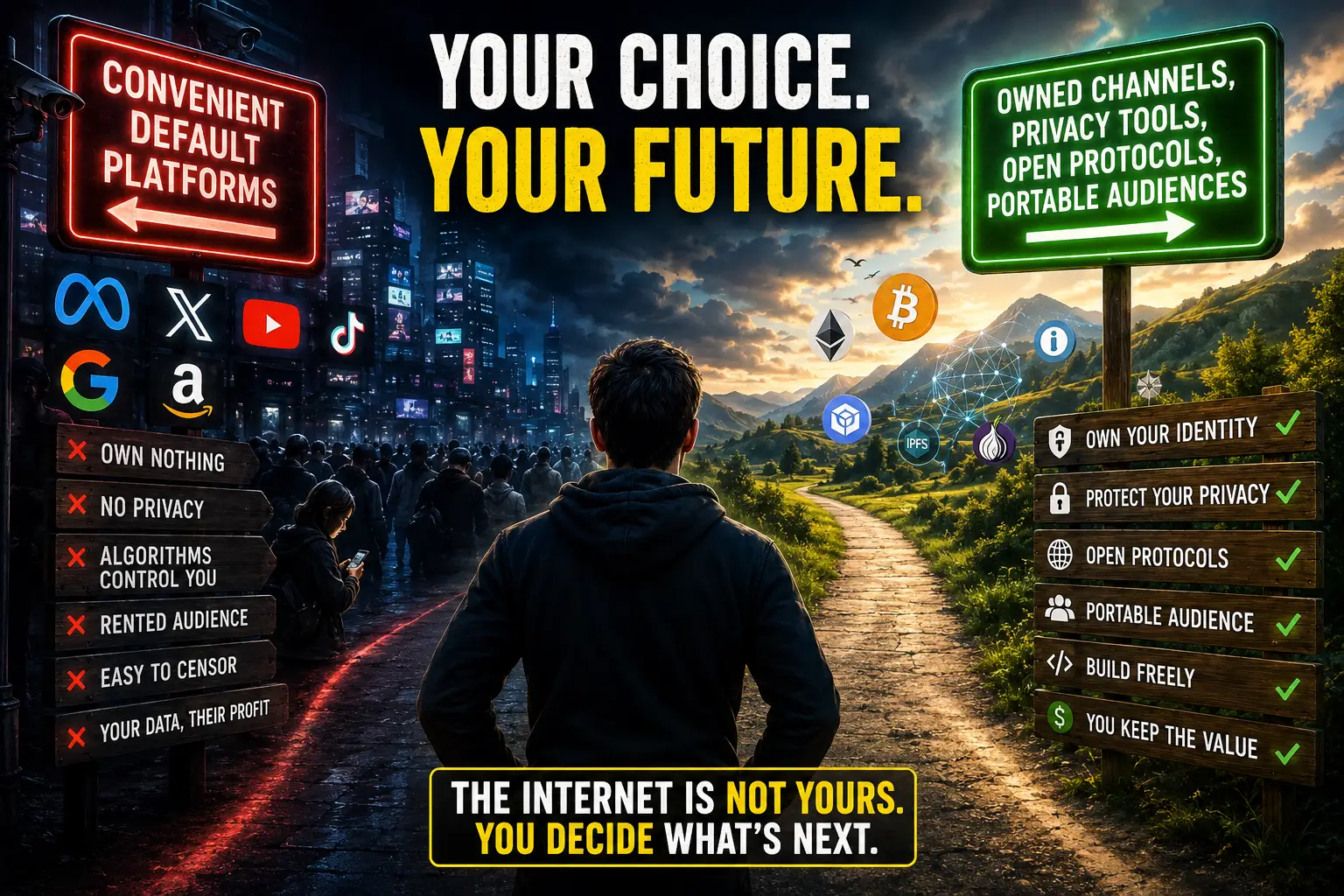
The goal is not purity. The goal is leverage.
A creator with a website, newsletter, RSS feed, community, and multiple distribution channels has more leverage than a creator who only exists on one platform. A business that owns its data and has direct customer relationships has more leverage than one that is fully dependent on paid ads and platform algorithms. A user with privacy tools, open-source options, and a portable identity has more leverage than a user locked into a single ecosystem.
Support systems that improve:
Ownership through websites, newsletters, and portable audiences.
Privacy through encryption, minimal tracking, and local-first tools.
Portability through open standards and exportable data.
Resilience through backups, mirrors, and decentralized storage.
Attribution through AI systems that cite, link, compensate, or drive traffic to sources.
Free expression through transparent rules and user choice.
Decentralization is not just an ideology. It is risk management.
The Next Internet Will be Decided by Defaults
Most people do not choose internet architecture. They choose defaults: default search engine, default browser, default app store, default cloud provider, default AI assistant, default social feed, default login, and default payment system.
That is why the AI layer matters so much.
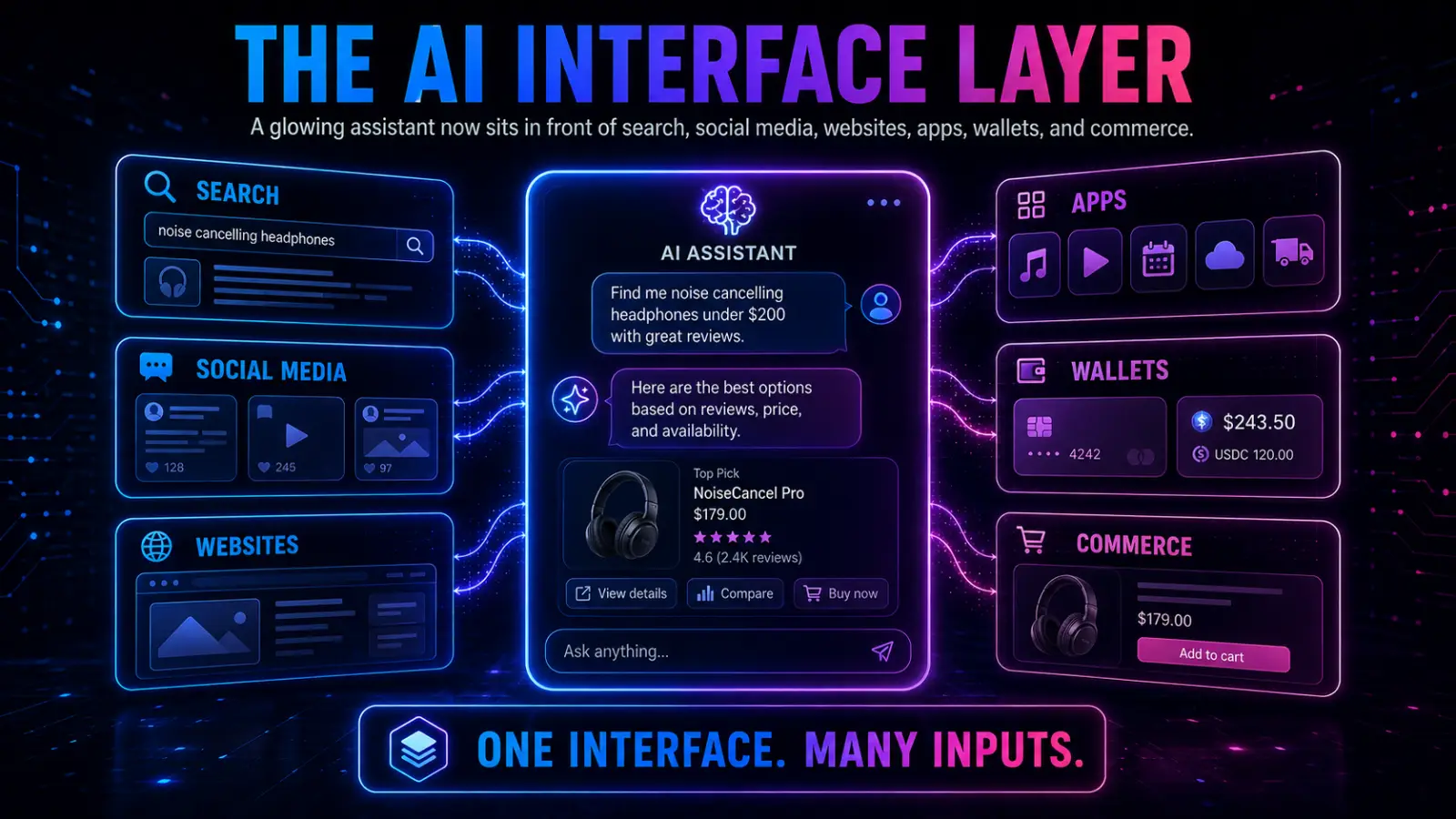
If the default way to use the internet becomes asking an AI assistant, then the assistant becomes the new homepage, search engine, browser, and recommendation feed combined. That is an enormous amount of power.
The next fight for the internet will not only be about who owns websites or social networks. It will be about who owns the interface between people and information.
Whoever owns the default interface owns more than attention. They own the path to reality.
The Fight for an Open Web
The internet keeps moving in loops: centralized origin, decentralized expansion, commercial capture, creator escape, platform capture, blockchain resistance, and AI recentralization.
The mistake is assuming the loop will fix itself. It will not.
Every decentralized phase creates new value. Every new value layer attracts companies that want to control it. Every control point becomes infrastructure. Every infrastructure layer becomes invisible once people depend on it.
That is how the web gets enclosed. Not overnight. Not with one villain. Not with one policy. It happens one convenience layer at a time.

The only way out is to actively support the tools, protocols, creators, communities, and businesses that keep the internet open.
Here are some ways you could get started:
Use privacy-respecting products.
Publish on owned channels.
Support open-source alternatives. Back interoperable systems.
Question AI summaries.
Click original sources.
Pay for work you value.
Avoid building your entire life, business, or community on rented land.
The internet can still be open.
But openness is not the default.
It is the fight.
Sources and Further Reading
- ARPANET
- ARPANET on the DARPA Innovation Timeline
- Brief History of the Internet and Related Networks
- A Brief History of the Internet
- Ideological and Policy Origins of the Internet, 1957 to 1969
- Cloud Market Share Trends: Big Three Together Hold 63% While Oracle and the Neoclouds Inch Higher
- Global Cloud Market Share Q3 2025: AWS Lowers, Microsoft and Google Stay Same
- Google Users Are Less Likely to Click on Links When an AI Summary Appears in the Results
- AI Summaries in Online Search Influence Users' Attitudes
- Preventing AI Oligopoly and Digital Enclosure via Compulsory Access
- Content Licensing Agreements Will Concentrate Markets Without Standardized Access
- The Dead Internet Theory
The Digital Debrief Newsletter
Subscribe for more field notes
Practical field notes on AI, Web3, privacy, decentralization, social media, and the systems shaping the internet, delivered straight to your inbox.
Found it useful?
Share it with someone who'd care, or grab the link.
Got a project or question?
I work with brands across AI, Web3, cybersecurity, and SaaS.