

The Dead Internet Theory Was Early, Not Wrong
In 2022, I argued that bots were already shaping much more of the internet than most people realized. In 2026, the issue is broader. AI crawlers, automated agents, synthetic profiles, scam automation, fake engagement, and algorithmic feeds now influence how we search, interact, trade, trust, and form opinions online.
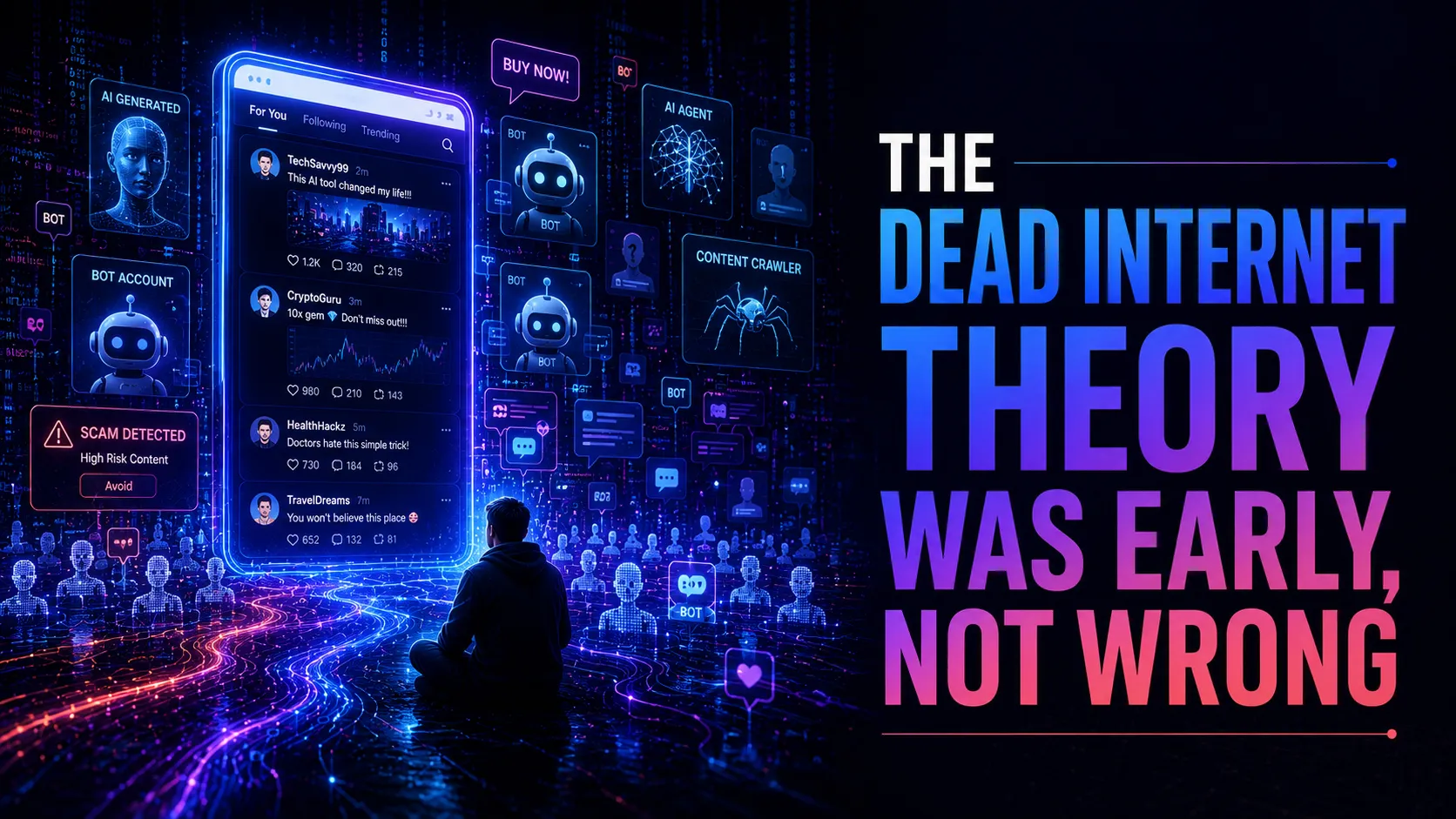
It's been 4 years since I originally published an article and video about bot traffic and the Dead Internet Theory.
At the time, the idea still sounded extreme to many people. The internet was already full of crawlers, spam, fake engagement, trading bots, moderation systems, scrapers, and malicious automation. Still, most people treated bots as an annoying side effect of the web rather than one of the main forces shaping it.
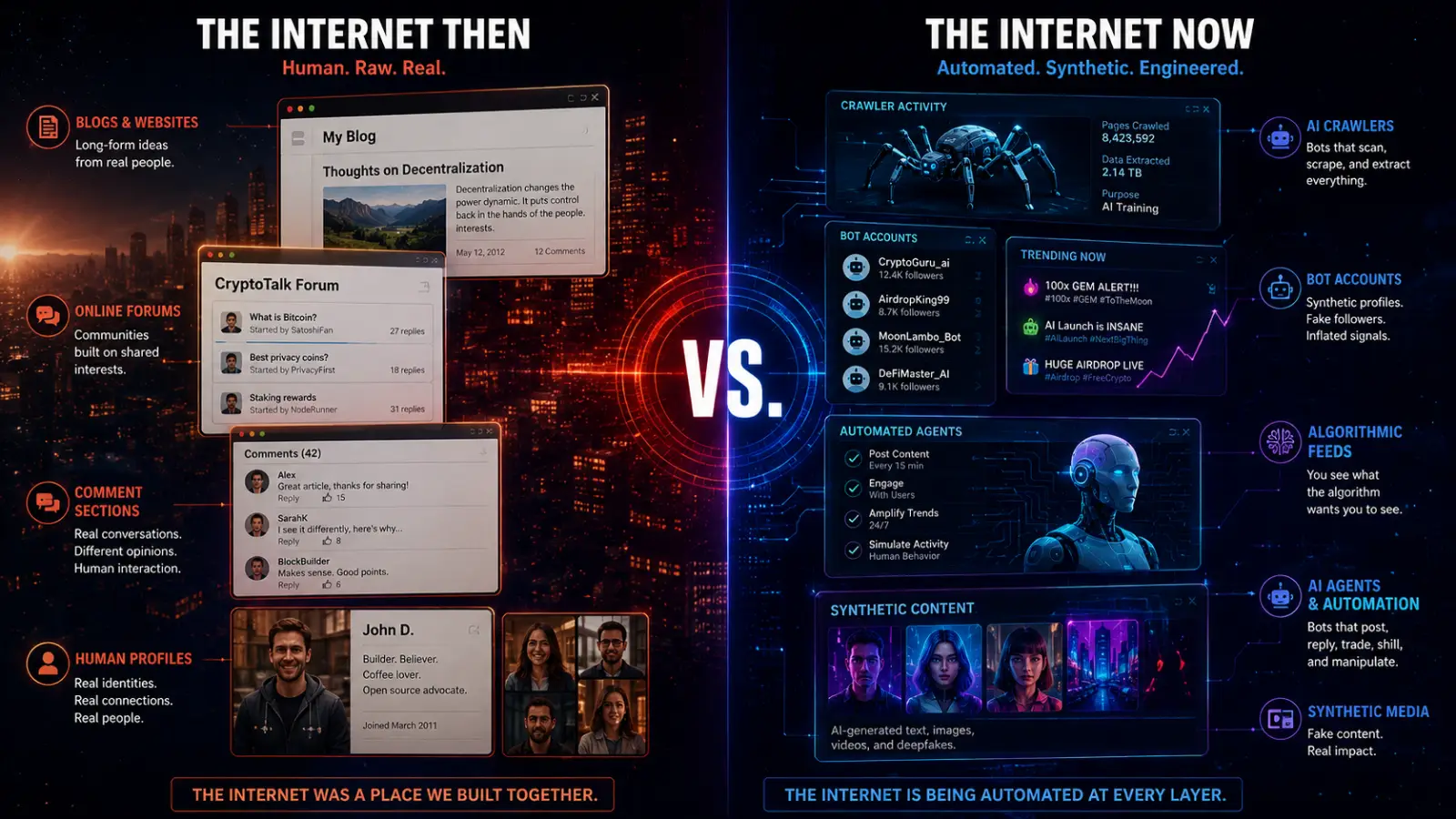
In 2026, that is much harder to argue.
The internet is not “dead” because there are no humans left. That is too simple. The better argument is that the human internet is increasingly buried under automated systems. Bots crawl it. AI models summarize it. Algorithms rank it. Agents act on it. Scammers exploit it. Platforms filter it. Synthetic accounts shape what looks popular, trusted, or normal.
The result is a web where real people still exist, but their experience is increasingly mediated by nonhuman systems.
The internet did not die all at once. It became less human one automated layer at a time.
What The Dead Internet Theory Actually Means
The Dead Internet Theory posits that much of the internet is no longer meaningfully human. The strongest version claims that most online content, engagement, and interaction are fake or automated. That version is too broad and usually overstates the case.
The more useful version is this: the internet still has real people, but the systems shaping what we see, trust, and respond to are increasingly automated.
That version is much easier to defend.
You see it when search results feel like SEO sludge. You see it when social posts attract comments that look human but say nothing. You see it when a fake project appears legitimate because it has followers, likes, volume, and engagement. You see it when customer support, moderation, discovery, and even scams are automated.
The issue is not that every profile is fake. The issue is that enough of the online environment is automated to distort perception.
That matters because the internet is where people form opinions, buy products, invest money, judge credibility, follow news, join communities, and decide what is socially acceptable.
If those signals are polluted, trust breaks.
The Numbers Are Complicated, But The Direction Is Clear
Previously, I cited reports showing that bot traffic had become a massive share of internet activity. One report put bot traffic at 64% in 2021, which helped frame the original argument.
Today, the numbers are more complicated because “bot traffic” is no longer a single, clean category.
The most important number is not the bot percentage. It is how much influence automation has over what humans see and believe.
Measuring The Automated Web
Cloudflare’s 2025 Radar Year in Review separated HTML request traffic into humans, AI bots, Googlebot, and non-AI bots. It found that AI bots averaged 4.2% of HTML requests across the year, Googlebot averaged 4.5%, and non-AI bots started the year responsible for roughly half of HTML page requests before the gap with human traffic narrowed later in the year.
Imperva’s 2025 Bad Bot Report found that bad bots made up 37% of all internet traffic, up from 32% the year before. It also reported that automated traffic surpassed human activity for the first time in a decade, reaching 51% of all web activity.
HUMAN Security’s 2026 benchmark report found that automated traffic grew eight times faster than human traffic year over year; AI-driven traffic nearly tripled in 2025; and traffic from AI agents and agentic browsers grew 7,851% year over year.
So, I would not frame this as “the majority of internet traffic comes from bots” yet, as a clean claim. That would be too broad.
A better framing is that automated activity already rivals or exceeds human activity in major traffic studies, and the fastest-growing categories are now AI-driven. That is the real story.
Why Bot Reports Seem to Disagree
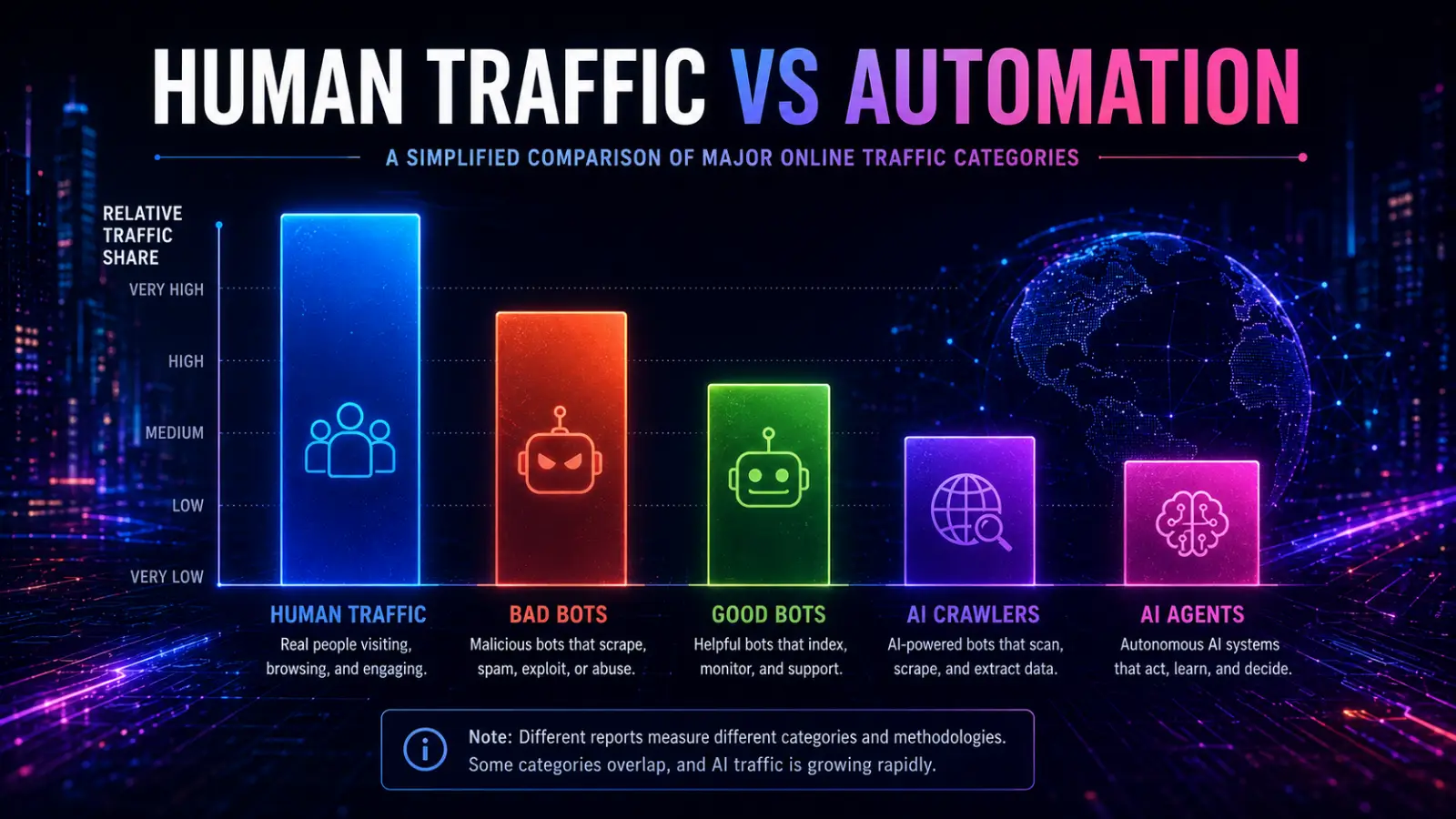
Bot reports often appear to contradict each other because they measure different things.
A search engine crawler is a bot. A price-monitoring tool is a bot. A credential-stuffing attack is a bot. A fake social account may be a bot. A trading algorithm is a bot. An AI agent using a browser may also be considered automated traffic. A moderation system and recommendation algorithm may not show up as “bot traffic,” but they still shape the user experience.
That distinction matters.
The old internet could be described with a simple split: human traffic versus bot traffic. The modern internet needs a more detailed map.
There are good bots, bad bots, crawlers, scrapers, AI training systems, real-time AI retrieval tools, autonomous agents, fake accounts, automated moderation tools, recommendation systems, and synthetic content engines. Some are useful. Some are harmful. Some are hard to classify.
That is why the most useful question is no longer, “Is this a bot?”
The better question is, “What is this automation doing?”
Is it indexing? Scraping? impersonating? Ranking? Moderating? Trading? Scamming? Buying? Posting? Summarizing? Testing stolen passwords? Generating fake demand?
That is where the Dead Internet Theory becomes less like a meme and more like an infrastructure problem.
AI Agents Changed The Conversation
Previously, bots were mostly discussed as crawlers, spam accounts, scrapers, and malicious automation.
In 2026, AI agents changed the conversation.
A crawler reads the web. An agent can act on the web.
That difference matters because agents can browse pages, compare products, fill forms, interact with interfaces, trigger workflows, and potentially complete transactions. Some of that will be useful. A personal AI assistant that books travel or compares insurance could save people time. A business agent who monitors inventory or checks pricing could improve operations.
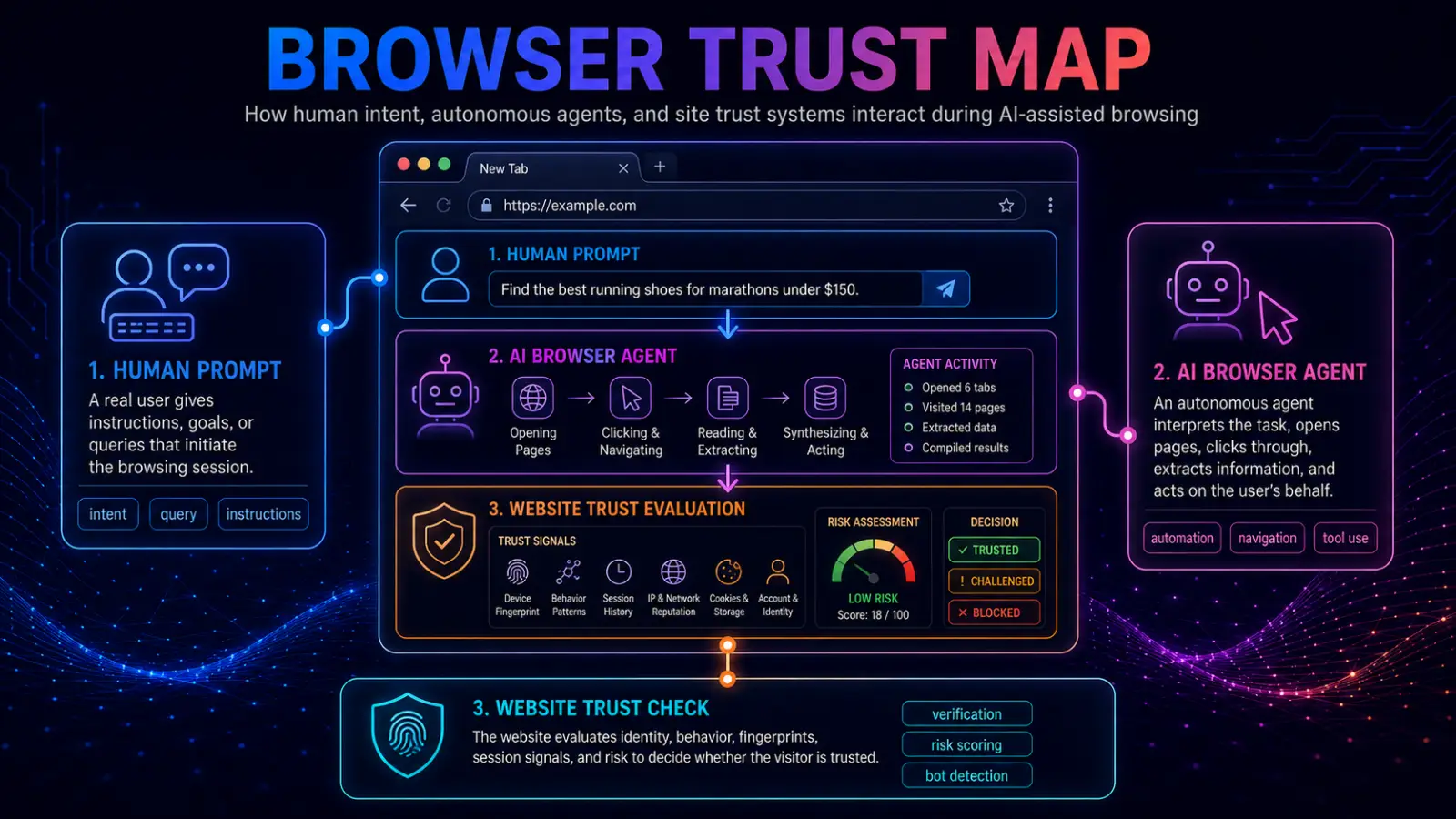
But the same capabilities can also be used for fraud, scraping, account abuse, manipulation, and impersonation.
HUMAN Security reported that training crawlers still accounted for the majority of AI-driven traffic in 2025, but their share declined as AI scrapers and agentic traffic grew rapidly. Agentic traffic was still a small share in December, but its year-over-year growth was extremely high.
That is the pattern to watch. The internet is moving from bots that observe to agents that act.
The next internet user may not be a person. It may be a person’s agent, a company’s crawler, or a scammer’s automation pretending to be both.
AI Crawlers Are Eating The Web
There is another major change since 2022: AI crawlers are not just visiting the web. They are extracting value from it.
Traditional search crawling had a rough exchange with publishers. Search engines crawled content, indexed it, and sent traffic back through links. It was not perfect, but there was at least a visible traffic loop.
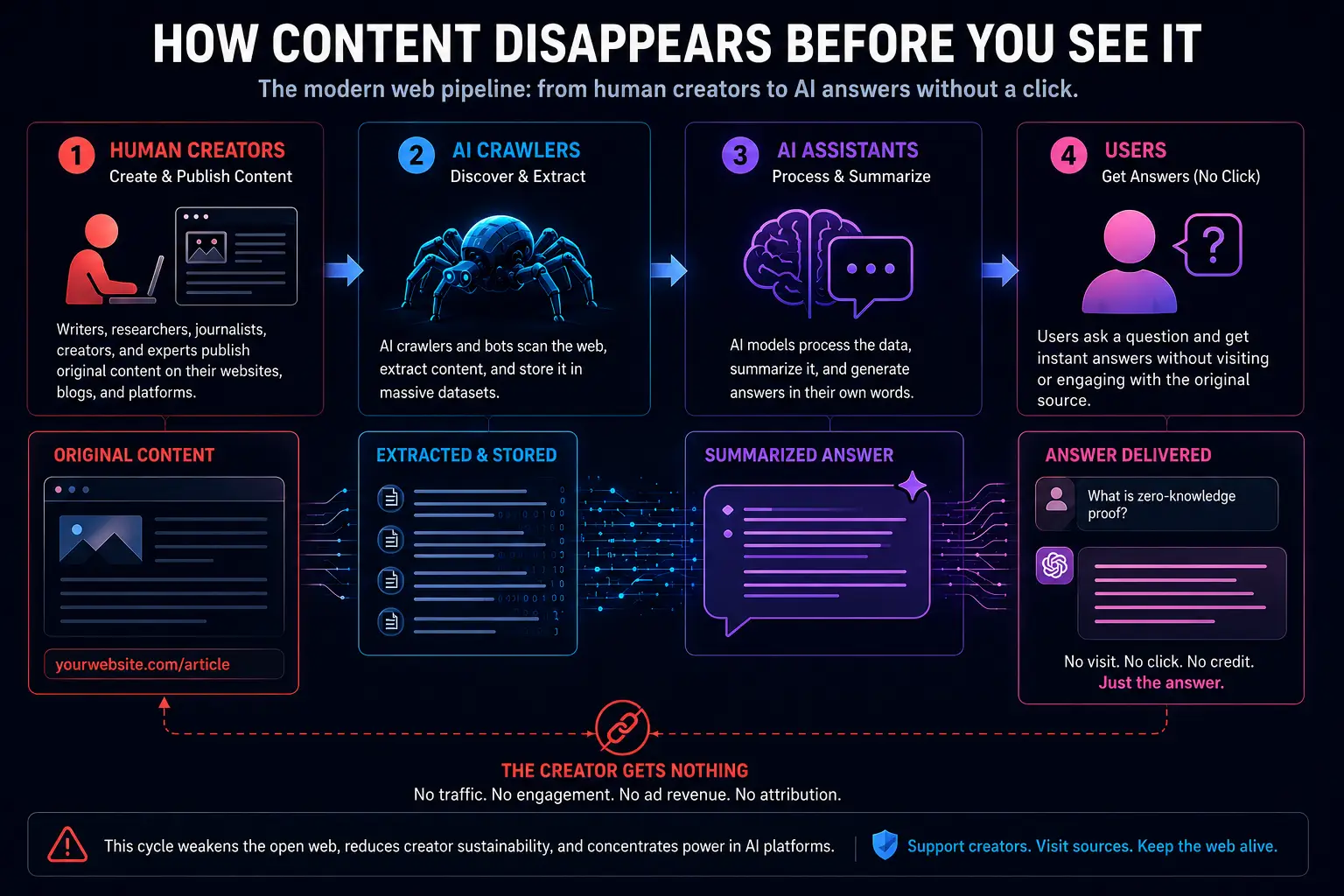
AI search and AI assistants weaken that loop.
They can extract information, summarize it, and respond directly to the user. In many cases, the user may never click the original source.
That creates a major incentive problem. Human writers, publishers, forums, communities, and independent websites create the material. AI systems consume and summarize it. Platforms capture the attention. The original source may receive little or nothing in return.
Cloudflare’s 2025 reporting distinguished AI bot activity and highlighted growing concerns among content owners about AI crawlers. HUMAN Security also found that more than 95% of AI-driven traffic in 2025 was concentrated in retail and e-commerce, streaming and media, and travel and hospitality, which are sectors where structured and frequently updated information is highly valuable.
This changes the web economy.
The old bot problem was about fake traffic and abuse. The new AI bot problem is also about extraction.
Fake Humans Are More Dangerous Than Crawlers
Most bots are not pretending to be people. Many are crawlers, monitoring tools, search bots, pricing tools, vulnerability scanners, or automated business systems.
That distinction matters because not all automation is malicious.
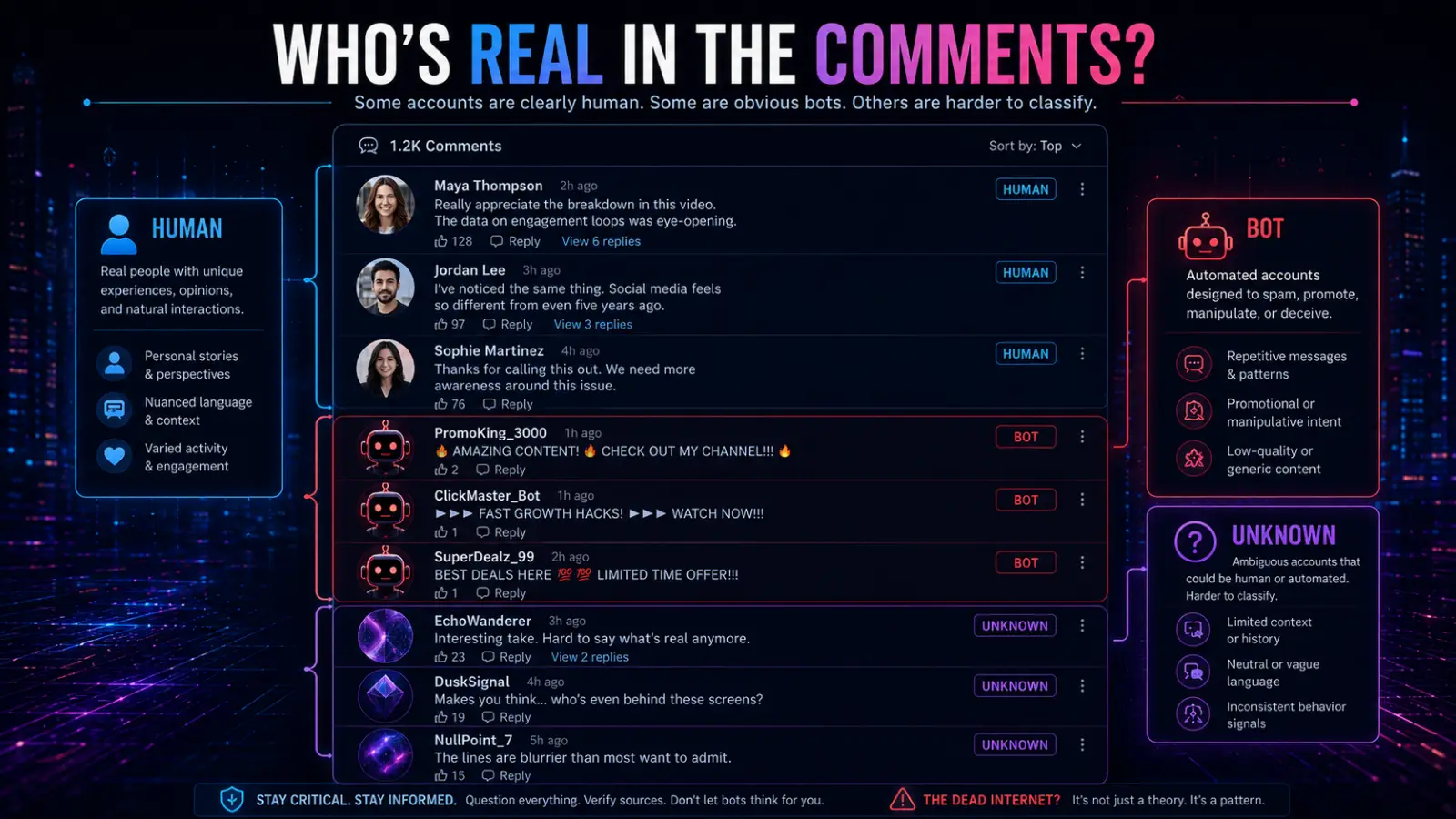
The more serious concern is the rise of fake humans. These are accounts, messages, voices, images, videos, or interactions that closely imitate real people to influence trust.
The scariest bots are not the ones crawling websites. They are the ones that make fake consensus feel human.
Fake Humans, Fake Trust, And Automated Scams
Fake humans are more dangerous than ordinary bots because they attack social proof.
They can make a scam look popular. They can make a political view look dominant. They can make a bad product look trusted. They can make a fake founder look credible. They can make harassment look organic. They can make a comment section feel like a consensus.
This is where the Dead Internet Theory feels real for ordinary users. You do not care that a crawler loaded a webpage. You care when you cannot tell whether the person replying to you is real.
Scams Are Becoming More Personal
The average person still thinks of scams as badly written emails.
That is outdated.
Modern scams are more personalized, more automated, and more emotionally targeted. AI makes this easier by improving the quality of fake writing, voices, images, videos, profiles, and support interactions.
The FBI’s 2025 Internet Crime Report showed nearly $21 billion in reported losses from cyber-enabled crime. It also reported that cryptocurrency and AI-related complaints were among the costliest categories. The FBI’s 2025 IC3 report also described AI-enabled romance scams, business email compromise, and voice-cloning “grandparent” scams where criminals impersonate loved ones in distress.
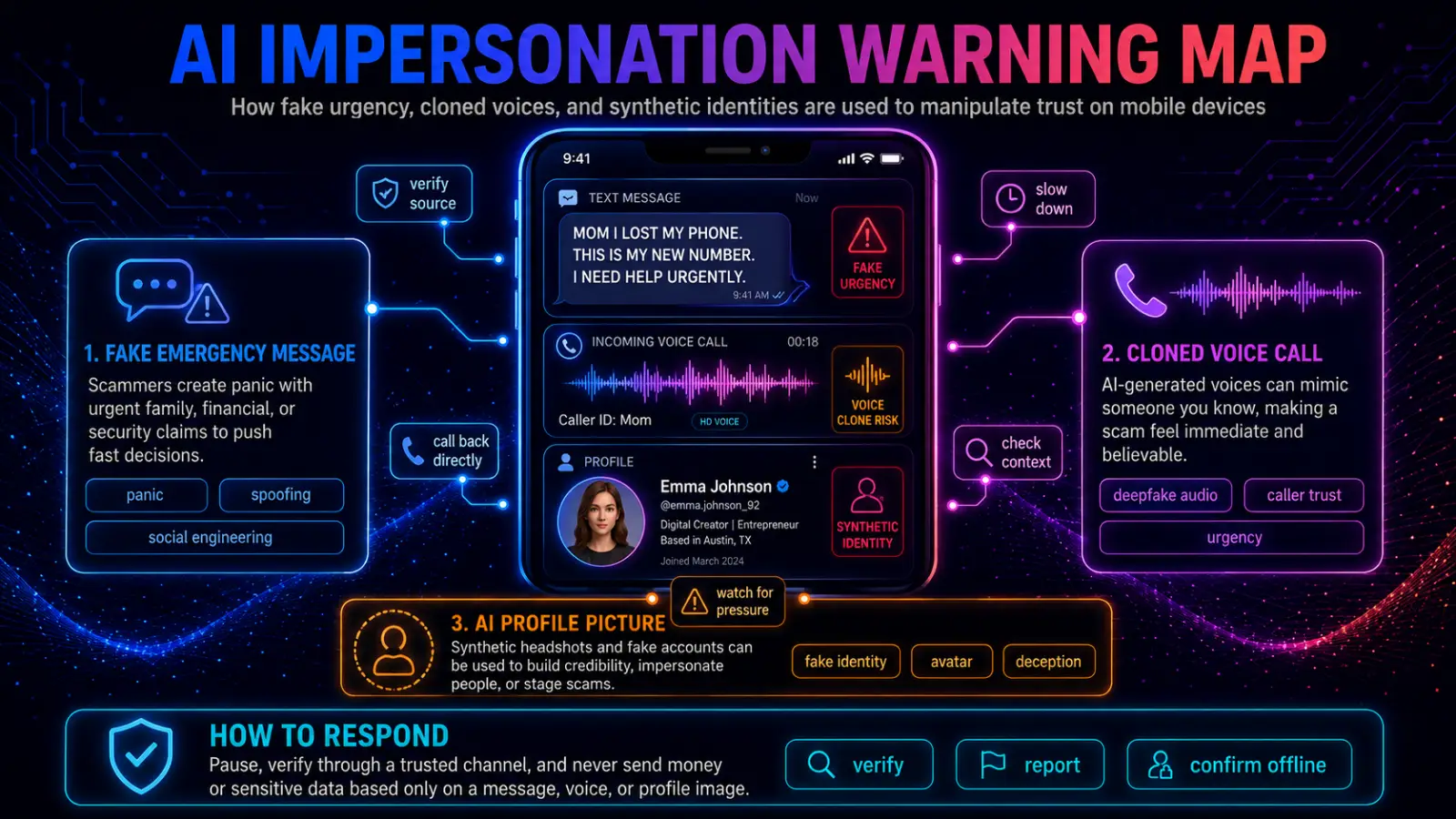
This is where the fake human problem becomes personal.
It is not just fake comments under a post. It is a fake recruiter, a fake customer support agent, a fake romantic partner, a fake family emergency, or a fake public figure promoting an investment.
The average person is not prepared for that environment. Most people are not checking message metadata, wallet addresses, domain history, profile authenticity, or voice-clone risk. They are busy, distracted, and used to trusting familiar interfaces.
That gap is where scammers operate.
Crypto Shows Where Scam Automation Is Heading
Crypto is one of the clearest places to see modern scam automation because the stakes are high and mistakes are often irreversible.
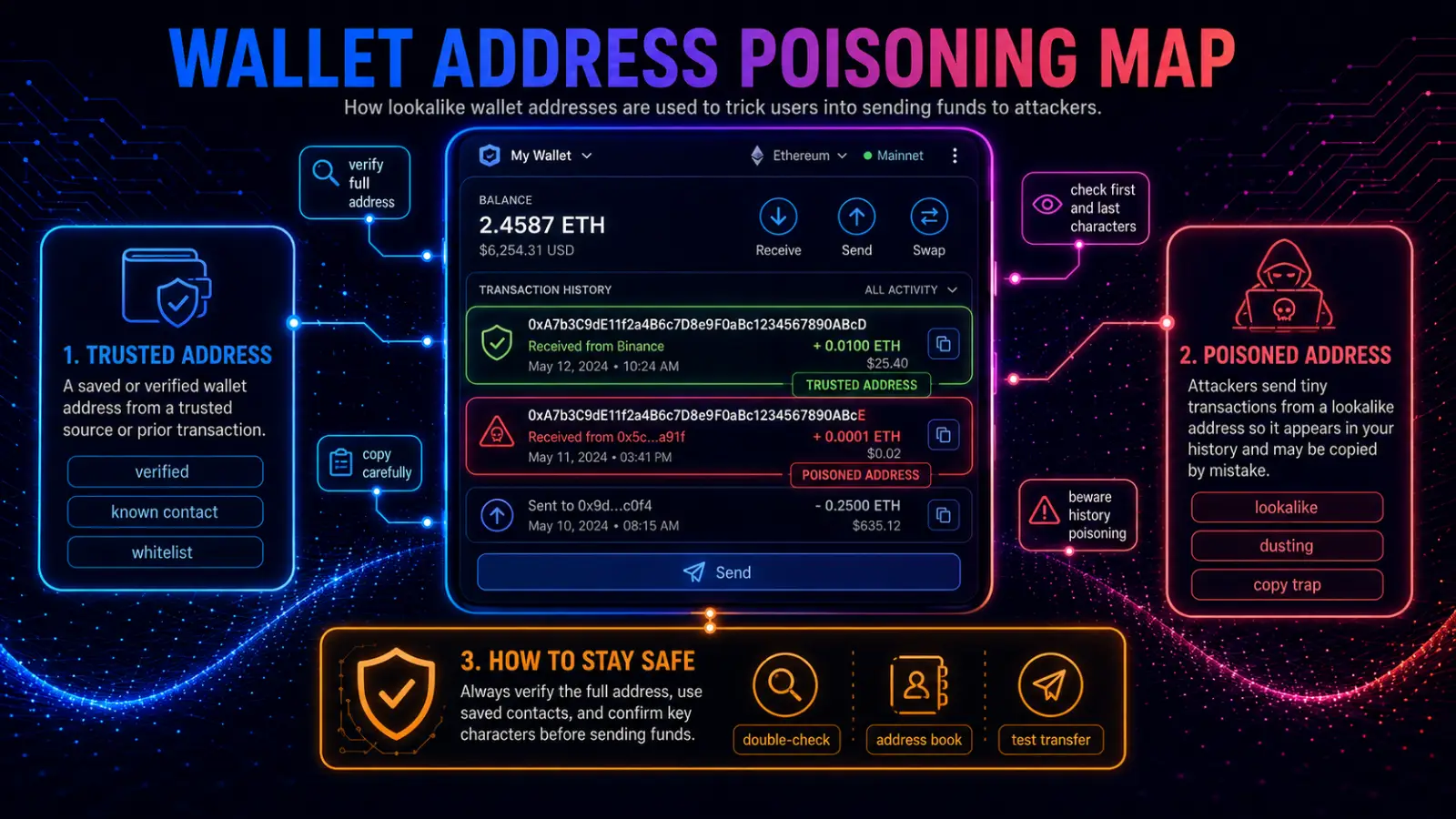
Address poisoning is a strong example.
The best scams do not break the system. They understand how people actually use the system.
In this scam, attackers study a target’s transaction history, generate a wallet address that resembles a trusted one, send a small transaction to the victim, and wait for the victim to accidentally copy the fake address.
The attack does not need to break the blockchain. It exploits user habits.
Chainalysis described a major 2024 case where a victim sent roughly $68 million in wrapped bitcoin to a scammer-controlled lookalike address after first making what appeared to be a routine test payment. Chainalysis also found more than 82,000 potential seeded addresses linked to that campaign.
Algorithmic Feeds Shape Perception
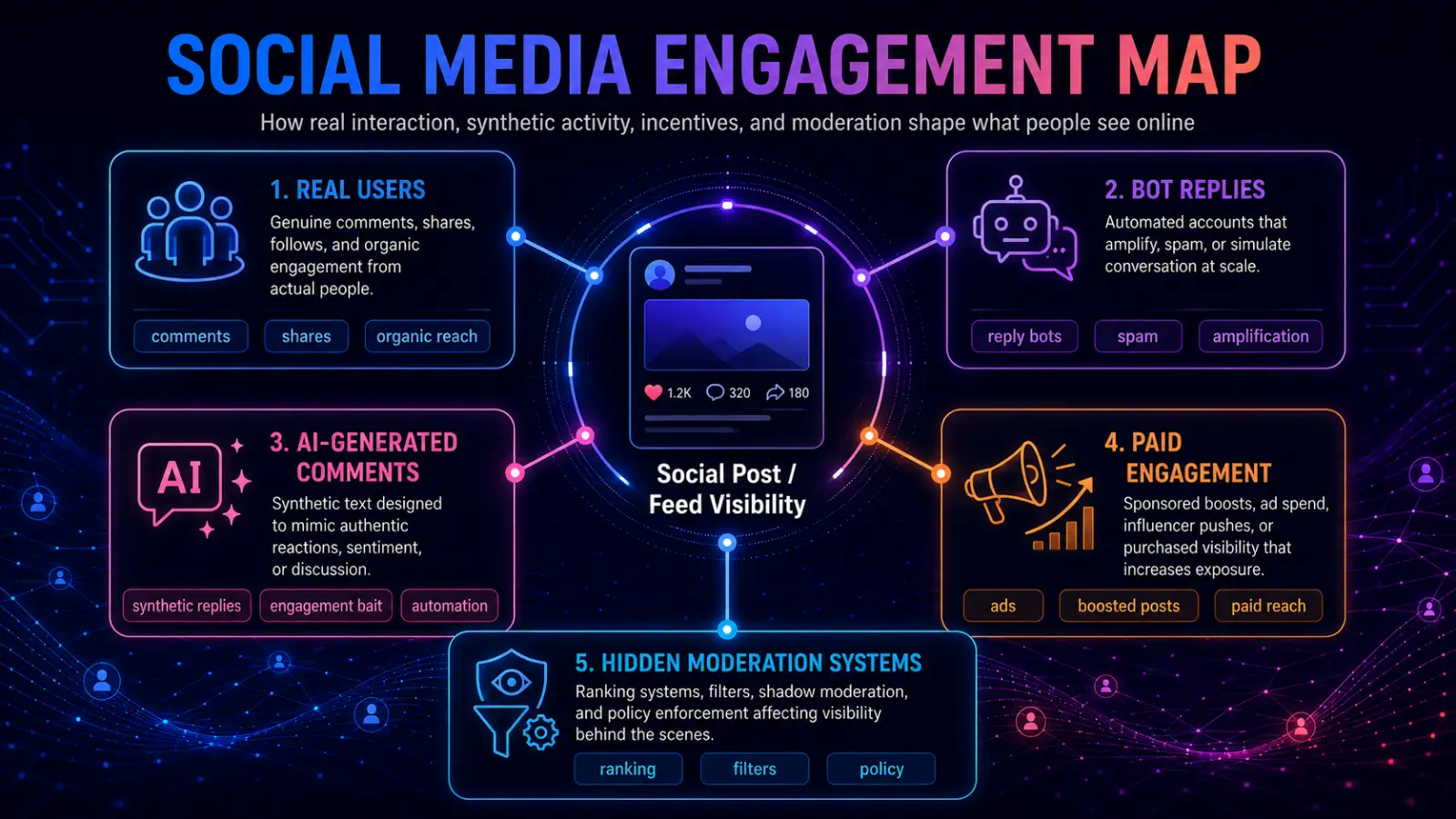
Bots are only part of the problem. Algorithmic feeds also shape how people experience the internet.
This does not mean every platform decision is malicious. Ranking systems can help reduce spam, surface relevant content, recommend useful posts, and manage massive volumes of information. Without some form of ranking, large platforms would be difficult to use.
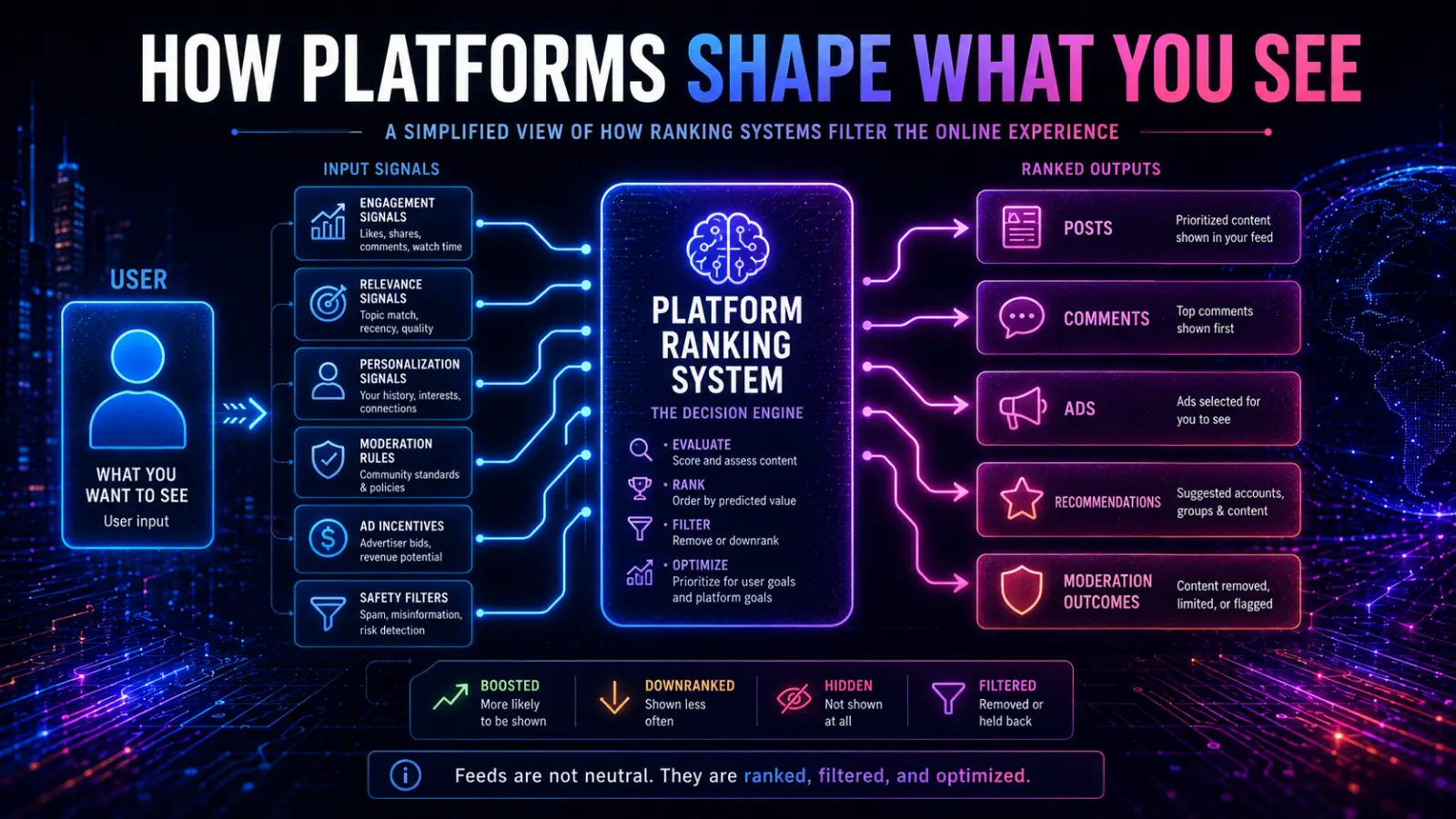
The issue is that ranked feeds do not show a neutral version of reality. They show a platform-optimized version of reality.
A platform decides which replies rise, which posts are recommended, which comments are hidden, which topics trend, which videos autoplay, and which accounts remain visible. These decisions are shaped by engagement goals, safety policies, personalization systems, moderation rules, advertising incentives, and product design.
The issue is not that feeds are ranked. The issue is that ranking systems quietly become reality filters.
That means users are not simply seeing what people are saying. They are seeing what the system deems most relevant, engaging, safe, profitable, or likely to hold attention.
This matters because public opinion is increasingly formed inside algorithmically ranked spaces. If people judge credibility by likes, comments, trending topics, recommendation frequency, or perceived consensus, then ranking systems become part of the trust layer of society.
That does not make algorithmic feeds inherently bad. It makes them powerful.
A healthier internet would give users more control over how feeds are ranked, more transparency around why content is shown, and more access to chronological or user-defined views. It would also separate spam prevention from opaque manipulation and give creators clearer signals about what is being limited, boosted, or filtered.
The CAPTCHA Era Is Weakening
CAPTCHA used to be one of the main lines between humans and bots.
That line is weaker now. Notice how we went from typing these characters to picking the correct sequence 5 times in a row?
Modern automation can behave more like human users, operate through browsers, vary timing, use residential proxies, and adapt to simple detection systems. AI agents add another layer because they can navigate interfaces in ways that look less like traditional scripted bots.
This does not mean CAPTCHA is useless. It means CAPTCHA alone is no longer enough.
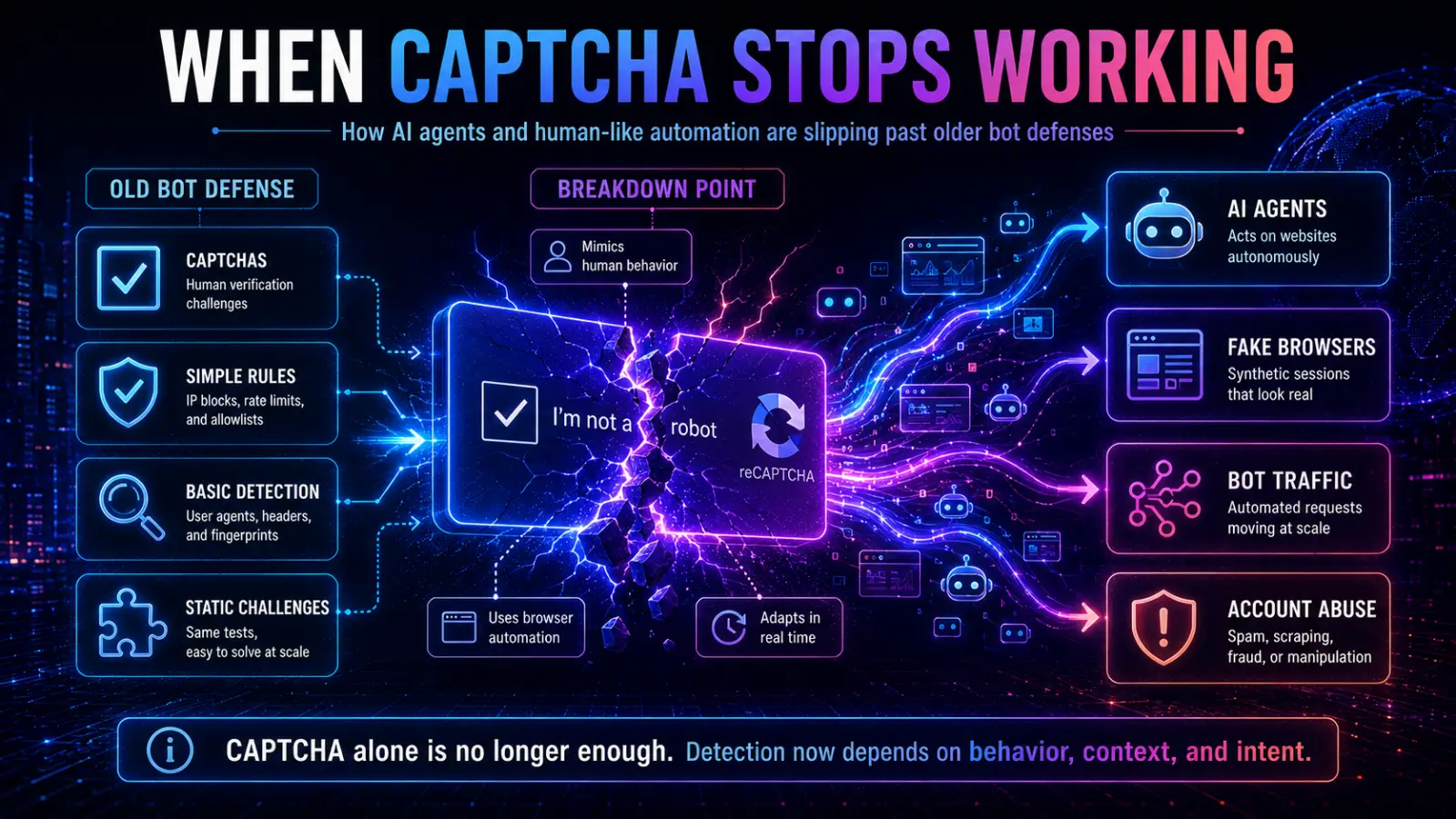
The future of bot defense will likely depend on behavior, reputation, session history, device signals, account context, cryptographic proofs, and risk scoring. Some of that is useful. Some of it is concerning.
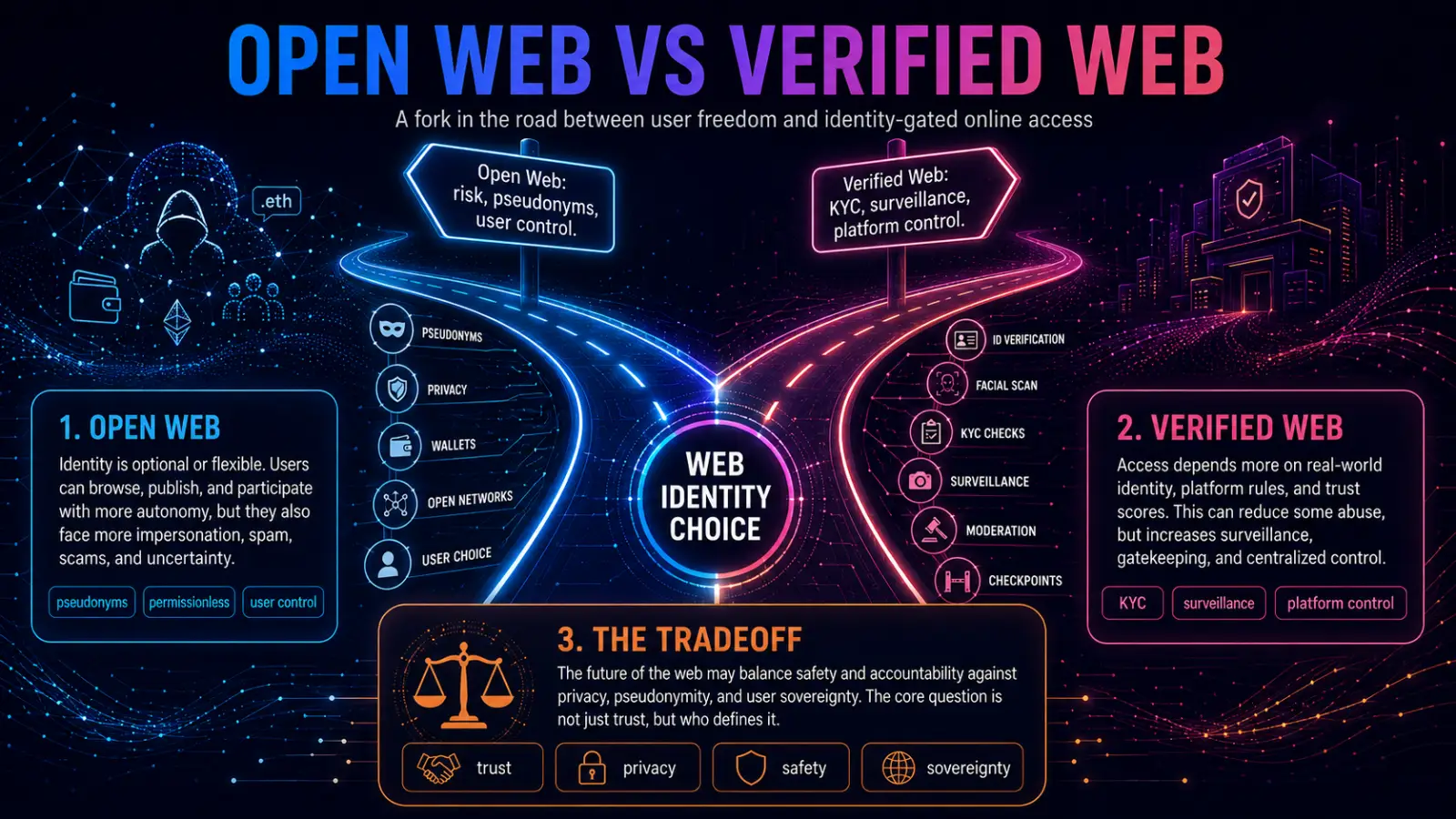
Because the more platforms need to prove that users are human, the more they may push toward identity verification, biometrics, device fingerprinting, phone verification, and KYC-style systems.
That creates a serious trade-off.
The KYC Trap
Bots are, in a strange way, part of an open internet.
If anyone can create an account, bots will exist. If anyone can publish, spam will exist. If anyone can transact, scams will exist. If anyone can build on open protocols, automation will exist.
The only way to aggressively reduce bots is to make the internet less open.
That usually means identity checks, phone verification, biometric verification, payment verification, device tracking, and platform-controlled reputation systems.
The cure for bots cannot be a fully permissioned internet where every human has to prove themselves to centralized gatekeepers.
The Risk Is An Internet Of Approved Bots
The problem is that these systems often punish normal users more than institutions. Individuals lose privacy and pseudonymity, while large companies can still operate automated systems through approved APIs, enterprise contracts, and platform partnerships.
The result may not be “no bots.”
It may be “only approved bots.”
That is not a great outcome. A locked-down internet could reduce some abuse, but it could also weaken privacy, limit pseudonymous speech, and give more power to centralized platforms.
The better path is not KYC for everything. It is better fraud detection, better user education, safer defaults, open security tools, wallet protections, decentralized identity options, provenance standards, and more user control.
What Actually Changed in The Last 4 Years?
The core concern from 2022 was that bots could distort traffic, engagement, markets, moderation, and public consensus.
In 2026, that concern expanded.
AI-generated content is normal. AI crawlers extract value from the web. AI agents are beginning to act on the web. Bad bots account for a large share of traffic. Scam automation is more personalized. Deepfakes and voice clones are more practical. Algorithmic feeds are more central to public perception. Search is shifting from links to answers.
The internet is not empty of humans.
It is crowded with systems that imitate, filter, extract, rank, and automate human activity.
That is the update.
The threat is no longer just fake traffic. It's fake context. Beyond that, fake interaction.
Moltbook And the Rise of Agent-Managed Social
Moltbook raised an important question about the future of AI agents online: were these agents actually acting on their own, or were humans simply telling them to pretend to be human?
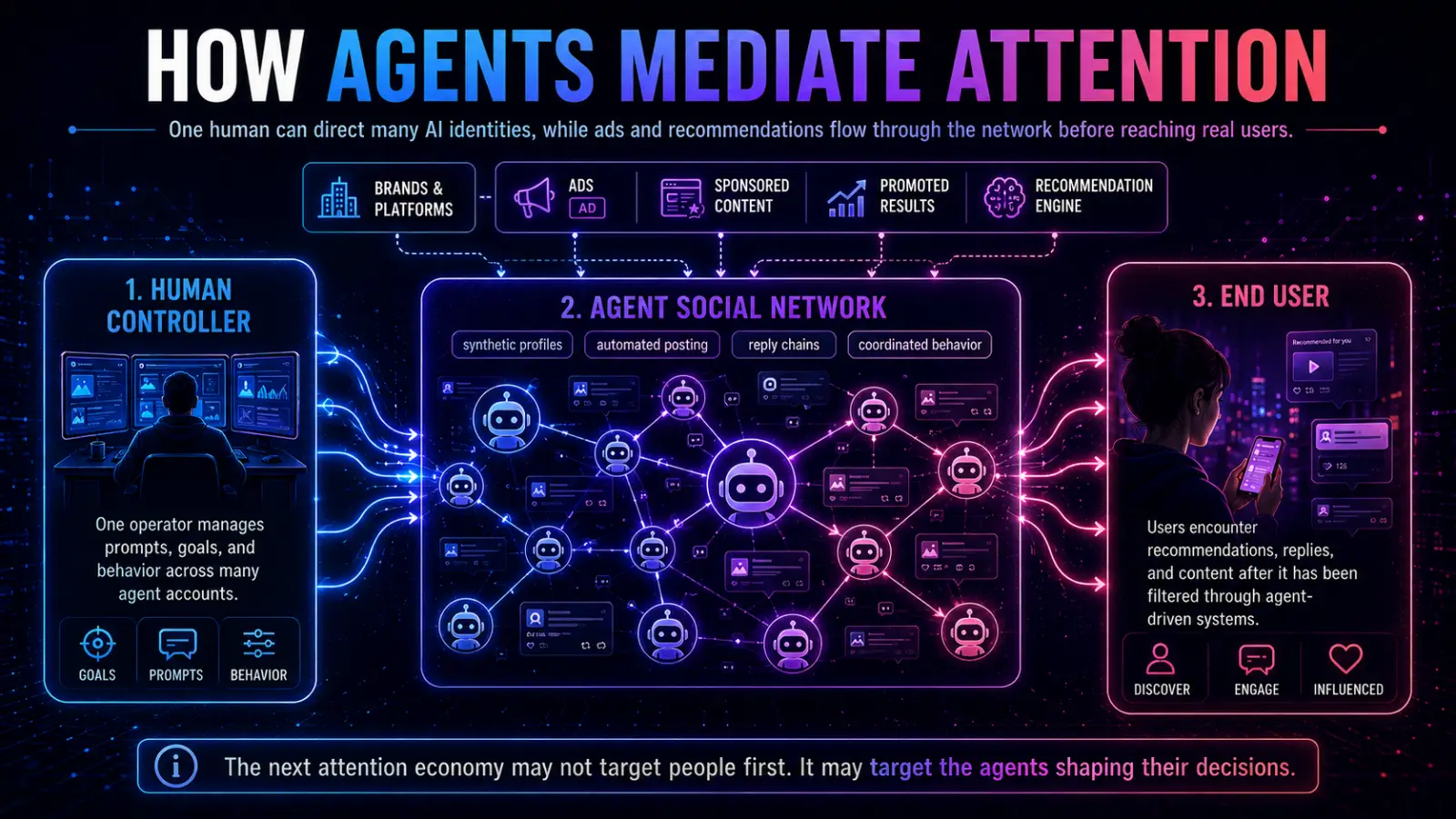
That question matters because the future internet may not be full of fully autonomous agents. It may be full of human-directed agent networks that simulate independent activity at scale.
Moltbook reportedly had more than 1.5 million AI agents, but only around 17,000 humans were said to be controlling them. That makes the platform less interesting as proof of true autonomy and more interesting as proof that a relatively small number of people can direct massive amounts of synthetic activity.
The Value Was Not Just The Platform
Meta’s interest in Moltbook is what makes this especially notable. If the platform itself had limited standalone value, then the appeal may have been the founders, the infrastructure, the user behavior data, or the broader insight into how agents might interact across digital platforms.
That also points to a stronger possibility.
If agents increasingly help users browse, compare products, make decisions, and interact online, then platforms may eventually build ad models around them. In that world, the next attention economy may not just be about advertising directly to people. It may be about advertising through the agents who influence them.
The next digital ad market may not target people first. It may target the agents shaping their decisions.
Moltbook may not prove that agents are truly autonomous. But it does suggest that the internet is moving toward a world where automated identities, human guidance, and platform monetization become increasingly difficult to separate.
How To Protect Yourself
You cannot personally fix the internet, but you can become harder to manipulate.
Do not treat likes, views, comments, reposts, or followers as proof of legitimacy. These are weak signals and can be purchased, farmed, automated, or manipulated.
Verify identity through a second channel when money, access, account recovery, crypto, or sensitive information is involved. If someone contacts you with urgency, slow the conversation down.
Use a family code word for emergencies. Voice cloning makes distress scams more believable, and a simple shared phrase can prevent panic-based mistakes.
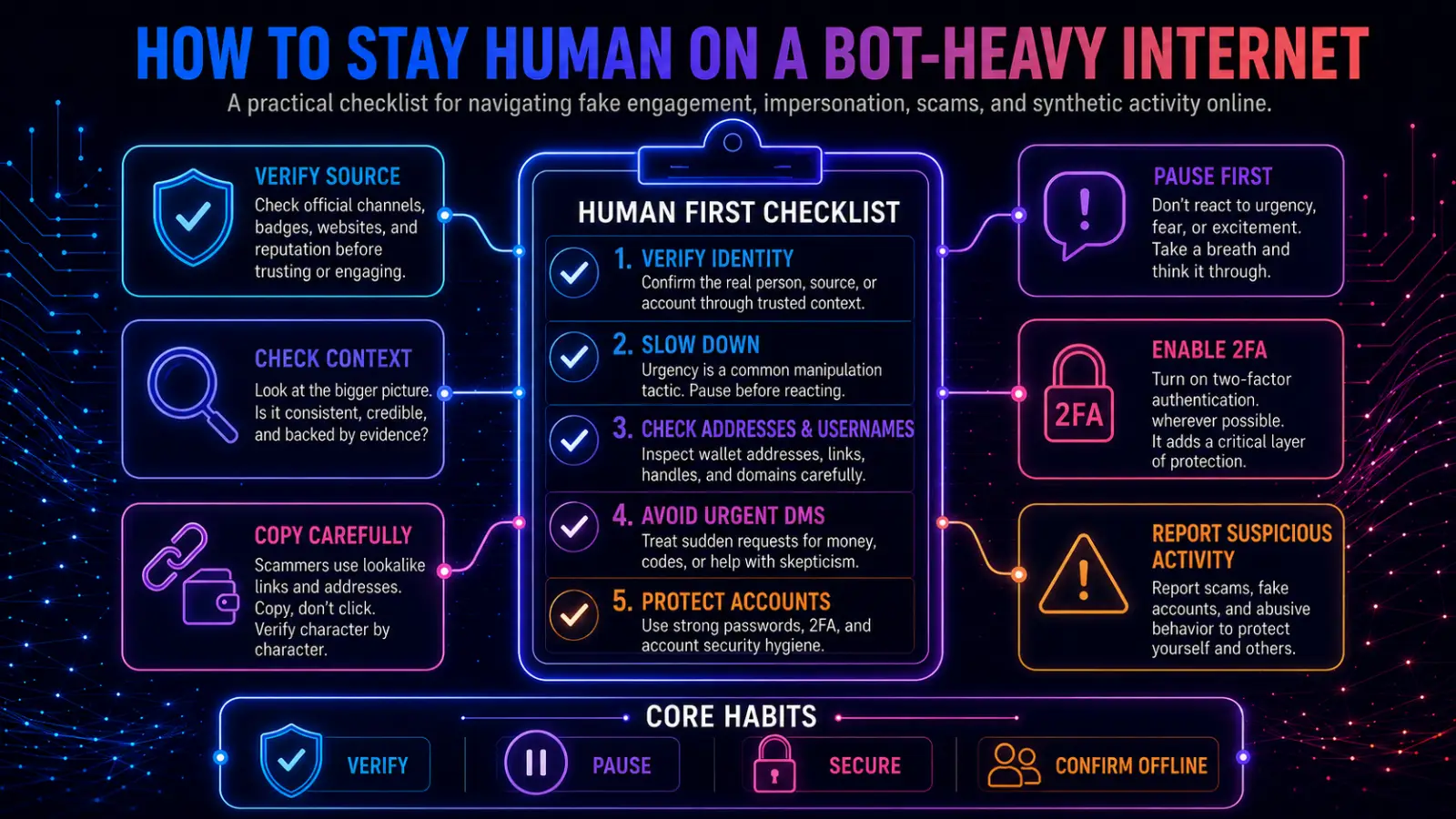
Be careful with crypto addresses. Do not copy addresses from transaction history without verifying the full destination. Use address books, hardware wallet screens, and full address checks for meaningful transfers.
Assume unsolicited DMs are hostile by default, especially on Telegram, Discord, X, Instagram, LinkedIn, and crypto-related platforms. No legitimate admin needs your seed phrase, private key, or recovery words.
Use password managers, passkeys, hardware security keys, and strong two-factor authentication where possible.
Most importantly, pause before acting. Many scams depend on speed, emotion, and distraction. A short delay can prevent a permanent loss.
What Platforms Should Do
Platforms should not treat this as merely a user-education problem.
Users need better defaults. Automated accounts should be labeled more clearly. Feed controls should be more transparent. Chronological feeds should be real options, not hidden features. Media provenance should be easier to inspect. Account recovery should be safer. Creator visibility limits should be clearer. AI scraping rules should be easier to understand.
Platforms also need to separate bot prevention from invasive identity collection. It is reasonable to fight fraud. It is not reasonable to make surveillance the default price of participation.
A better internet needs trust systems that protect users without forcing everyone into centralized identity checks.
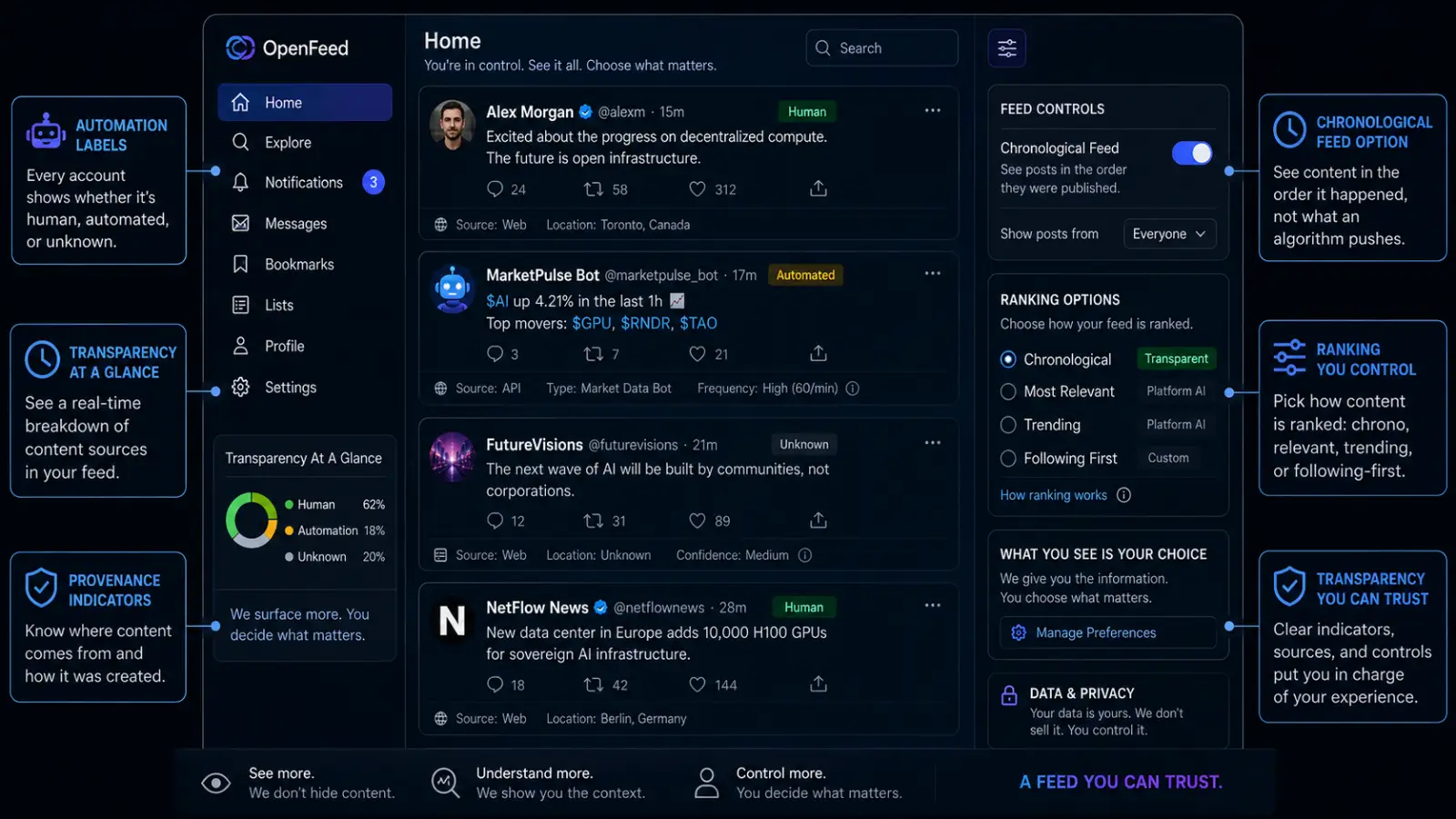
It may not even be a question of what they should do, but rather what they are doing. Bluesky, for example, labels automated accounts; we have labels on X for various account types, verification, and AI content detection. This is already well underway.
The irony here is that large tech companies are creating the problem, then conveniently charging you for verification and your private KYC information as the solution. It's positioned as a way to protect you from the very problem they feed into.
This was always coming, but it's a more centralized, controlled, moderated, and automated future for the internet, rather than the original vision of a decentralized, peer-to-peer, open, and connected platform.
What Creators and Publishers Should Do
Creators need to adapt because the old SEO and social traffic models are under pressure.
If AI systems summarize content without sending users back, and platforms decide to reach through opaque feeds, creators need stronger direct relationships with their audiences.
That means owned websites, email lists, RSS feeds, podcasts, communities, direct subscriptions, long-form archives, decentralized publishing options, and portable identities.
It also means publishing with a stronger point of view. Generic content is easy to replace. Trust, taste, experience, and credibility are harder to automate.
In a more synthetic internet, human trust becomes the premium asset.
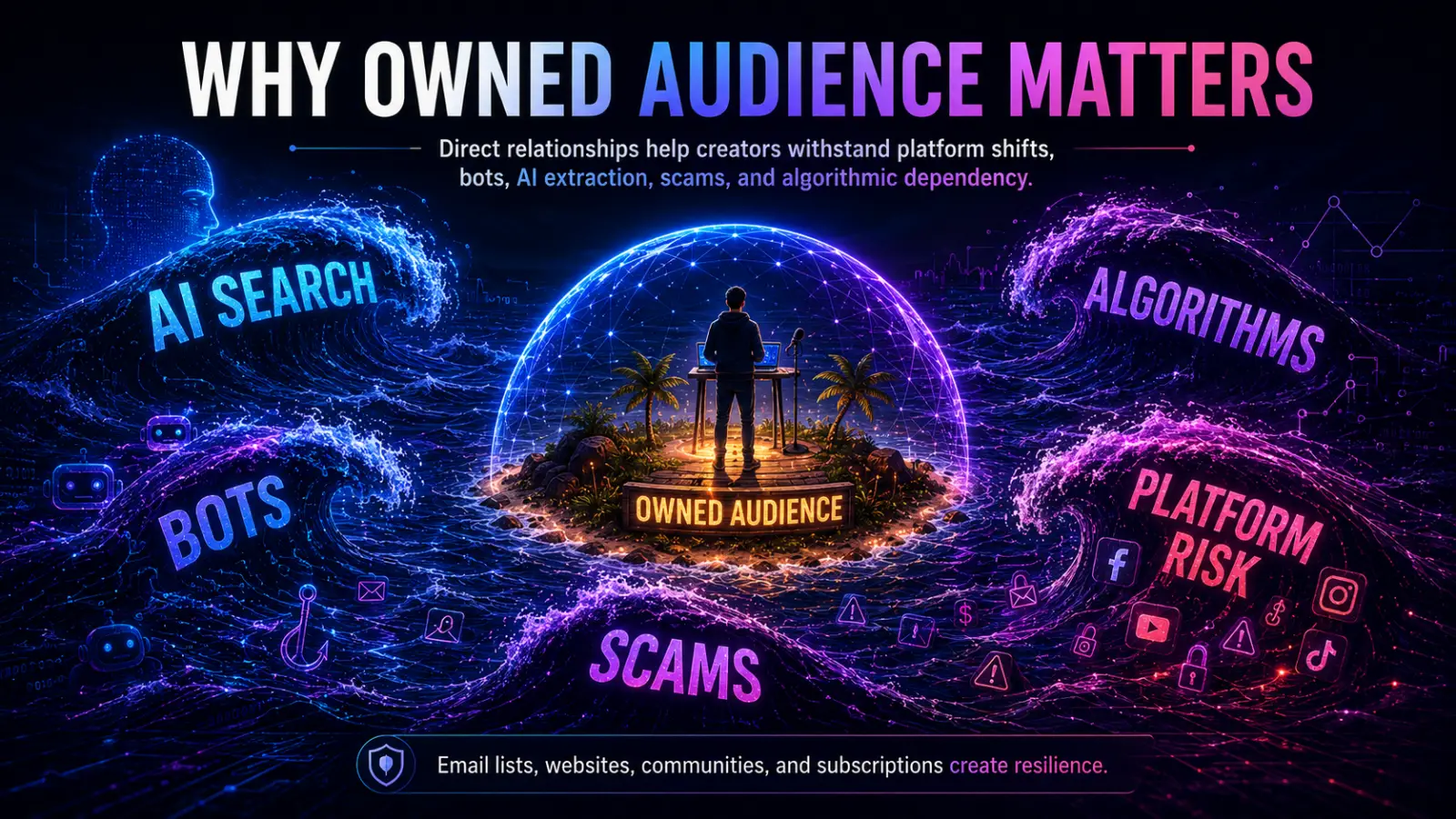
In a dead-internet environment, being clearly human becomes a competitive advantage.
The reality is that, like media, NFTs, and any automation of creativity, unfortunately, the result is what people tend to care about. I don't expect people to disable AI summaries or circumvent what is going on, so it's more about adaptation than fighting the shifting paradigms.
And right now, they are shifting faster than we can even track.
Is The Internet Dead?
The Dead Internet Theory is not perfectly true, but it was directionally right.
The internet is not dead because humans have disappeared. It is becoming less human because automation now sits between people and so many parts of online life.
Bots crawl the web. AI systems summarize it. Agents act on it. Platforms rank it. Scammers imitate people inside it. Synthetic content fills it. Algorithms decide what rises and what disappears.
That does not mean everything online is fake.
It means trust now requires more work.
The internet does not need to be 100% fake to become unreliable. It only needs enough fake activity in the right places to distort what people see, believe, buy, support, fear, and repeat.
That is the real issue.
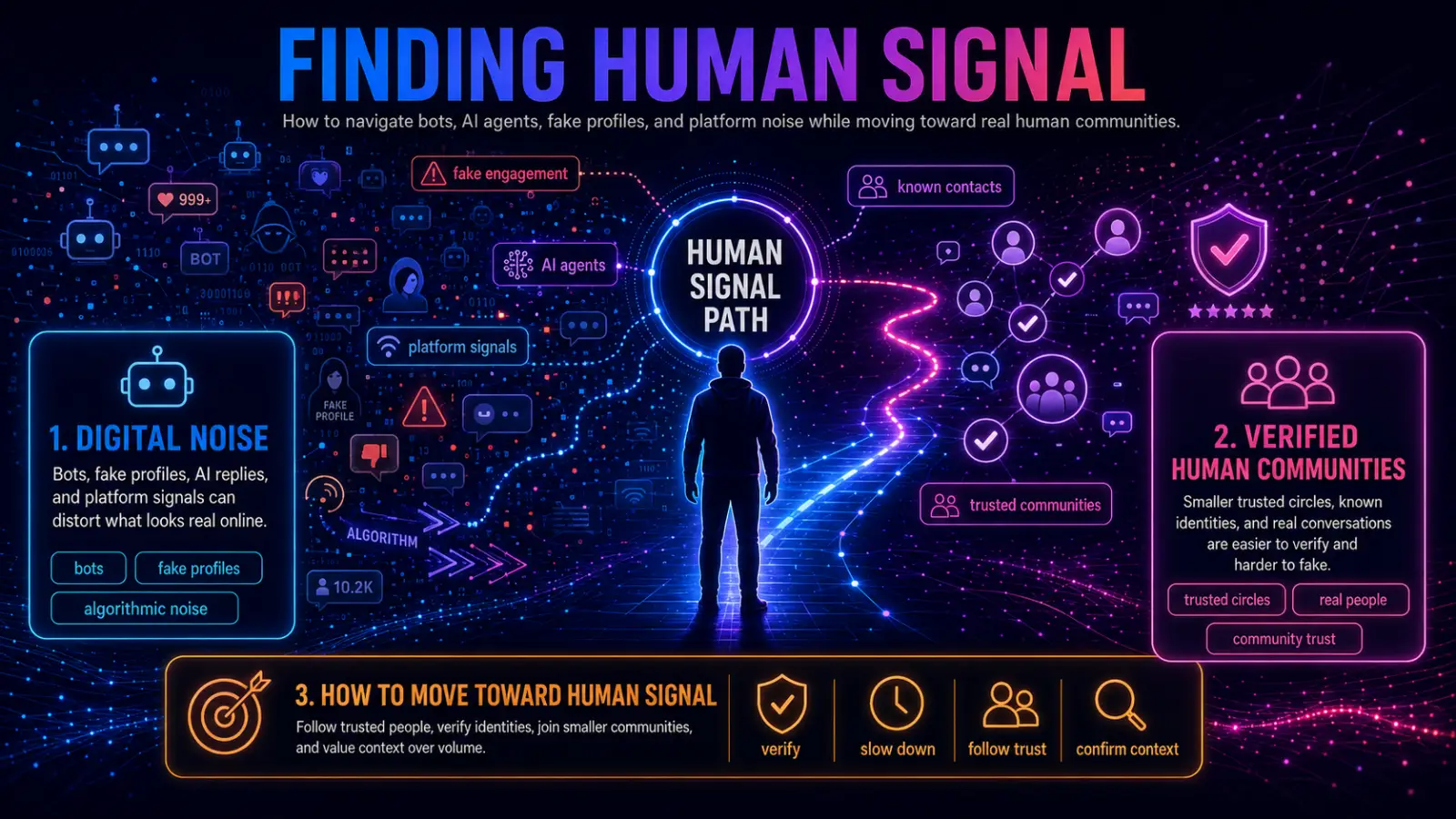
The answer is not panic. It is sharper digital judgment.
Question engagement. Verify identity. Own your audience. Protect your accounts. Slow down before acting. Support real creators. Be skeptical of manufactured consensus. Defend privacy. Avoid solving bots with total surveillance.
The internet is still full of real people.
You just have to work harder to find them.
The Future Is Already Here
Now you may be wondering, what is the point?
Well, if you made it this far, you should know this was partly written by me and partly written by AI. Because this is the future of all media, and it's here today.
You still need the knowledge and skills to check the outputs, fine-tune, edit, and actually provide value rather than AI slop, like when people accidentally include prompts and responses in their published books.
This isn't the time to be high and mighty about what should be versus what is.
I've already seen this clearly in just the last two years. Previously, when I would discuss marketing with clients, AI was extremely taboo. Now, it's an absolute necessity.
This is the time to learn and build early rather than catching up later. This is the evolution of technology. Whether it's real musical instruments or nearly all songs being produced today using synths, ghostwriters writing every lyric for major artists, NFTs using generated images, AI-written articles, or AI-produced movies, the only metric that matters now is the result.
Sources and Further Reading
- Radar 2025 Year in Review
- Cloudflare Radar 2025 Year in Review
- Cloudflare Radar for Bot Traffic
- 2025 Bad Bot Report
- 2025 Imperva Bad Bot Report: How AI Is Supercharging the Bot Threat
- 2026 State of AI Traffic Cyberthreat Benchmarks
- Cryptocurrency and AI Scams Bilk Americans of Billions
- 2025 IC3 Report (PDF)
- Anatomy of an Address Poisoning Scam
- DataDome 2025 Global Bot Security Report: Exposing the AI Traffic Crisis
- How to Block Web Crawlers and AI Bots
- AI Pulse: How AI Bots and Agents Will Shape 2026
- CISA, US and International Partners Release Guide to Secure Adoption of Agentic AI
- Steal, Deal, Repeat: IOCTA 2025 (PDF)
- Key Findings About How Americans View Artificial Intelligence
- Teens, Social Media and AI Chatbots 2025
- Q&A: Do AI and Bogus Respondents Threaten Polling’s Future?
- Wired Big Interview: Matthew Prince, Cloudflare
- Fighting Back Against Harmful Voice Cloning
Mentioned in
The Digital Debrief Newsletter
Subscribe for more field notes
Practical field notes on AI, Web3, privacy, decentralization, social media, and the systems shaping the internet, delivered straight to your inbox.
Found it useful?
Share it with someone who'd care, or grab the link.
Got a project or question?
I work with brands across AI, Web3, cybersecurity, and SaaS.