

Stablecoins, CBDCs, and the Future of Digital Money
Stablecoins are one of the most useful parts of crypto, but also one of the least understood. This paper breaks down fiat-backed, crypto-backed, algorithmic, commodity-backed stablecoins, and CBDCs to explain how they work, where the risks are, and why the future of digital money is really a fight over trust, control, liquidity, and financial sovereignty.

Stablecoins sit in the middle of crypto’s biggest contradiction.
They are among the most useful parts of the ecosystem, but also among the least decentralized. They make trading easier, improve liquidity, support DeFi, simplify settlement, and let users move in and out of volatile crypto assets without constantly relying on traditional banking rails.
Stablecoins are not just crypto products. They are becoming a private money-market infrastructure with blockchain rails.
At the same time, the largest stablecoins rely on centralized issuers, reserve managers, auditors, custodians, blacklist controls, banking partners, legal terms, and regulatory systems that crypto was originally designed to route around.
That does not make stablecoins useless. It makes them misunderstood.
A stablecoin is a crypto asset designed to maintain a relatively stable value against another asset, usually the U.S. dollar. As of May 2026, CoinMarketCap listed the stablecoin category with a total market capitalization of more than $323 billion and a 24-hour trading volume of more than $102 billion.
The core question is not whether stablecoins are useful. They clearly are.
The better question is: what kind of risk are you accepting when you use one?
Fiat-backed stablecoins are not the same as crypto-collateralized stablecoins. Algorithmic stablecoins are not the same as tokenized gold. CBDCs are not simply “government stablecoins,” even though they may compete with stablecoins in some payment use cases.
Every model solves one problem while creating another.
The Main Types of Stablecoins
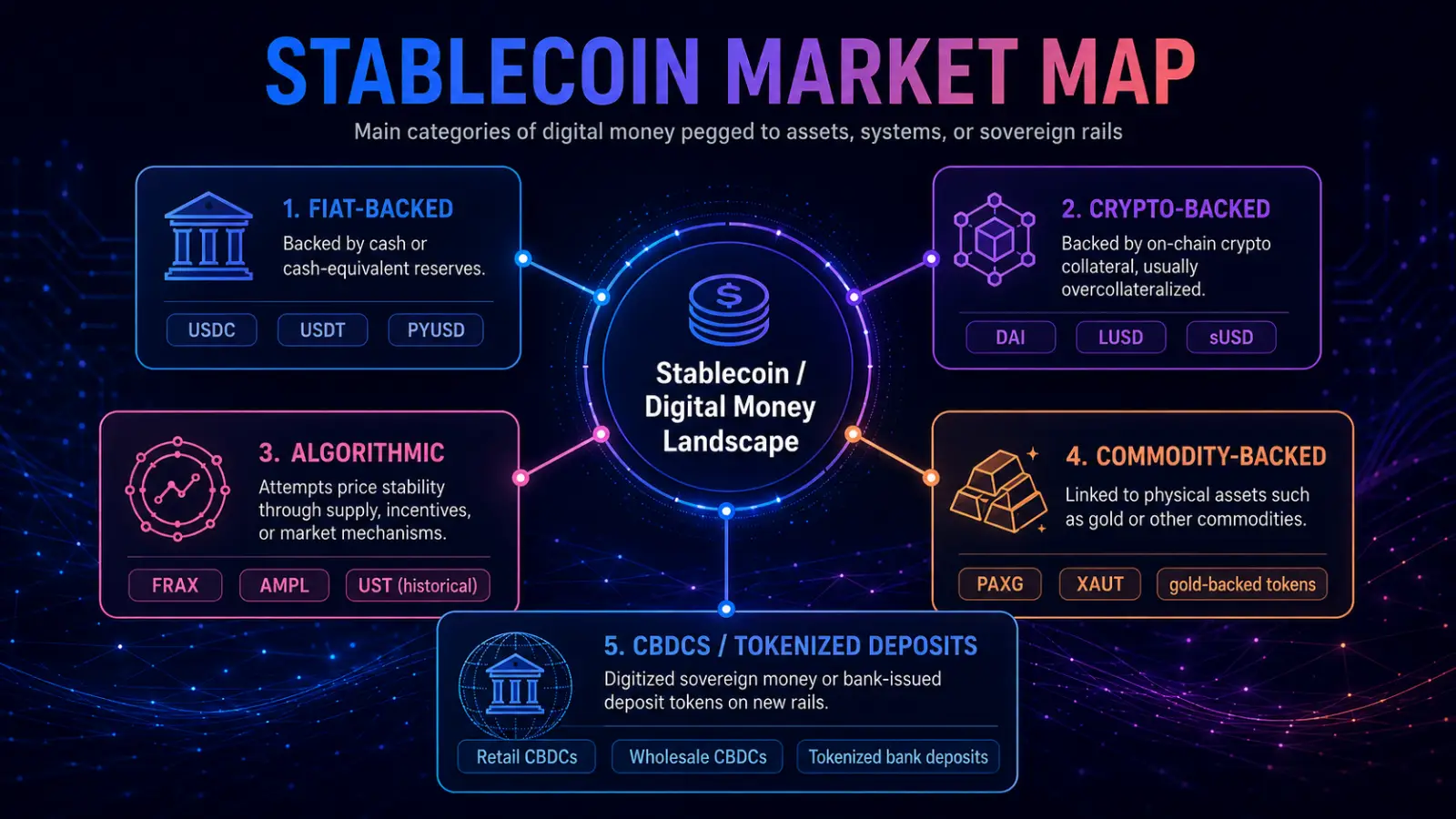
Stablecoins can be grouped into five broad categories.
Fiat-collateralized stablecoins include USDT, USDC, PYUSD, TUSD, GUSD, USDP, and the now-wound-down BUSD. These are backed by dollar-denominated assets such as cash, bank deposits, Treasury bills, money market funds, or similar short-duration instruments.
Crypto-collateralized stablecoins include DAI and USDS. These use crypto assets as collateral and usually require overcollateralization to absorb volatility.
Algorithmic stablecoins include failed models such as UST, Basis Cash, and IRON, as well as other incentive-based systems. These try to maintain a peg through supply adjustments, arbitrage, confidence, or a connected volatile token.
Commodity-backed stablecoins include gold-backed tokens like PAXG and XAUT. These track the price of the commodity backing them.
CBDCs and tokenized bank money are not stablecoins in the traditional crypto sense, but they compete for the same future of programmable digital payments.
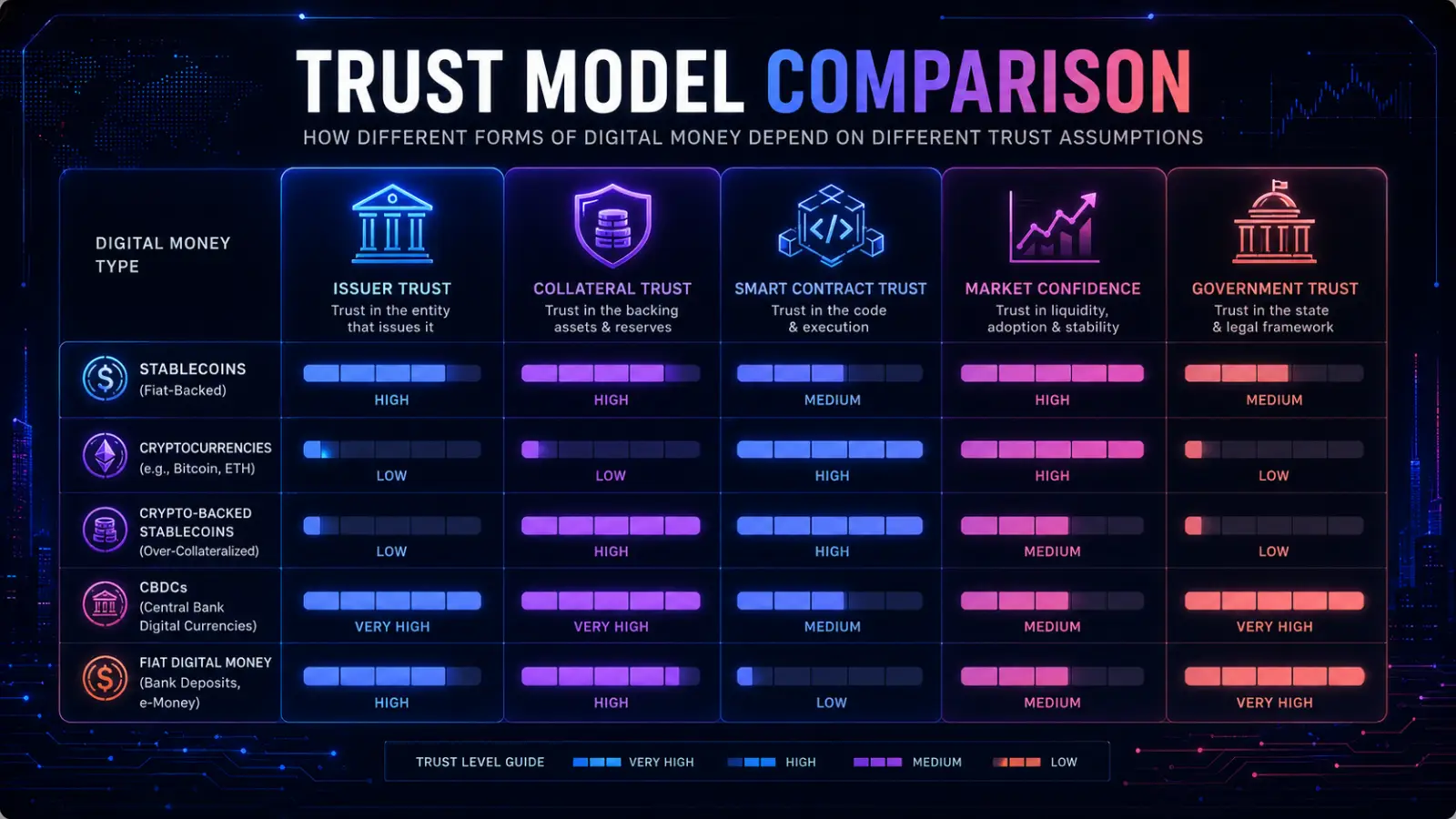
Different Stablecoins, Different Trust Models
The mistake many users make is treating these categories as if they share the same risk profile.
They do not.
A fiat-backed stablecoin asks you to trust the issuer, reserves, custodians, banking relationships, redemption process, and legal structure. A crypto-collateralized stablecoin asks you to trust collateral, smart contracts, liquidations, governance, oracles, and underlying assets. An algorithmic stablecoin asks you to trust incentives, confidence, and often a second token whose value can collapse when confidence disappears. A commodity-backed token asks you to trust that the real-world asset exists and can be redeemed under clear rules.
There is no stablecoin without trust. The only question is where that trust gets placed.
Every stablecoin has a trust model. The only question is where that trust is placed.
Fiat-Collateralized Stablecoins
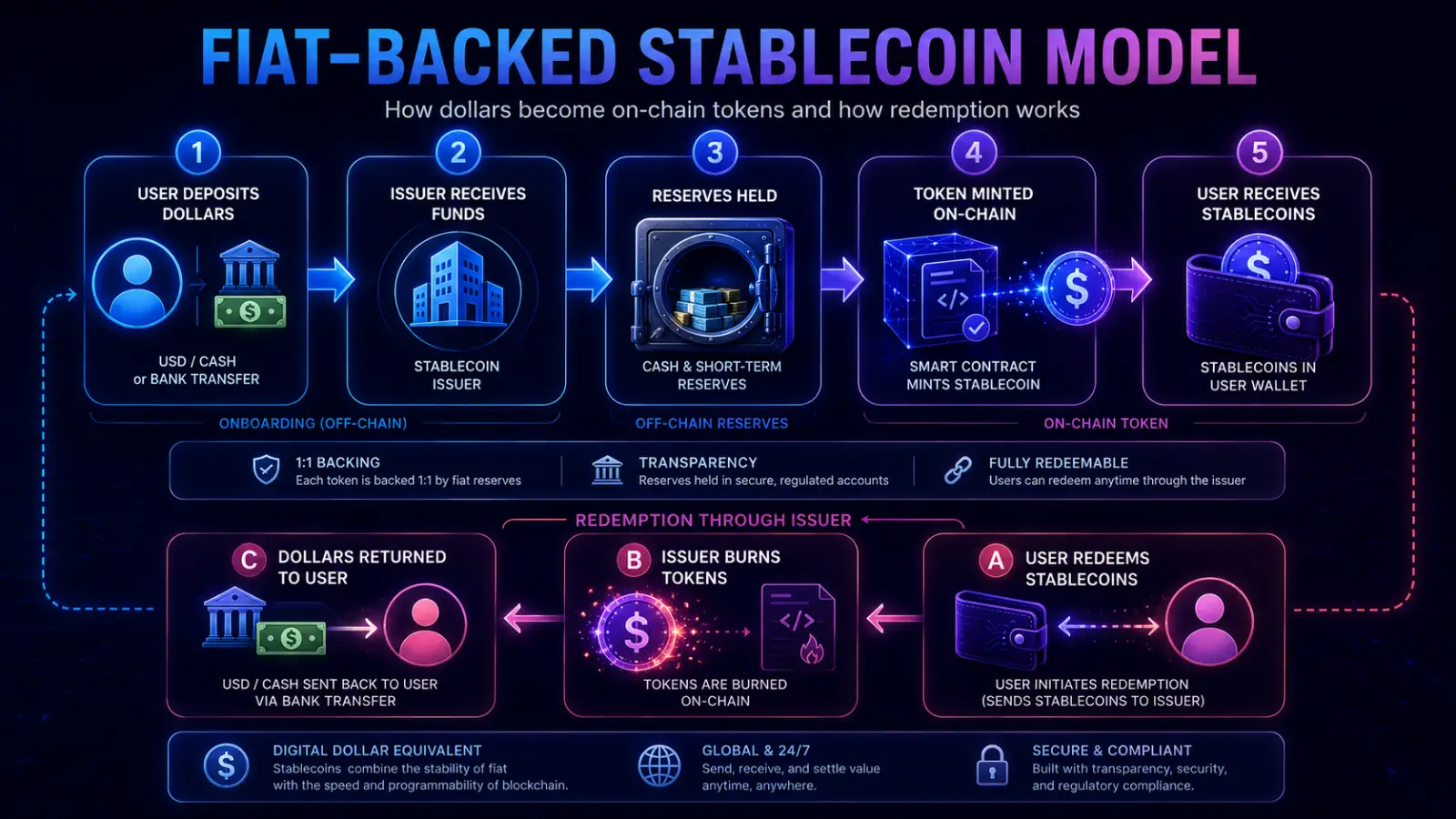
Fiat-backed stablecoins are the most common and liquid type of stablecoin.
The promise is simple: one token should equal one dollar, backed by dollar-denominated reserves. The two dominant examples are Tether’s USDT and Circle’s USDC.
USDT Is The Liquidity Trade-Off
USDT remains the largest stablecoin by market share. Tether publishes reserve reports stating that its tokens are backed by reserves, though these reports are still distinct from a full traditional audit. Its transparency page shows a reserve mix heavily weighted toward cash equivalents, short-term deposits, U.S. Treasury bills, and other liquid instruments.
Tether has also become a major holder of U.S. Treasury exposure. Reporting around its Q1 2026 attestation showed $1.04 billion in quarterly profit, an $8.23 billion reserve buffer, and roughly $141 billion in U.S. Treasury exposure.
That matters because stablecoin issuers increasingly resemble private money-market institutions with tokenized liabilities.
USDC Shows The Compliance Trade-Off
USDC takes a more institutionally aligned approach. Circle says USDC is fully backed by highly liquid cash and cash-equivalent assets and is redeemable 1:1 for U.S. dollars. Most of the reserve is held in the Circle Reserve Fund, an SEC-registered government money market fund.
Circle’s public USDC page listed $77.4 billion in circulation as of May 11, 2026, with monthly reserve attestations by a Big Four accounting firm. BlackRock’s Circle Reserve Fund page showed 100% daily and weekly liquid assets, with a weighted average maturity of 10 days as of May 13, 2026.
This is the strongest argument for fiat-backed stablecoins: when reserves are short-duration, liquid, transparent, and conservatively managed, they can be practical payment and settlement tools.
But they are not decentralized.
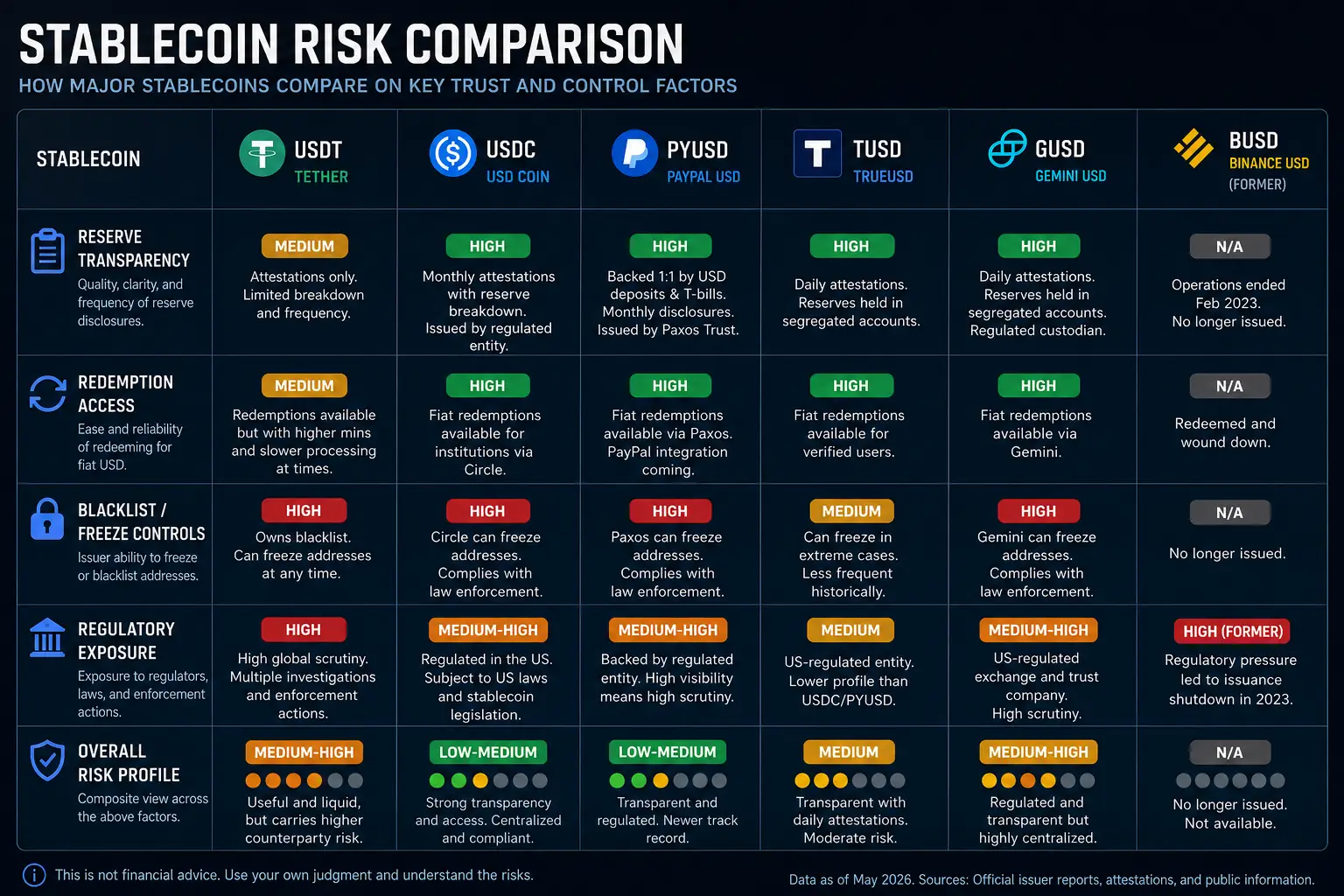
Most major fiat-backed stablecoins include blacklist or freeze functions. That means the issuer can freeze funds at specific addresses for sanctions compliance, law enforcement requests, hacks, or other legal obligations.
Fiat-backed stablecoins solve crypto’s liquidity problem by importing the traditional financial system into crypto.
From a consumer protection perspective, that can be useful. From a decentralization perspective, it is a major weakness. It means the token is not censorship-resistant money. It is a tokenized liability controlled by an issuer.
The Safety Problem with Fiat-Backed Stablecoins
The biggest risks with fiat-backed stablecoins are reserve risk, redemption risk, issuer risk, custody risk, regulatory risk, censorship risk, and banking partner risk.
Reserve risk is the risk that the issuer does not actually hold assets that can support every token in circulation. This is why users should distinguish between attestations, audits, reserve disclosures, and real-time transparency.
Redemption risk is different. A stablecoin may be backed, but users still need to know whether they can redeem it directly, under what conditions, and through which entity. In a crisis, users depend on exchange liquidity, market makers, banking partners, and issuer redemptions all working at once.
Regulatory Risk is Growing Fast
In the United States, the GENIUS Act created a federal framework for payment stablecoins. In April 2026, the U.S. Treasury proposed rules that would treat permitted payment stablecoin issuers as financial institutions for Bank Secrecy Act purposes and impose anti-money-laundering and sanctions-compliance obligations.
The European Union has moved ahead with MiCA, which creates uniform EU rules for crypto assets, including asset-referenced tokens and e-money tokens. ESMA says MiCA covers transparency, disclosure, authorization, and supervision. The European Banking Authority says issuers of asset-referenced tokens and e-money tokens must hold the relevant authorization under MiCA.
The likely result is a more regulated stablecoin sector. That may reduce some risks, especially around reserves. But it will not make stablecoins decentralized. It will make them more bank-like.
Regulation can make stablecoins safer as financial products while making them less neutral as crypto tools.
The BUSD example is a warning. Paxos announced in February 2023 that it would stop issuing new BUSD after direction from the New York Department of Financial Services. Paxos continued redemptions, but the token’s growth was effectively ended through regulatory pressure.
PayPal’s PYUSD reflects another trend. Major fintech companies want stablecoins not just as crypto trading tools, but as payment infrastructure. That may help mainstream adoption, but it may also make stablecoins more platform-dependent and less open.
Crypto-Collateralized Stablecoins
Crypto-collateralized stablecoins try to avoid relying entirely on fiat reserves and centralized issuers.
Instead of being backed by dollars in bank accounts or Treasury bills, they use crypto assets as collateral. The best-known example is DAI, now part of the broader Sky ecosystem following MakerDAO’s rebrand.
The classic DAI model requires users to overcollateralize crypto assets. For example, a user might deposit $150 worth of ETH to mint a smaller number of DAI. The extra collateral helps protect the peg if the collateral price falls. If the collateral drops too far, the position can be liquidated.
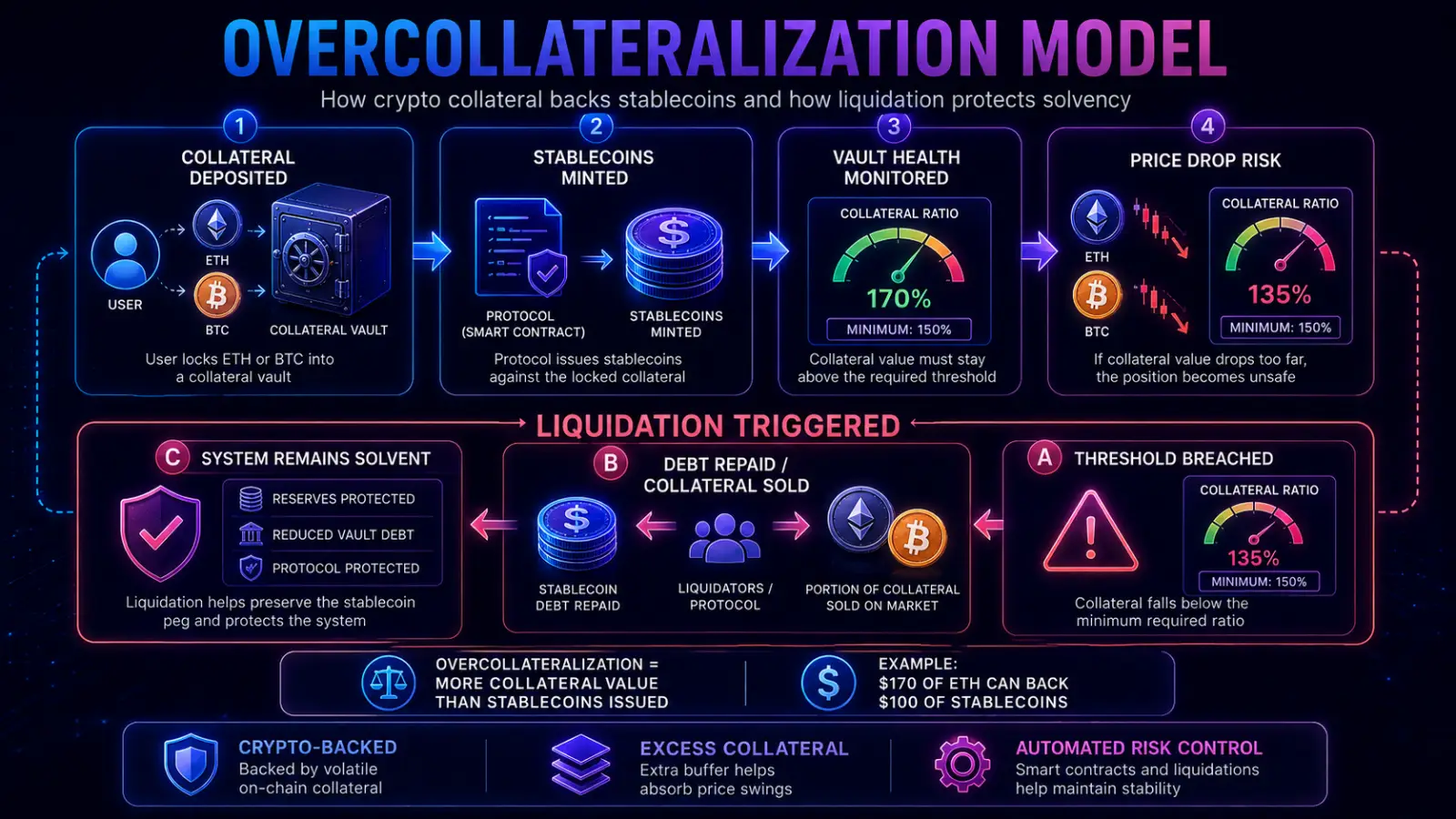
How Overcollateralized Stablecoins Work
This model is more crypto-native because it can operate via smart contracts rather than relying on a single issuer’s bank account. Collateral and liquidations can also be tracked on-chain.
But crypto-collateralized stablecoins are not risk-free.
They depend on volatile collateral, smart contract security, price oracles, liquidation incentives, governance, market liquidity, and collateral quality. A model that looks overcollateralized during normal markets can become fragile during a sharp crash.
Crypto-backed stablecoins are not magic dollars. They are decentralized credit systems with liquidation risk.
DAI also became more complex over time because its backing included both centralized stablecoins and real-world assets. That improved stability, but reduced ideological purity.
MakerDAO rebranded to Sky in 2024, with the ecosystem shifting toward USDS. This shows the trade-off: the more a decentralized stablecoin uses centralized collateral, the more stable it may become. But the more it relies on centralized collateral, the more it inherits the risks of fiat-backed stablecoins.
Crypto-collateralized stablecoins are probably the most philosophically aligned with DeFi. But users should not confuse “on-chain” with “riskless.” They are decentralized credit systems that can fail due to poor governance, flawed collateral design, oracle failures, liquidity shocks, or smart contract exploits.
Algorithmic Stablecoins
Algorithmic stablecoins are the most dangerous category because they often promise stability without sufficient collateral.
They usually try to maintain a peg through incentives, supply adjustments, arbitrage, or a relationship with another token. In theory, the model sounds elegant: if the stablecoin trades below $1, users buy it and redeem it for $1 worth of another asset. If it trades above $1, users mint more and sell into the market.
The system depends on arbitrage and confidence.
The problem is that confidence is not collateral.
Confidence is not collateral.
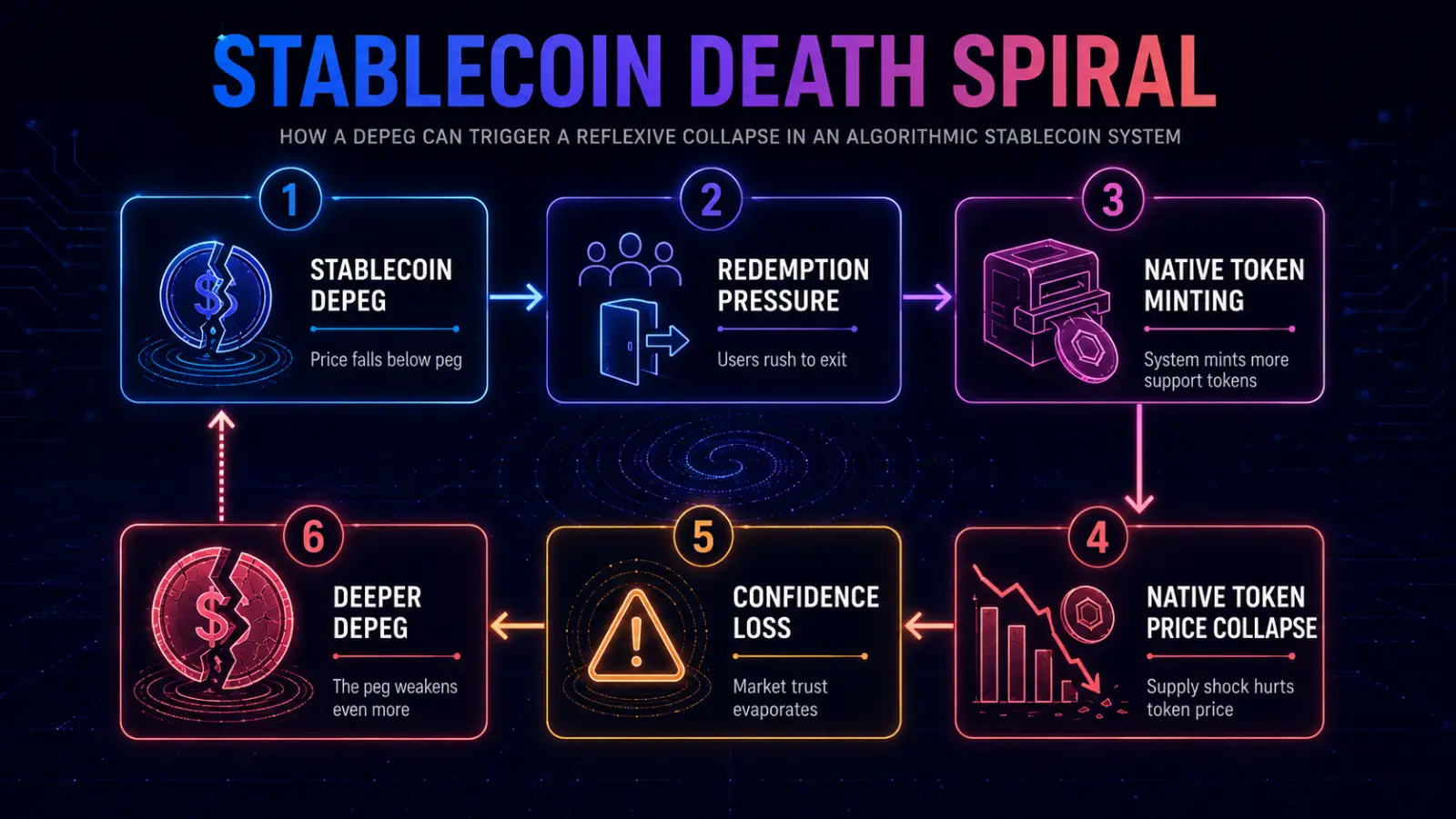
When “Algorithmic Stability” Becomes Reflexive Risk
TerraUSD, or UST, was the defining failure. UST was marketed as a stablecoin, but its stability depended on the relationship between UST and LUNA, as well as on market confidence in the Terra ecosystem. When confidence failed, the mechanism created a death spiral. UST lost its peg, LUNA hyperinflated downward, and tens of billions of dollars in value were destroyed.
The aftermath made the critique stronger. Terraform Labs agreed to a $4.47 billion settlement with the SEC in 2024 after being found liable for defrauding investors. Do Kwon later pleaded guilty in 2025 to U.S. fraud charges tied to the $40 billion collapse.
UST became a case study in how “algorithmic stability” can hide reflexive risk. When a stablecoin’s backing depends on a volatile token that also depends on confidence in the stablecoin, both can collapse together.
Basis Cash failed. Iron Finance collapsed amid a bank run. DEI lost its peg after stress spread through the broader stablecoin market. Many of these systems claimed incentives would hold the peg, but incentives only work while the market believes the exit door is large enough.
USDD from TRON remains active and describes itself as a decentralized stablecoin pegged to the U.S. dollar, backed by crypto reserves. Newer models often describe themselves as overcollateralized rather than purely algorithmic. That may be an improvement, but users still need to examine collateral composition, liquidity, governance, redemption mechanisms, and dependence on native ecosystem tokens.
The simple rule is this: if the stablecoin depends mainly on confidence, incentives, or a related volatile token, it is not stable in the way most users mean stable.
Commodity-Backed Stablecoins
Commodity-backed stablecoins are tokens backed by real-world commodities, usually gold.
They track the commodity’s price rather than staying stable against the dollar.
PAX Gold is one of the better-known examples. Paxos states that every PAXG token is backed by one ounce of allocated gold. Its site also provides a lookup tool for users holding PAXG in on-chain Ethereum wallets to verify allocation details.
Gold-backed tokens are designed to give users tokenized exposure to gold, not to serve as a perfectly stable unit of account for crypto trading.

Tokenized Gold Still Requires Trust
The benefits are obvious: fractional gold exposure, easier transferability, compatibility with crypto wallets, potential for on-chain settlement, and easier integration with exchanges and DeFi products.
The downside is equally obvious: users rely on a centralized issuer, vaulting and custody must be trusted, redemption rules matter, liquidity may be thinner than major dollar stablecoins, and the token tracks gold rather than the dollar.
Gold-backed tokens are not censorship-resistant gold. They are tokenized claims on vaulted gold.
If you do not trust the custodian, vaulting structure, or legal redemption path, the token is not equivalent to holding physical gold.
Commodity-backed stablecoins may be useful, but they are closer to tokenized commodities than money.
CBDCs: Central Bank Digital Currencies
CBDCs are digital liabilities issued by central banks.
Unlike stablecoins, which are usually issued by private companies, CBDCs would be direct or indirect forms of central bank money.
A retail CBDC would be designed for the public. A wholesale CBDC would be designed for banks, financial institutions, and settlement systems. A wholesale CBDC could modernize financial market settlement without giving every citizen a central bank wallet. A retail CBDC would be more directly visible to everyday users.
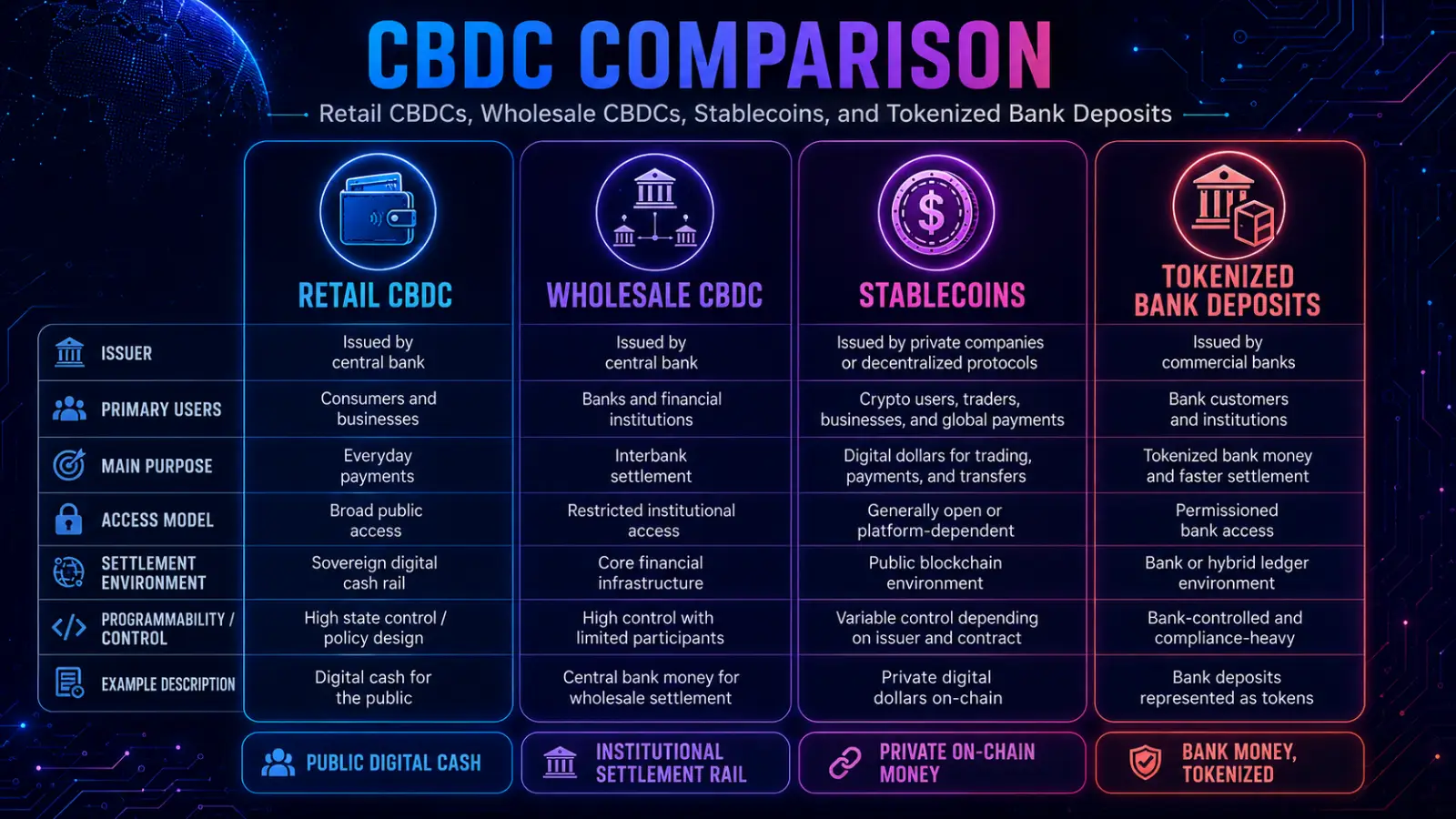
Digital Cash Or Programmable Control?
The strongest case for CBDCs is safety and settlement finality. A CBDC issued by a central bank would not have the same issuer default risk as a private stablecoin.
But CBDCs raise serious concerns around privacy, surveillance, programmability, transaction control, financial censorship, negative interest rates, commercial bank disruption, political abuse, and centralized monetary power.
A CBDC could be designed with strong privacy protections. It could also be designed to give authorities unprecedented visibility and control over transactions.
The technology is not the deciding factor. The governance model is.
CBDCs are not just digital cash. They are a governance choice about the future of money.
CBDC development is uneven globally. The Atlantic Council’s CBDC tracker says 146 countries and currency unions, representing more than 98% of global GDP, are exploring CBDCs. It also reports 77 countries in advanced exploration, including development, pilot, or launch phases.
Canada has been more cautious. The Bank of Canada frames its digital Canadian dollar work as research and preparation rather than an active launch.
The European Central Bank is further along. In October 2025, the ECB moved the digital euro project into its next phase, focused on technical readiness. If legislation is in place in 2026, a pilot could start in 2027, with a potential first issuance in 2029.
CBDCs are not just a technical upgrade to money. They are a political decision about who controls digital payments.
Stablecoins vs CBDCs vs Tokenized Deposits
The future of digital money will probably not have one winner.
It will likely involve three competing models.
Stablecoins are private tokenized money, usually backed by reserves. They are crypto-native and globally accessible, but carry issuer and regulatory risk.
CBDCs are central bank money in digital form. They may offer the safest settlement asset, but raise major privacy and control concerns.
Tokenized deposits are commercial bank deposits represented on programmable rails. They may preserve the existing two-tier banking system while giving banks blockchain-like settlement features.
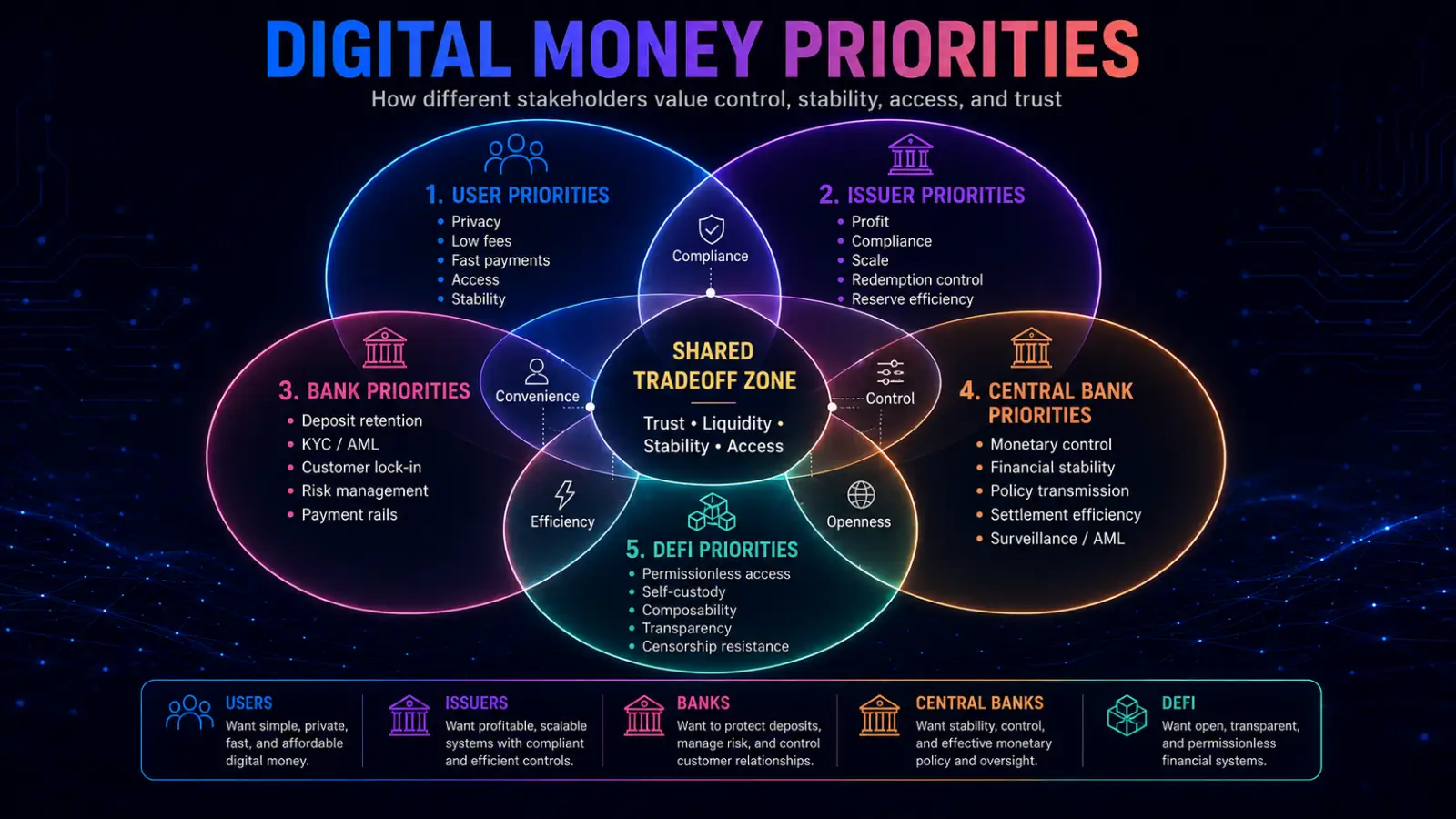
Banks, fintechs, stablecoin issuers, payment processors, central banks, and DeFi protocols are all competing to define programmable money.
Crypto wants open, borderless money. Banks want programmable money inside regulated institutions. Central banks want monetary control and settlement finality. Stablecoin issuers want scale, yield on reserves, payment adoption, and network effects. Users want speed, low fees, liquidity, privacy, safety, and freedom.
The future of digital money is not just about technology. It is about who controls the rails.
Those goals overlap, but they are not the same.
Are Stablecoins Actually Safe?
Stablecoins are safer than volatile crypto assets in one specific sense: they are designed to reduce price volatility relative to a reference asset.
That does not mean they are safe overall.
A stablecoin can maintain its peg while still exposing users to censorship risk. It can have strong reserves and still be frozen. It can be regulated and still be surveilled. It can be decentralized yet still fail due to a smart contract or collateral risk. It can be backed by gold and still depend on a custodian.
A stablecoin can be stable, liquid, and useful while still being centralized, censorable, and dependent on traditional finance.
The Federal Reserve noted in 2026 that stablecoin market capitalization grew by about 50% during 2025, with transaction volume and DeFi usage also rising. It also noted that stablecoins with safer, more liquid reserve compositions saw stronger adoption.
That is the direction the market is heading: more scale, more regulation, more institutional reserves, more compliance, more surveillance pressure, and more integration with traditional finance.
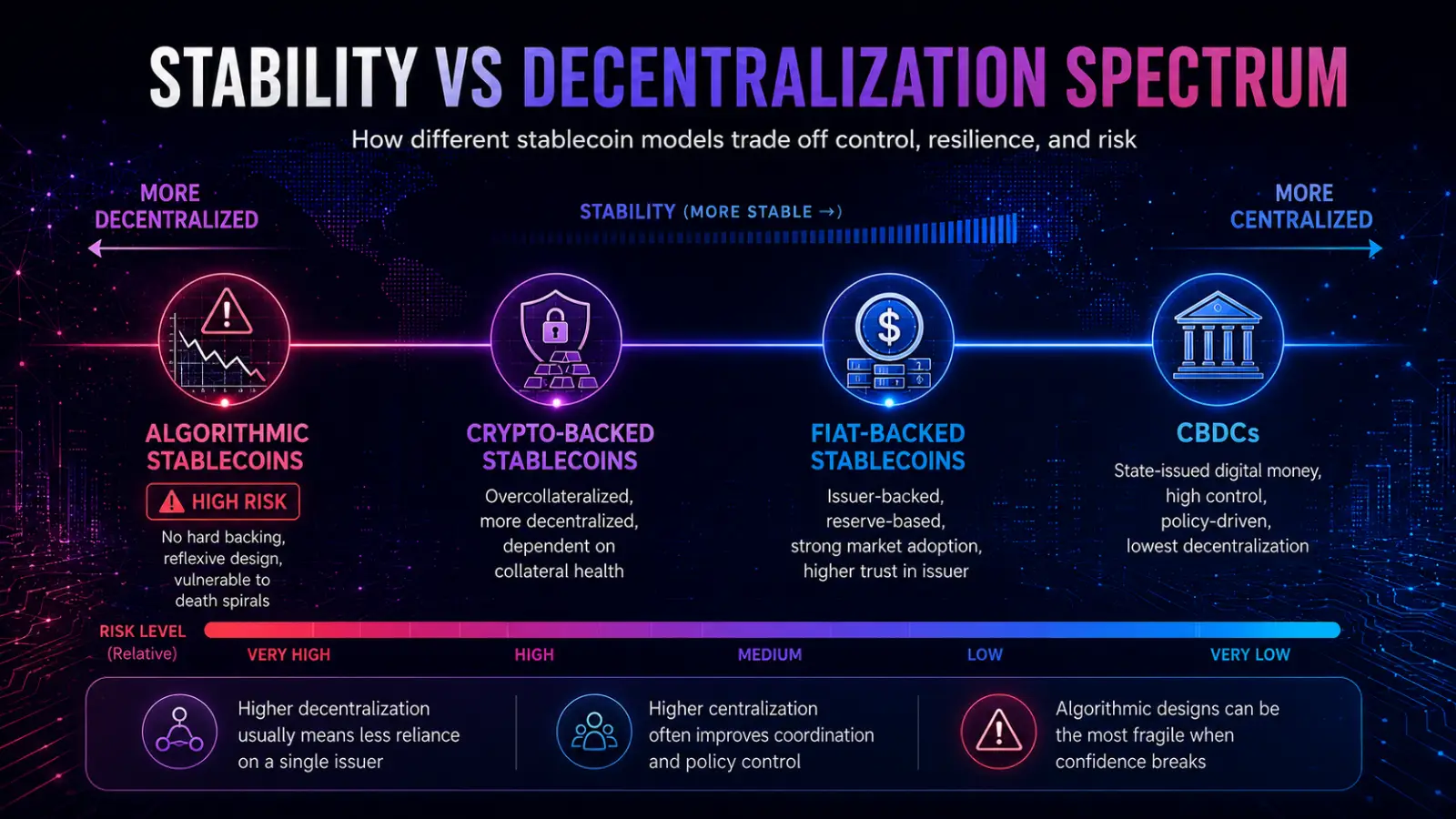
This will probably make the largest stablecoins more reliable as financial products. It will also make them less neutral as crypto tools.
The Future of Digital Money
The stablecoin debate usually gets framed as “safe or unsafe.”
That is too simplistic.
The real trade-off is this:
The more stable and regulated a stablecoin becomes, the more it tends to rely on centralized institutions. The more decentralized and crypto-native it becomes, the more it tends to rely on volatile collateral, governance, incentives, or smart contract systems.
Fiat-backed stablecoins are practical but centralized. Crypto-collateralized stablecoins are more transparent and crypto-native but structurally more complex. Algorithmic stablecoins are usually the weakest model unless they are heavily redesigned with real collateral and realistic risk controls.
Commodity-backed tokens are useful for tokenized exposure, but they are not censorship-resistant money. CBDCs may offer the safest settlement asset, but they could also become the most controlled form of digital money ever created.
Stablecoins are not going away. They are becoming more important and more political.
The likely end state is not one universal stablecoin. It is a layered system where digital dollars, euros, tokenized deposits, CBDCs, and crypto-native stable assets compete across different use cases.
The Real Stablecoin Question
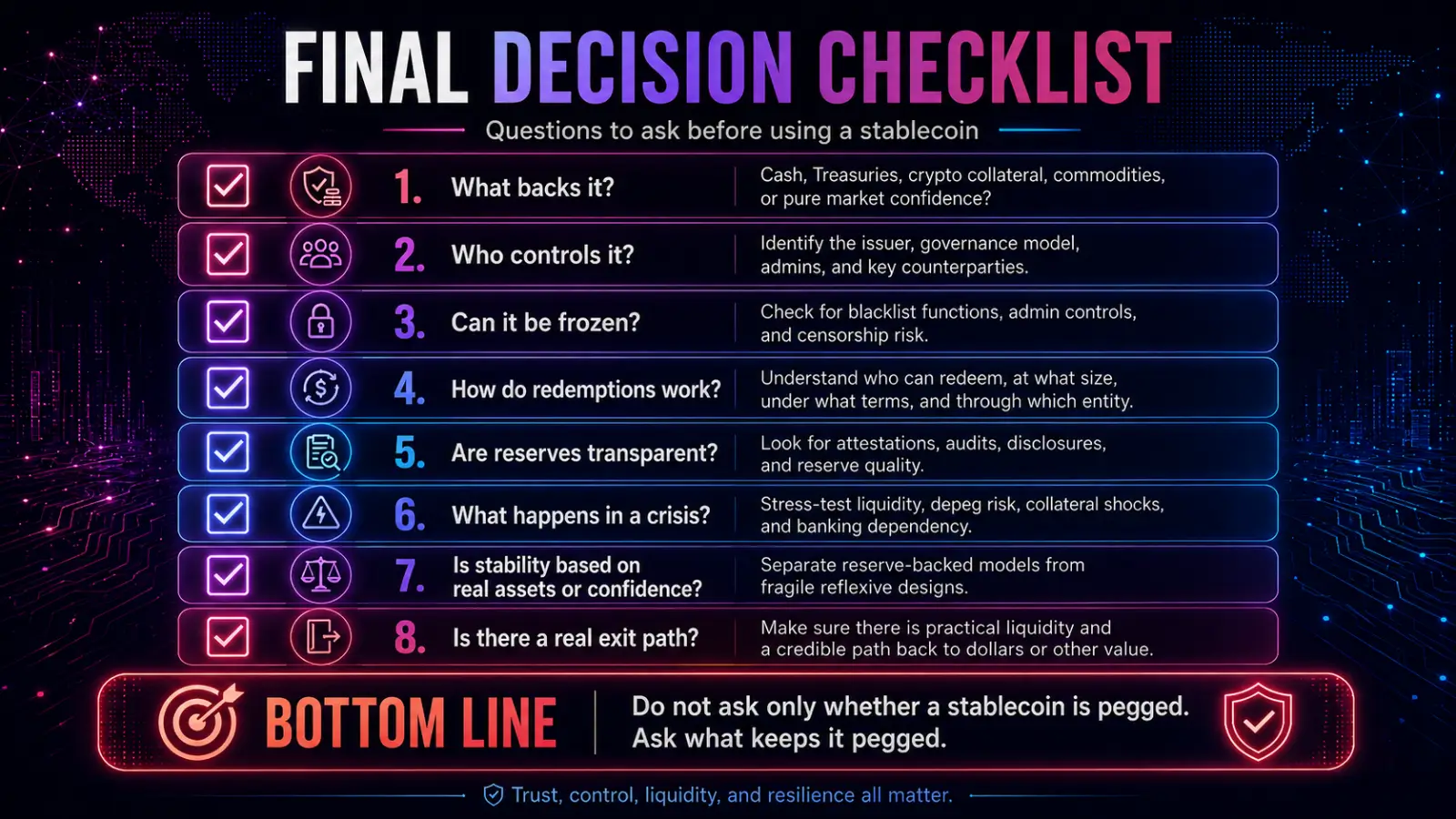
For users, the practical takeaway is simple: do not ask only whether a stablecoin is pegged. Ask what backs it, who controls it, who can freeze it, how redemptions work, what happens in a crisis, whether its stability is based on real assets or market confidence, whether it depends on another volatile token, and whether there is a real redemption path.
Do not ask only whether a stablecoin is pegged. Ask what keeps it pegged.
Stablecoins are a necessary infrastructure for crypto, but they are not the same thing as decentralized money. They are bridges. Some connect crypto to dollars. Some connect DeFi to collateral markets. Some connect tokenized assets to real-world commodities. Some may eventually connect central banks to programmable payments.
But every bridge has a gatekeeper, a failure point, or a trust assumption.
That is the real stablecoin question.
Not just “is it stable?”
But stable for whom, controlled by whom, and at what cost?
Sources and Further Reading
- Complete Stablecoins List
- Top Stablecoin Tokens by Market Capitalization
- Stablecoin Definition
- Algorithmic Stablecoin Definition
- Top Seigniorage Tokens by Market Capitalization
- Top Tokenized Gold Tokens by Market Capitalization
- Tether Transparency
- Tether Legal
- Transparency & Stability
- USDC
- Circle Reserve Fund
- Attestations
- Paxos Will Halt Minting New BUSD Tokens
- PYUSD Stablecoin
- PYUSD by Paxos
- MakerDAO
- Sky: Put Stablecoins to Work
- Dai Stats
- Top Algorithmic Stablecoin Tokens by Market Capitalization
- Crypto Firm Terraform Labs Agrees to Pay $4.47 Billion to Resolve SEC Dispute
- Do Kwon Pleads Guilty to US Fraud Charges Over $40 Billion Crypto Collapse
- USDD: A Fully Decentralized Stablecoin
- USDD Homepage
- Pax Gold
- How Physical Gold Becomes Tokenized PAXG
- Tether Gold (XAUt)
- Central Bank Digital Currency Tracker
- Digital Canadian Dollar
- Money and Payments: The U.S. Dollar in the Age of Digital Transformation
- Digital Euro
- Eurosystem Moving to Next Phase of Digital Euro Project
- Treasury Proposes Rule to Implement the GENIUS Act’s Requirements to Counter Illicit Finance
- Markets in Crypto-Assets Regulation (MiCA)
- Asset-Referenced and E-Money Tokens (MiCA)
- III. The Next-Generation Monetary and Financial System
The Digital Debrief Newsletter
Subscribe for more field notes
Practical field notes on AI, Web3, privacy, decentralization, social media, and the systems shaping the internet, delivered straight to your inbox.
Found it useful?
Share it with someone who'd care, or grab the link.
Got a project or question?
I work with brands across AI, Web3, cybersecurity, and SaaS.