

The Financial Cost of Centralization
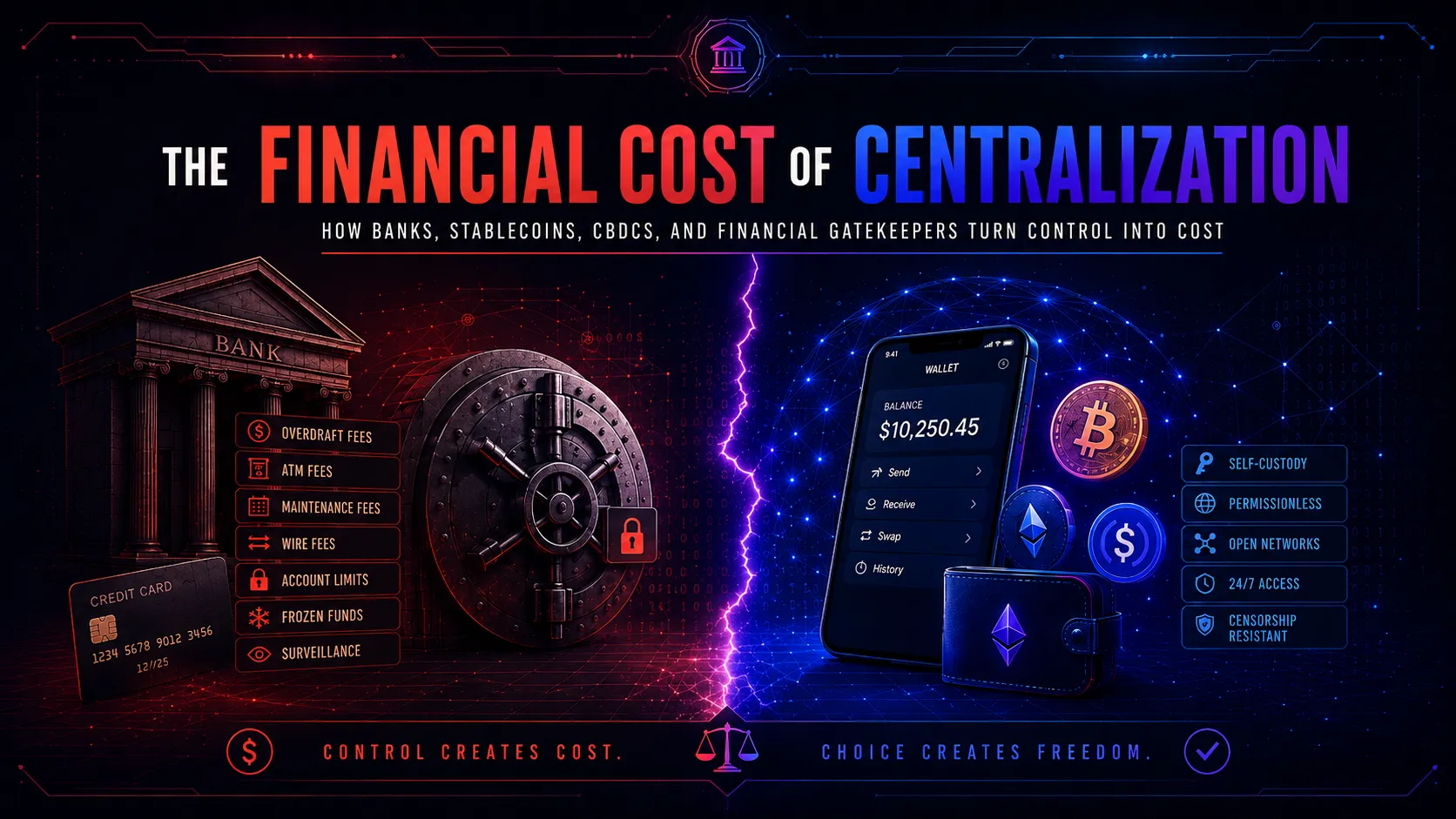
Centralization is often sold as convenience, but its costs show up through fees, frozen funds, surveillance, payment restrictions, and lost financial autonomy. This article explores how banks, stablecoins, CBDCs, and financial gatekeepers turn control into cost, and why preserving parallel financial systems matters.
Introduction: Centralization Always Sends a Bill
Centralization is usually sold as convenience.
One app. One bank. One issuer. One regulator. One payment rail. One button that “just works.”
The problem is that every centralized system eventually turns control into cost. Sometimes that cost is obvious, such as overdraft fees, ATM fees, wire transfer fees, trading fees, account maintenance fees, or frozen funds. Sometimes it is hidden inside compliance checks, blacklist functions, withdrawal limits, surveillance, delayed settlement, platform dependency, and permissioned access.
Decentralized finance does not magically remove every cost. Crypto has transaction fees, volatility, scams, UX issues, bridge risk, smart contract risk, and plenty of fake decentralization. But it changes one important thing: users can sometimes choose systems where access is not dependent on a bank, issuer, payment company, or administrator.
That choice matters.
Centralization is not free. It's just usually billed through fees, restrictions, surveillance, or lost autonomy.
The Core Argument
The financial cost of centralization shows up in four major ways:
Direct fees: overdraft, NSF, ATM, maintenance, wire transfer, investment, and account service fees.
Indirect costs: time delays, minimum balance requirements, account holds, permissioned access, restricted operating hours, and withdrawal limits.
Control costs: frozen funds, blacklisted addresses, blocked transactions, closed accounts, KYC failures, and compliance-based restrictions.
Systemic costs: concentration of power, weaker user privacy, limited competition, and fewer parallel financial options.
The old argument was “banks cost more, crypto costs less.” That is too simple.
The better argument is this:
Centralized finance often charges users for the cost of controlling them. Decentralized finance charges users for the cost of using open infrastructure. Those are not the same thing.
Traditional Banking: The Costs Are Smaller Than Before, But Still Real
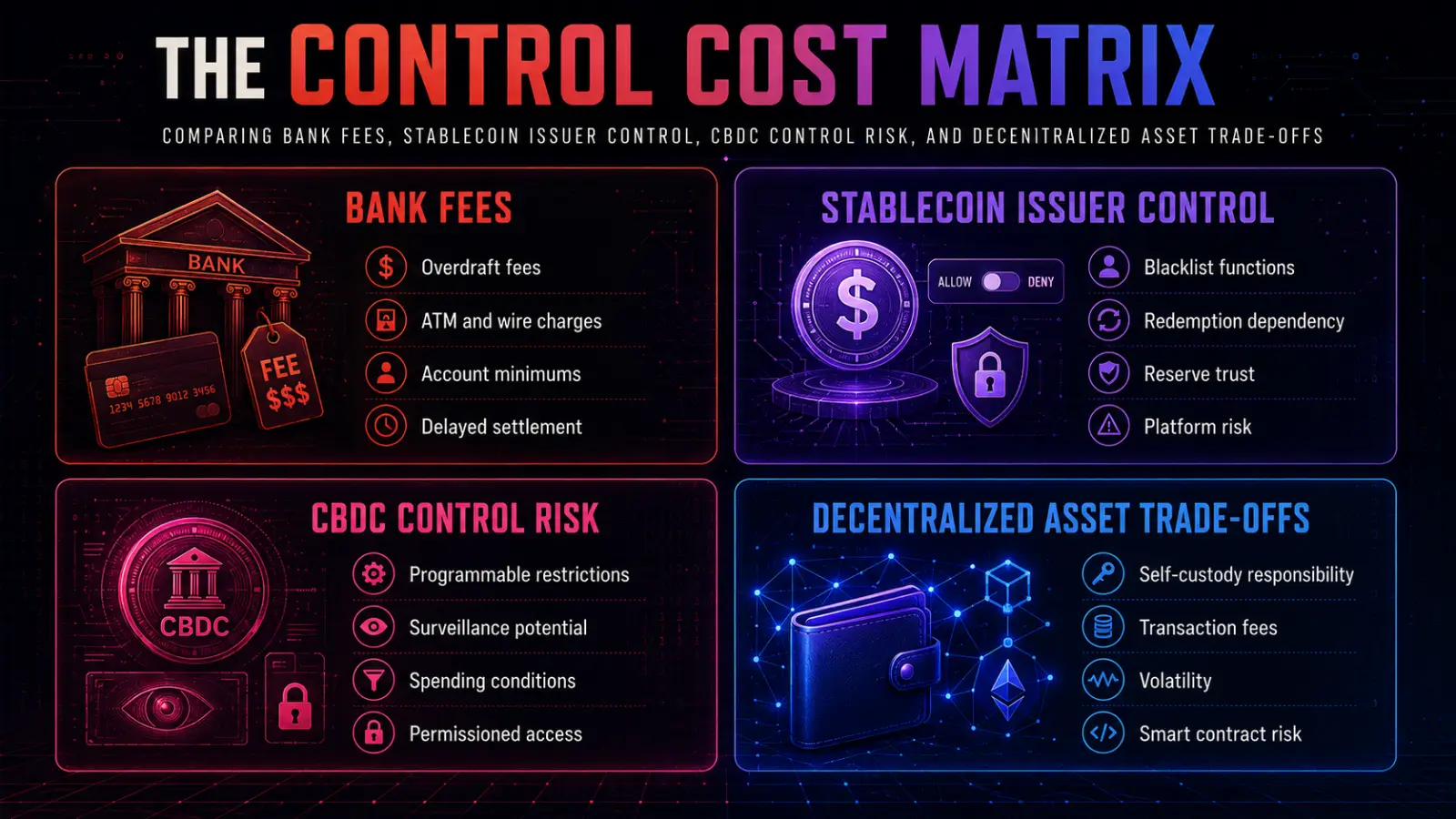
Banking fees have changed since the original 2023 version of this article. Some fees have declined. Some banks removed NSF fees. Some accounts are easier to keep free. But the overall pattern remains: the people with the least financial flexibility are often the ones most exposed to penalties.
In 2025, Bankrate reported that the average overdraft fee fell to $26.77, while the average total out-of-network ATM withdrawal fee hit a record $4.86. Bankrate also found that non-interest checking accounts had an average monthly service fee of $5.47, while interest checking accounts had an average monthly service fee of $15.65.
The CFPB reported that large banks have broadly eliminated NSF fees, with all banks over $75 billion in assets and all but seven over $25 billion eliminating NSF fees as of its 2023 review. That is a real improvement, but it does not erase the broader fee model.
The burden is still uneven. The Federal Reserve’s 2025 report on U.S. household financial well-being found that 11% of banked adults paid an overdraft fee in the prior year. That rate was higher for lower-income households, BIPOC, younger adults, and adults with disabilities.
Current Bank Fee Snapshot
Reference Point | Fee Category |
|---|---|
Average overdraft fee | $26.77 |
Average out-of-network ATM fee | $4.86 |
Average non-interest checking monthly fee | $5.47 |
Average interest checking monthly fee | $15.65 |
Average annual cost of non-interest checking fees | About $65.64 if paid monthly |
Average annual cost of interest checking fees | About $187.80 if paid monthly |
This is where centralization becomes practical, not philosophical. Banks can waive many fees, but the waivers usually require behaviour that benefits the bank: direct deposit, minimum balances, higher account balances, linked accounts, or recurring activity.
That is not always a scam. Banks have costs. Fraud protection costs money. Branches cost money. Compliance costs money. But the user should understand the trade-off.
A fee you can avoid is still a fee structure you must organize your life around.
The Real Cost of Being “Bad With Money”
A financially prudent user can often reduce bank fees to near zero by using a no-fee checking account, staying in-network for ATMs, avoiding overdrafts, going paperless, and using low-cost brokerages.
A financially stressed user may face the opposite reality. They are more likely to overdraft, use out-of-network ATMs, miss minimum balance requirements, rely on alternative financial services, and pay for access to their own money.
The FDIC’s latest national household survey found that 4.2% of U.S. households were unbanked in 2023, equal to about 5.6 million households, while 14.2% were underbanked, equal to about 19 million households.
That matters because centralized finance is cheapest when you already have stability.
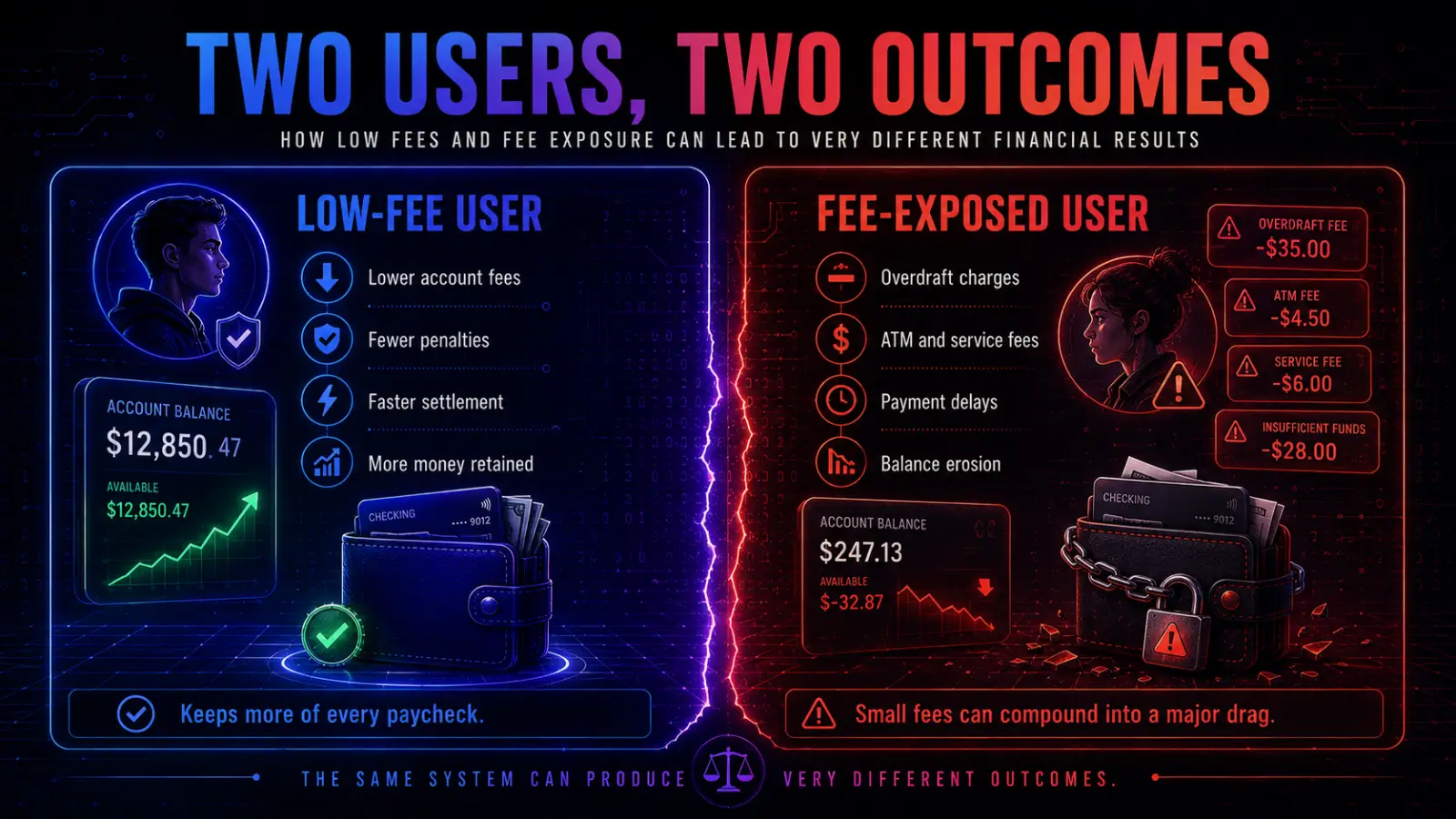
Scenario A: Low-Fee Banking User
This person:
Uses a free checking account.
Has direct deposit.
Avoids overdrafts.
Uses in-network ATMs.
Uses paperless statements.
Uses low-fee ETFs or a no-commission brokerage.
Maintains enough balance to avoid most account fees.
Estimated annual banking cost: $0 to $100.
Scenario B: Fee-Exposed Banking User
This person:
Pays several overdraft fees per year.
Uses out-of-network ATMs.
Pays a monthly account maintenance fee.
Occasionally pays paper statement, wire, check, or transfer fees.
Uses higher-fee investment products or advisory accounts.
Estimated annual banking cost: $300 to $1,000+, depending on behaviour and account type.
The key point is not that every bank customer pays massive fees. Many do not. The point is that centralized systems often create fee traps around liquidity, timing, access, and mistakes.
Cash: Still Useful, Still Private, Still Limited
Cash is the original peer-to-peer payment system.
It is immediate. It works offline. It does not require a bank app. It does not require a payment processor. It does not generate a default digital trail for every transaction. For privacy, cash still matters.
But cash has limits:
It can be stolen.
It is hard to recover.
It does not work for most online services.
It is inconvenient for large payments.
It is harder to track for budgeting and records.
It is restricted at borders and in certain business environments.
It remains subject to inflation and central bank monetary policy.
The Bank of Canada has explored a digital Canadian dollar, but in 2024, it shifted away from active retail CBDC development and toward broader payments research after public consultation and years of research.
That is important because it shows the tension: cash is still valued for privacy and resilience, while governments and institutions continue exploring digital payment systems that could replace or reduce its role.
Cash is inefficient by modern standards, but that inefficiency is part of what makes it private.

Crypto: Financial Autonomy, But Not Automatic Freedom
Cryptocurrency gives users a different model.
Instead of asking a bank to move money, users can hold and transfer assets directly through wallets and public networks. Bitcoin, Ethereum, and other open blockchain systems can operate 24/7. They do not close on weekends. They do not require a branch. They do not require permission from a traditional bank to broadcast a transaction.
But this freedom has costs:
Network fees.
Wallet security risk.
Smart contract risk.
Scam risk.
Volatility.
User error.
Regulatory uncertainty.
Bad UX.
Bridge and exchange risk.
Crypto is not “free finance.” It is user-controlled finance, and user control means user responsibility.
The Real Story
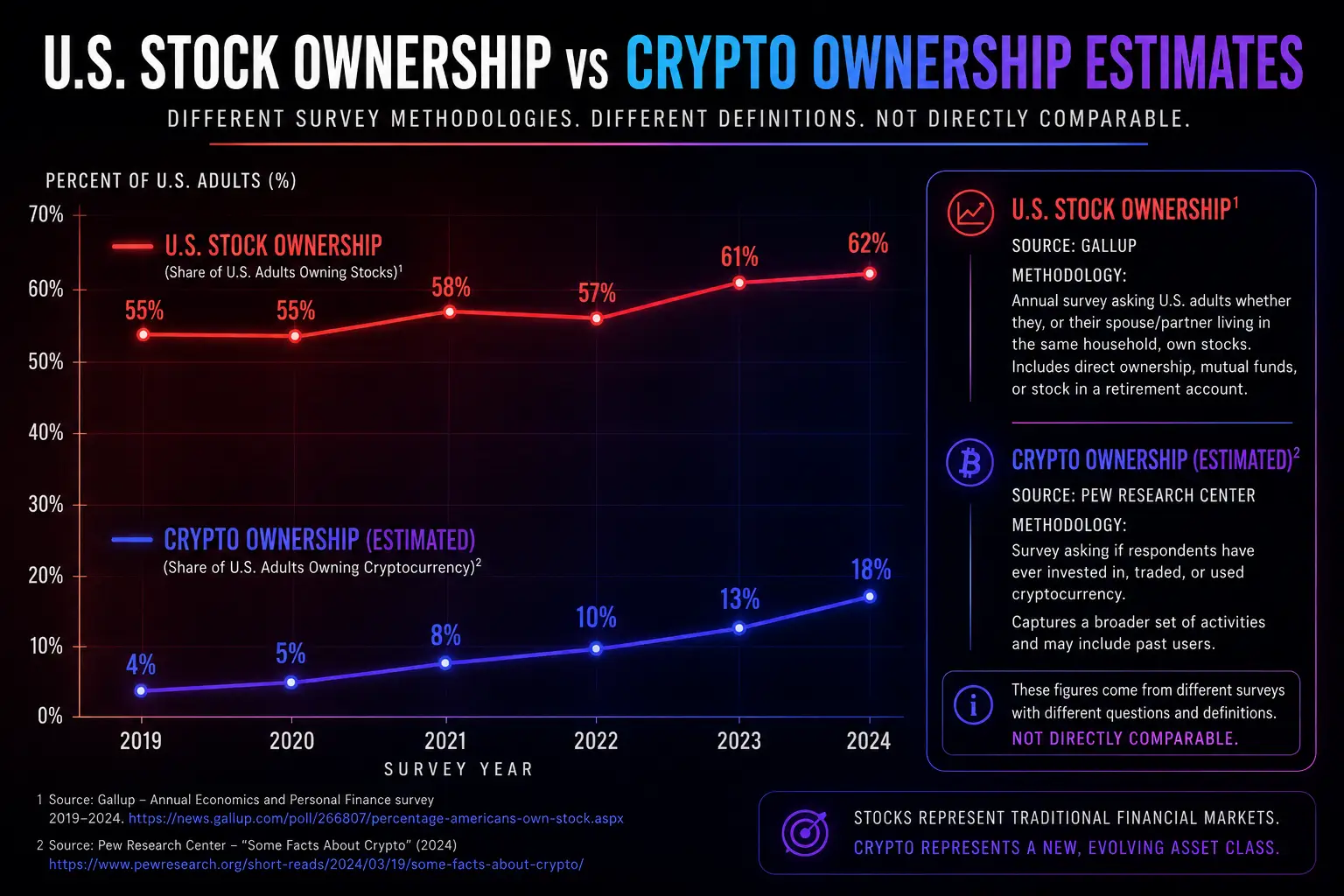
The adoption trend is still significant. Gallup reported that 62% of Americans owned stock in 2025, while estimates of crypto ownership vary widely by methodology. Security.org’s 2026 consumer survey estimated that 30% of U.S. adults own cryptocurrency, while other surveys have reported lower ownership rates.
The real story is not that crypto has replaced banking. It has not.
The real story is that more people are learning to hold value outside traditional financial systems.
Stablecoins: The Centralization Trade-Off Hidden in Plain Sight
Stablecoins are one of crypto’s most useful inventions. They let users hold dollar-like assets on-chain without constantly moving in and out of bank accounts.
They are also one of crypto’s clearest examples of hidden centralization.
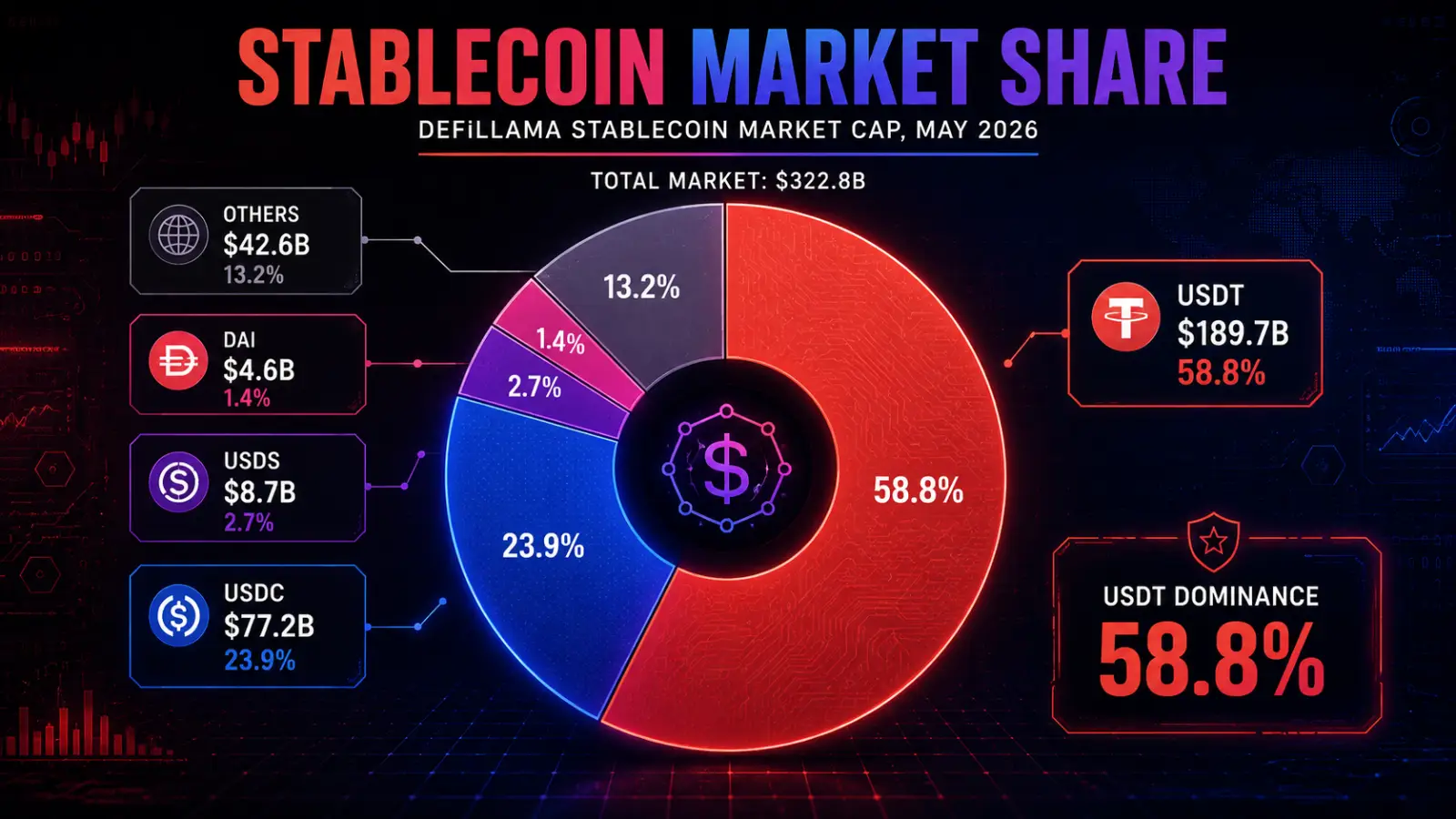
As of May 2026, DefiLlama reported the stablecoin market at roughly $323 billion, with USDT at around $190 billion, USDC at around $77 billion, USDS at around $8.7 billion, and DAI at around $4.6 billion. USDT alone represented about 59% of the total stablecoin market.
That is useful liquidity, but also massive concentration.
Stablecoin Market Reality
USDT dominates stablecoin liquidity.
USDC is the main regulated U.S.-aligned stablecoin competitor.
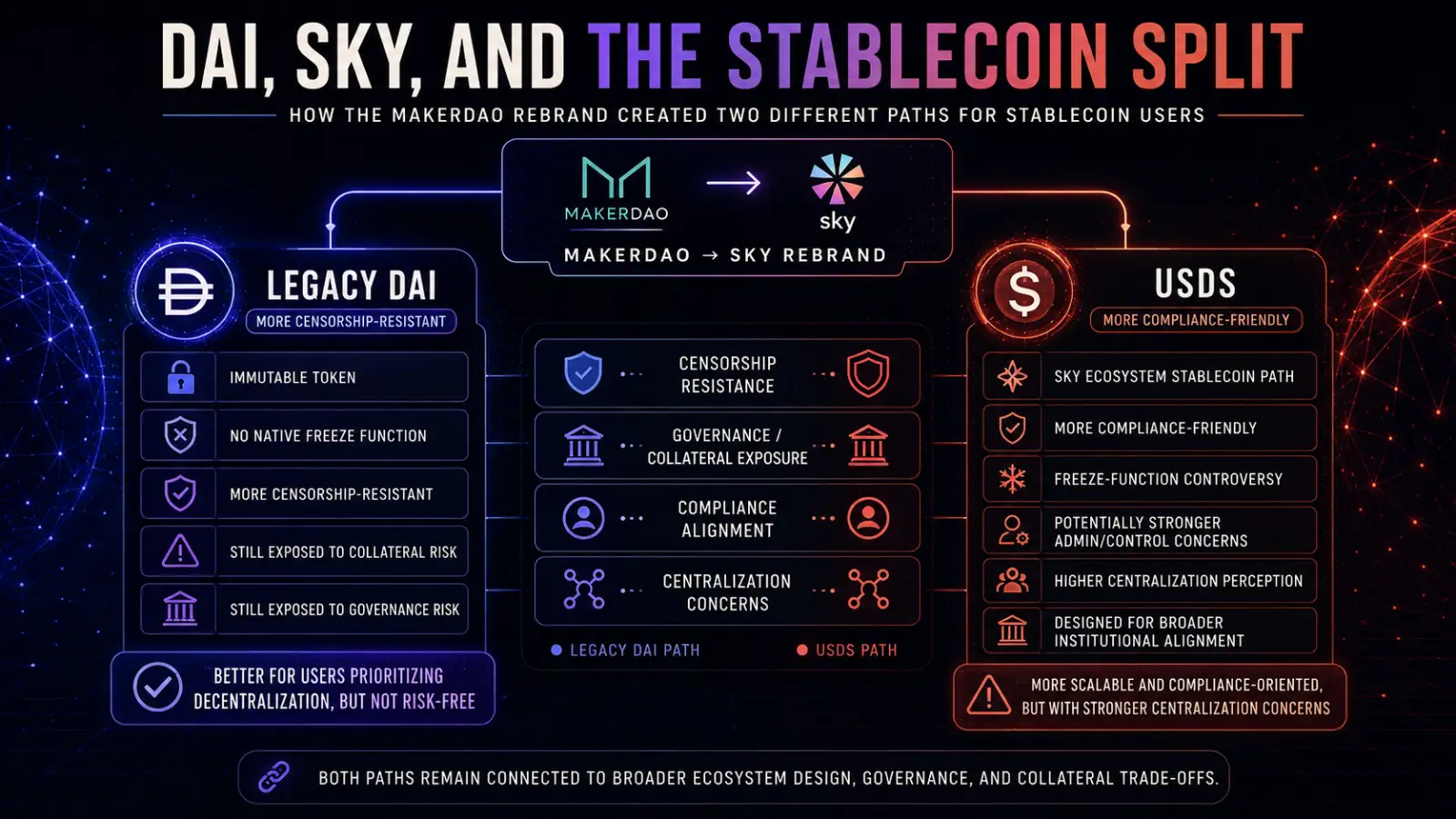
DAI is no longer the simple “only good stablecoin” story it was in 2023 because MakerDAO rebranded to Sky and introduced USDS.
USDS created controversy due to its potential freeze-function upgrade path, while DAI itself remains separate and immutable, according to statements and reporting from Sky/MakerDAO.
PYUSD is a PayPal/Paxos stablecoin that includes asset-protection controls in its contract architecture. Paxos’ public PYUSD contract documentation states that an asset protection role can freeze, unfreeze, and wipe balances after freezing.
This is where the debate gets uncomfortable. Stablecoins are useful because they connect crypto to the dollar. But the more they connect to the regulated banking system, the more they inherit banking-style controls.
A stablecoin can be fast, liquid, and useful while still being deeply centralized.
Blacklists, Freezes, and the Cost of Compliance
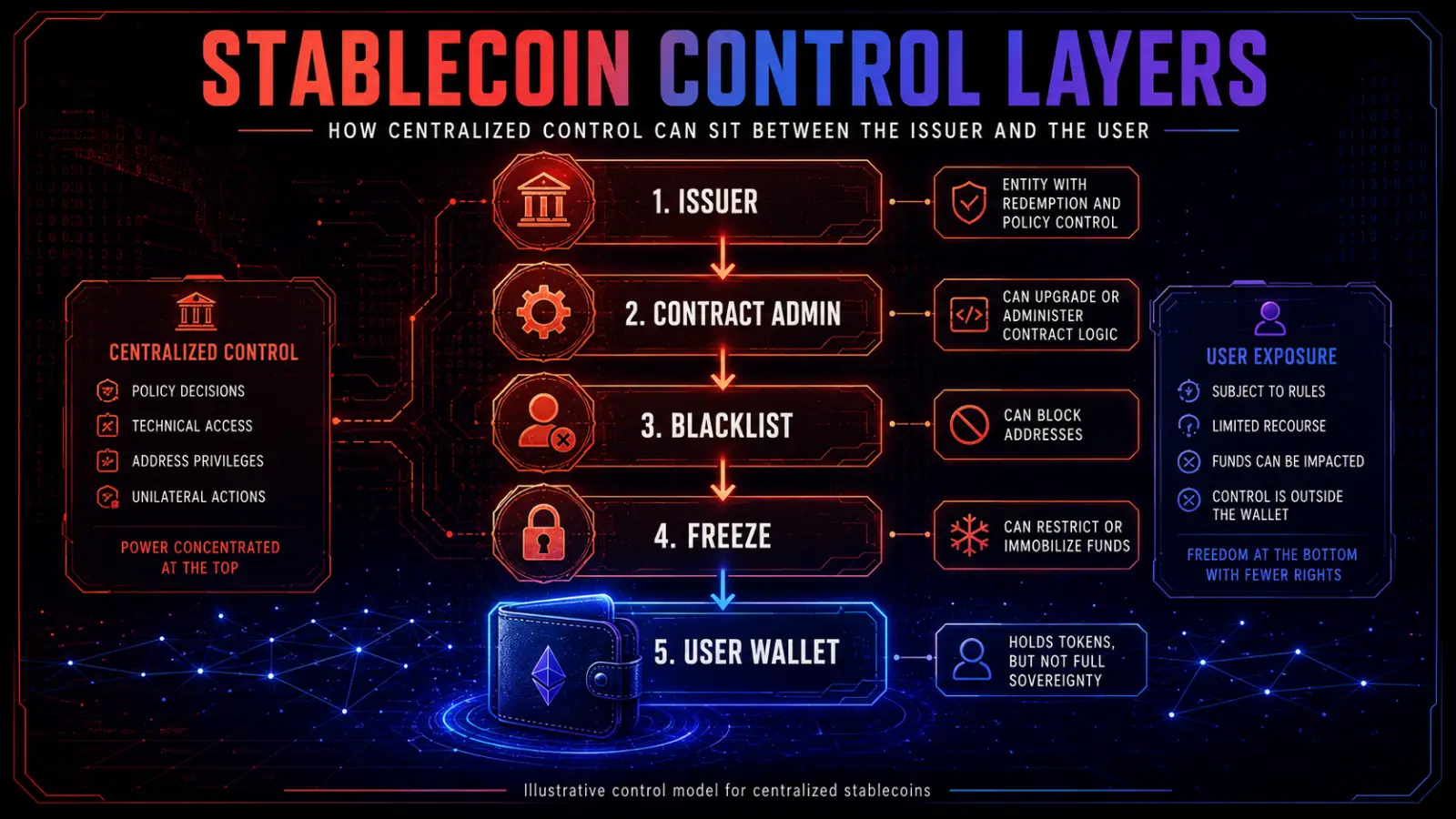
USDC, USDT, and PYUSD all have forms of centralized control.
Circle’s USDC terms state that Circle may block certain USDC addresses and freeze associated USDC in certain cases tied to illegal activity or terms violations.
Tether’s Ethereum USDT contract includes blacklist-related functions, such as adding addresses to a blacklist and destroying blacklisted funds, which are visible through Etherscan’s verified contract interface.
Paxos’ PYUSD contract documentation states that its asset-protection role can freeze and unfreeze balances and wipe out frozen balances to allow seizure of backing assets by the appropriate authorities.
This does not mean these issuers are always acting maliciously. Often, freezes occur in response to hacks, sanctions, law-enforcement requests, or court orders. The problem is that the control exists, and users should price that into their trust model.
Third-party blacklist trackers estimate that stablecoin freezing has expanded significantly since 2023. AMLBot’s 2025 analysis, based on Dune dashboards across Ethereum and TRON, estimated that USDT had blacklisted thousands of addresses and frozen billions in value, while USDC had blacklisted hundreds of addresses and frozen over $100 million. Those figures should be treated as third-party estimates, not issuer-audited totals.
The USDC Gas Argument Still Matters
Previously, I had focused heavily on USDC and USDT blacklist checks, which added extra gas costs to transfers on Ethereum.
That was a strong argument in 2023 because Ethereum fees were higher, and every storage read mattered more to normal users. But Ethereum fees have changed materially. BitInfoCharts recently reported average transaction fees for Ethereum at around $0.38 and median fees at around $0.06, far below the high-fee periods that shaped earlier stablecoin transfer costs.
The blacklist check still incurs real design and computational costs, but the larger issue is no longer just the per-transfer dollar amount. The bigger issue is that centralized stablecoins add a compliance control layer to every user’s financial activity.
That layer can cost users in three ways:
Gas overhead: extra contract logic can make transactions marginally more expensive.
Execution risk: transactions can fail or be blocked if an address is restricted.
Sovereignty risk: balances can be frozen or rendered unusable by issuer-controlled mechanisms.
The cost is not just gas.
The cost is dependence.
Stablecoins Are Becoming Too Big to Ignore
Stablecoins are no longer a niche DeFi tool.
Visa’s on-chain analytics work and industry reporting have pushed the market toward more realistic volume estimates by filtering out non-economic activity like self-transfers, bots, internal reshuffling, and high-frequency loops. A 2026 Kansas City Fed research briefing noted that Visa estimated about $1.5 trillion in monthly adjusted stablecoin transaction volume, while other payment-specific estimates are much lower, depending on methodology.
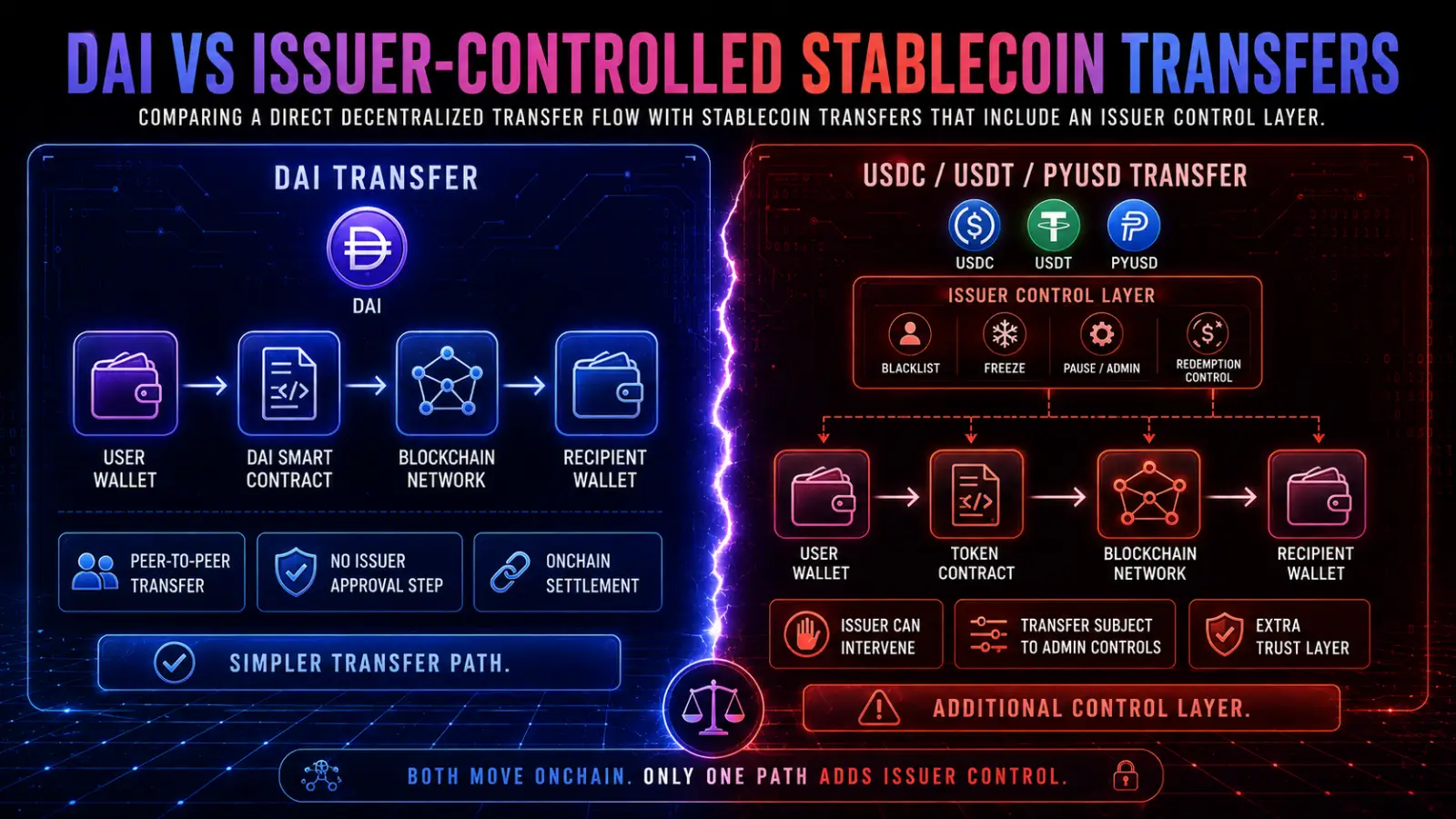
BCG’s 2026 stablecoin payments report estimated that of about $62 trillion in gross stablecoin transfer volume in 2025, around $4.2 trillion remained after removing non-economic activity.
Chainalysis argued that stablecoins processed $28 trillion in real economic volume in 2025, with large projected growth over the next decade.
The numbers vary because the methodology varies. That is the important part.
Stablecoins are clearly big. But not every on-chain transfer is a real payment.
Stablecoin volume is massive, but the honest debate is about how much of it is real economic activity versus financial machine traffic.
DAI, USDS, and the End of the “Only Good Stablecoin” Argument
I used to consider DAI “the only good stablecoin.”
That framing no longer holds.
DAI remains one of the most important decentralized stablecoins in crypto history. It helped prove that a crypto-collateralized, overcollateralized stablecoin could operate at scale without being issued by a traditional company such as Tether, Circle, or PayPal.
But DAI is not the simple decentralization story it once was.
MakerDAO rebranded to Sky in 2024 and introduced USDS, a new stablecoin tied to the Sky ecosystem. DAI and USDS can coexist, and DAI itself was not simply rewritten into a frozen stablecoin. The existing DAI contract remains live. The problem is the direction of travel.
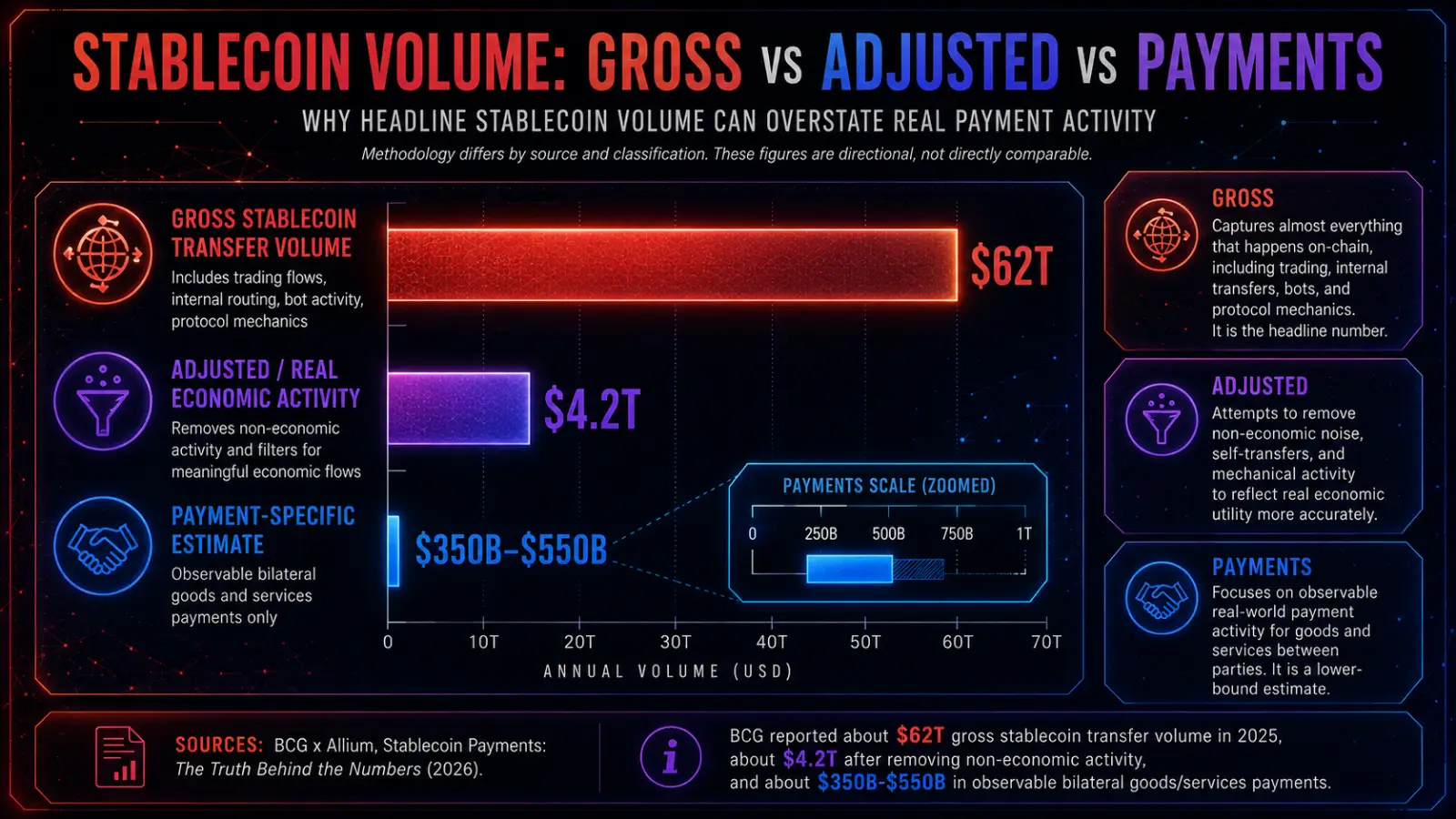
USDS introduced a more compliance-friendly model, sparking controversy because of its freeze-function path. In plain English, USDS moves the Maker/Sky stablecoin system closer to an issuer-controlled design, similar to centralized stablecoins like USDC, USDT, and PYUSD.
That does not mean DAI instantly became USDC.
It means the “DAI is purely decentralized” argument became much weaker.
DAI Is No Longer A Simple Decentralization Story
DAI already had centralization concerns before USDS because Maker’s collateral mix expanded beyond purely decentralized crypto assets. Over time, DAI became exposed to centralized stablecoins, real-world assets, and governance decisions that rely on institutions, legal structures, and off-chain systems. Even if the DAI token itself is harder to censor than USDS, the system around it is no longer cleanly decentralized.
A better conclusion is:
DAI is still one of the better legacy stablecoins for users who care about token-level censorship resistance, as long as it still exists.
USDS is more centralized and compliance-friendly, which may help adoption but weakens the decentralization case.
The Maker/Sky ecosystem is no longer a pure decentralized stablecoin model.
USDC, USDT, and PYUSD are clearly centralized issuer stablecoins with freeze or blacklist controls.
No stablecoin is perfect. Every option is a trade-off between liquidity, censorship resistance, collateral risk, regulatory exposure, governance risk, and usability.
The uncomfortable reality is that liquidity keeps winning over decentralization. USDT and USDC dominate because they are useful, liquid, and widely integrated. DAI remains philosophically stronger in some ways, but USDS shows how even DeFi-native systems can drift toward compliance, real-world assets, and central control.
DAI was not instantly destroyed by USDS, but the Maker/Sky shift made it much harder to call DAI the clean decentralized alternative.
CBDCs: The Endgame of Permissioned Digital Money?
Central Bank Digital Currencies are not dead. They are evolving.
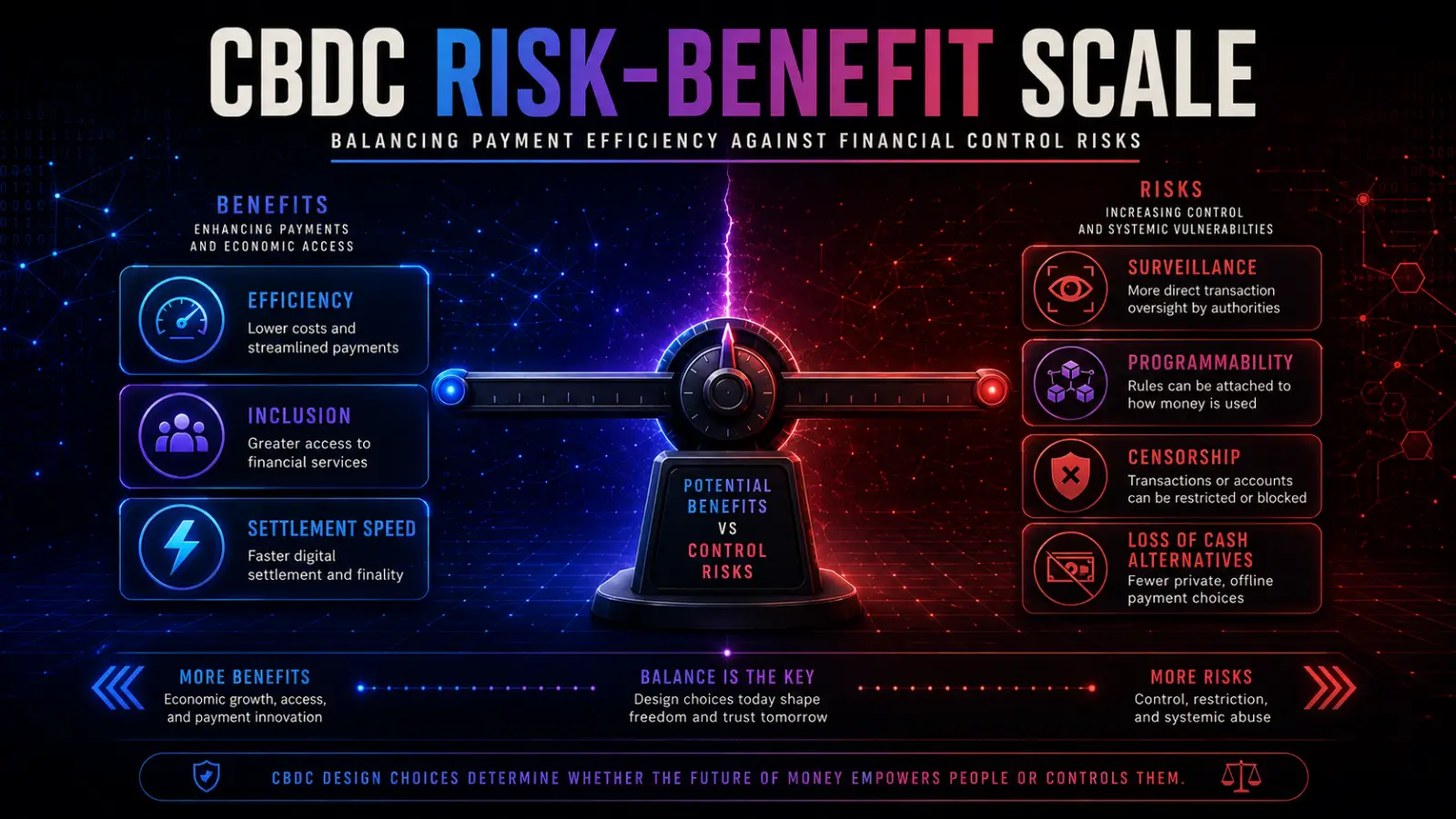
The Bank for International Settlements’ 2024 CBDC survey, published in 2025, found that 91% of 93 surveyed central banks were exploring retail CBDCs, wholesale CBDCs, or both. Wholesale CBDC work was generally more advanced than retail CBDC work.
CBDCs are often presented as a way to modernize money, improve settlement, reduce payment friction, and strengthen financial inclusion. Those are real possible benefits.
But CBDCs also raise serious questions:
Who can access transaction data?
Can payments be censored?
Can money be programmed?
Can users transact offline?
Can accounts be frozen automatically?
Can CBDCs coexist with cash?
Can citizens opt out?
What happens if CBDCs become mandatory for tax refunds, benefits, or government payments?
Why Public Consent Matters
Canada is a good example of public tension. The Bank of Canada spent years researching a digital Canadian dollar, then shifted its focus away from active retail CBDC development in 2024 after public feedback and changing payment priorities.
That does not mean CBDCs are gone. It means the public is not convinced.
A CBDC could reduce payment friction. It could also make financial permissioning more precise than anything banks can do today.
Centralization Has Seven Recurring Costs
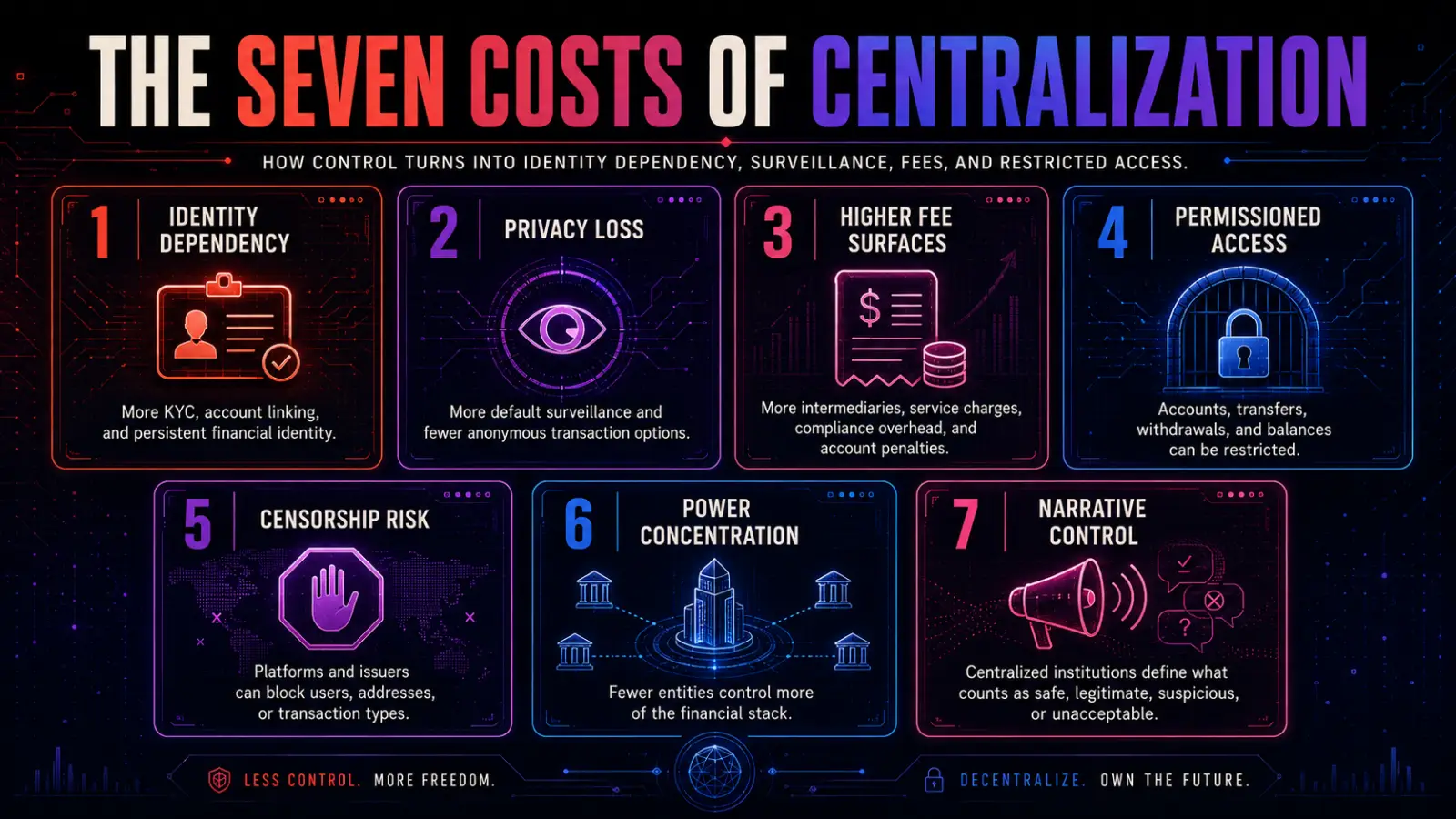
This is my interpretation of the “seven deadly sins of centralization” idea:
Identity dependency: more KYC, account linking, and persistent financial identity.
Privacy loss: more default surveillance and fewer anonymous transaction options.
Higher fee surfaces: more intermediaries, service charges, compliance overhead, and account penalties.
Permissioned access: accounts, transfers, withdrawals, and balances can be restricted.
Censorship risk: platforms and issuers can block users, addresses, or transaction types.
Power concentration: fewer entities control a larger share of the financial stack.
Narrative control: centralized institutions define what counts as safe, legitimate, suspicious, or unacceptable.
Where Decentralization Actually Helps
Decentralization is not automatically better. Plenty of crypto projects are centralized in practice while pretending to be open.
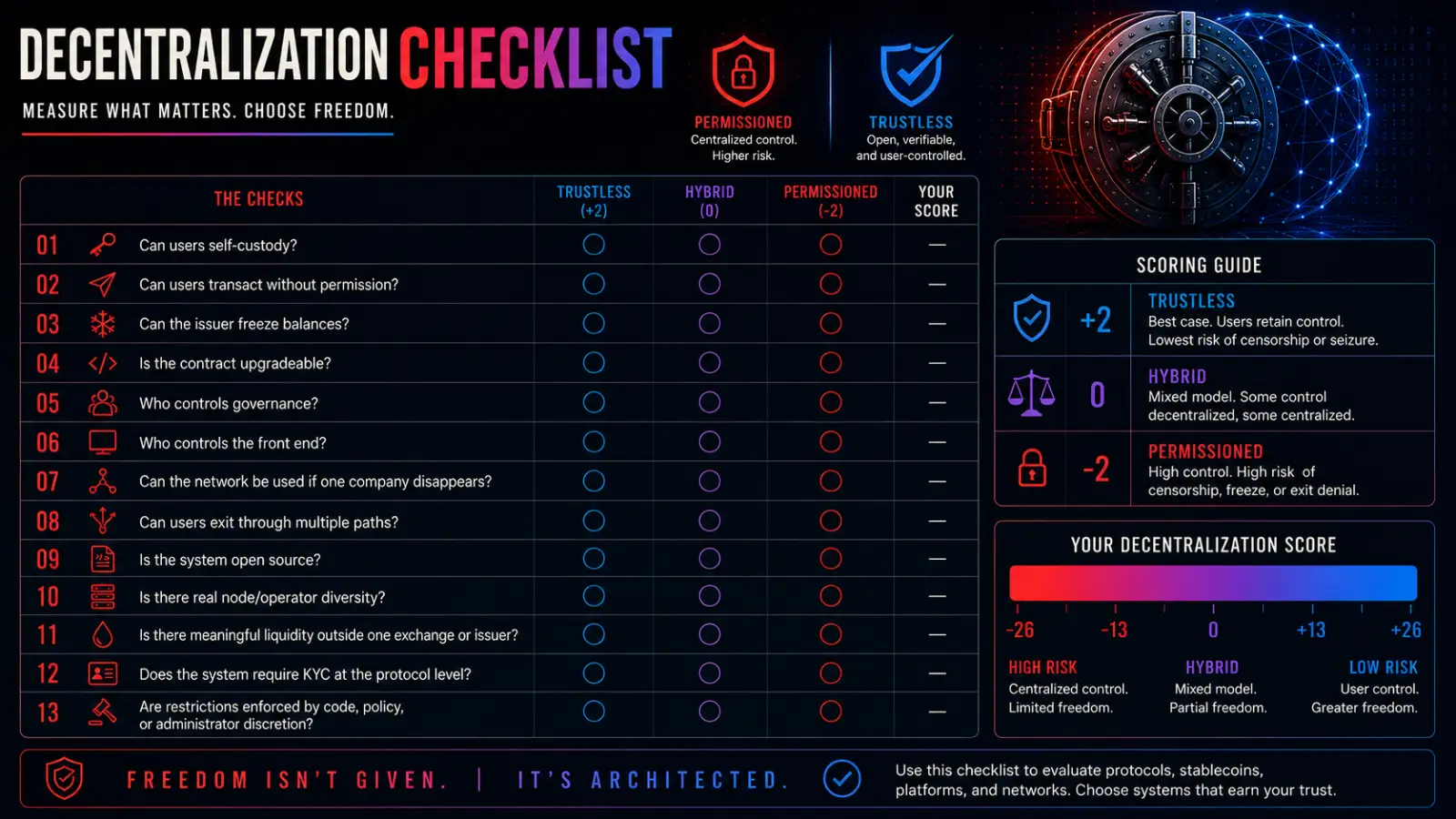
A useful decentralization test should ask:
Can users self-custody?
Can users transact without permission?
Can the issuer freeze balances?
Is the contract upgradeable?
Who controls governance?
Who controls the front end?
Can the network be used if one company disappears?
Can users exit through multiple paths?
Is the system open source?
Is there real node/operator diversity?
Is there meaningful liquidity outside one exchange or issuer?
Does the system require KYC at the protocol level?
Are restrictions enforced by code, policy, or administrator discretion?
The goal is not ideological purity. The goal is to know what risks you are accepting.
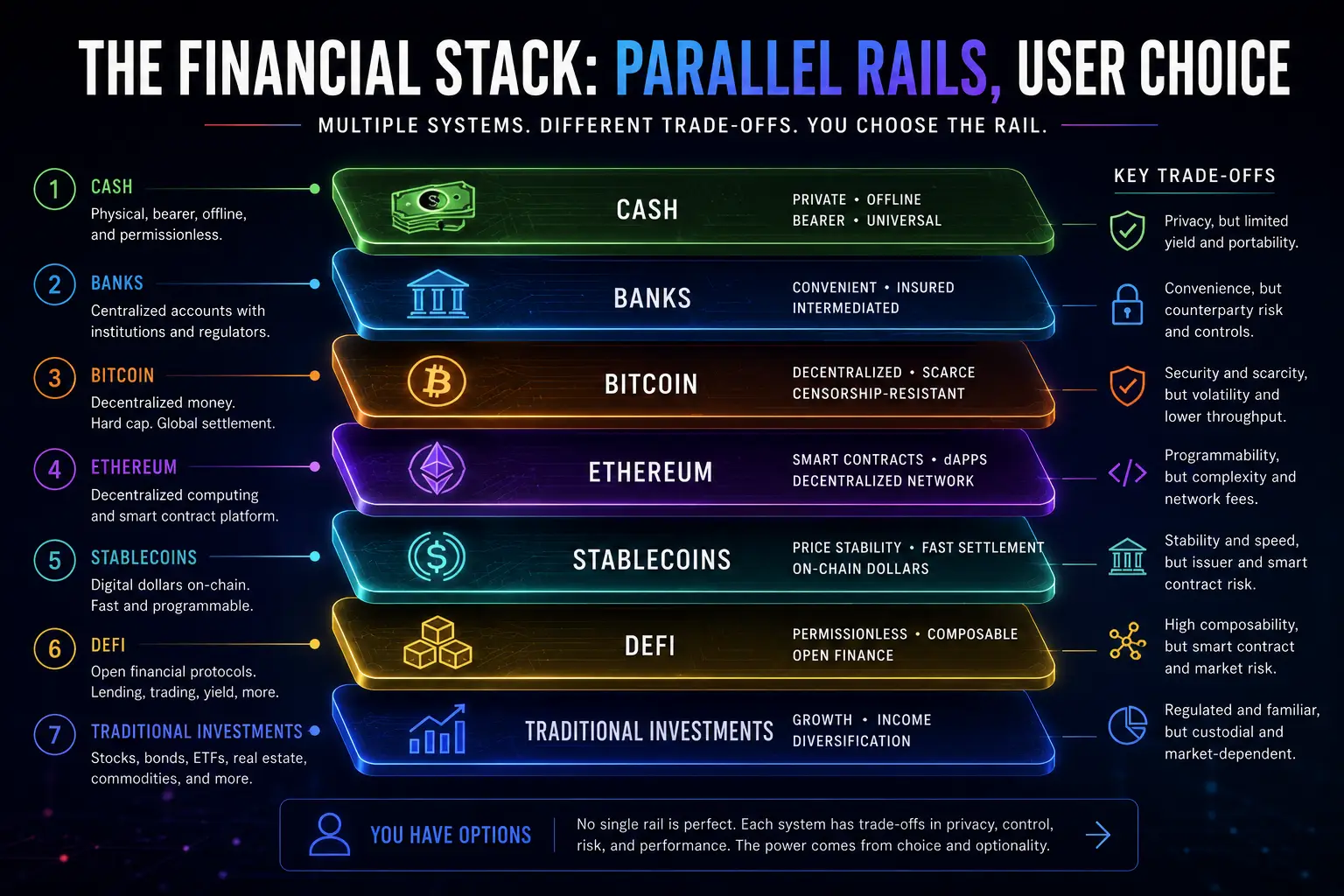
The Practical Strategy: Use Parallel Financial Systems
The answer is not “only use crypto.”
That is unrealistic for most people.
The better answer is to keep parallel options alive:
Use banks when you need banking.
Use cash when privacy and offline settlement matter.
Use crypto when self-custody and open access matter.
Use stablecoins carefully when you need on-chain digital dollars.
Avoid pretending centralized stablecoins are decentralized.
Avoid keeping all financial access within a single institution, app, exchange, or issuer.
Learn which tools can freeze, block, or restrict you before you depend on them.
The strongest financial position is optionality.
Not blind loyalty to banks.
Not blind loyalty to crypto.
Optionality.
The future should not be bank-only, cashless-only, CBDC-only, exchange-only, or stablecoin-only. The future should preserve parallel rails.
The Cost Is Control
Centralization is not always evil. It can create convenience, safety, speed, accountability, consumer protection, and scale.
But it always comes with a trade-off.
Banks can charge fees and restrict access. Stablecoin issuers can freeze funds. Payment companies can block transactions. CBDCs could give governments more direct control over digital money. Even “decentralized” systems can become centralized through governance, infrastructure, front ends, token distribution, or compliance pressure.
The real question is not whether centralization is always bad.
The real question is whether users understand what they are paying for.
Sometimes they are paying for convenience.
Sometimes they are paying for compliance.
Sometimes they are paying for safety.
Sometimes they are paying to be controlled.
The financial cost of centralization is not just fees. It is the moment convenience becomes dependency, dependency becomes control, and users realize they were paying for access to their own money.
Sources and further reading
Main reading sources:
- USDC Banned Addresses
- USDT Banned Addresses
- Tether Transparency
- Privacy and Cryptocurrency Part IV: Stablecoins for Human Rights, Blacklists, and Traceability
- The Costs of Stablecoin Blacklisting
- USDC Blacklist Cost Users an Extra $3.6 Million
- Survey: ATM Fees Hit Record High for Third Straight Year While Average Overdraft Fee Dips
- Etherscan: PYUSD Contract
- USDP Contracts on GitHub
- Regulation and Transparency
- Stablecoins
- Maker DAO
- Centre Whitepaper (PDF)
- Etherscan: USDT Token Contract
- Ethereum Average Gas Price (Daily)
- Dai Stats
- Bitcoin, Ethereum, Dogecoin, Litecoin Stats
- Stock Ownership Edges Higher
Additional reading
- How Much Bank Fees Cost
- Watch Out for These Banking and Investment Fees
- Financial Fees Could Cost Americans $1.1 Million Over Their Lifetime
- Bank Fees
- Where to Buy Checks: Avoid Your Bank to Save Money
- Cheap Personal Checks
- How Much Are Wire Transfer Fees?
- How Much Banks Charge for Wire Transfer Fees
- Bank Fees for Wire Transfers
- Wire Transfer Fees: What Banks Charge for Sending Money Abroad
- Wire Transfer Fee
- A Guide to Canadian Bank Fees for Wire Transfers
- Monthly Maintenance Fee
- Overdraft Fees Can Price People Out of Banking
- CFPB Finds Small Debit Purchases Lead to Expensive Overdraft Charges
- Americans Are Spending Less on Overdraft Fees, but It Still Adds Up to Billions
- Navigating ATM Withdrawal Limits: What You Need to Know
- ACH Transfer Limits
- Inactivity Fee
- 5 Common Bank Fees and How to Avoid Them
- Where to Order Checks
- Check Ordering FAQs
- Paper Bank Statement Fees: What You Need to Know
- Paper Statement Fees
- Checking Account Fees Study
- 2020 Was a Big Year for Individual Investors
The Digital Debrief Newsletter
Subscribe for more field notes
Practical field notes on AI, Web3, privacy, decentralization, social media, and the systems shaping the internet, delivered straight to your inbox.
Found it useful?
Share it with someone who'd care, or grab the link.
Got a project or question?
I work with brands across AI, Web3, cybersecurity, and SaaS.